
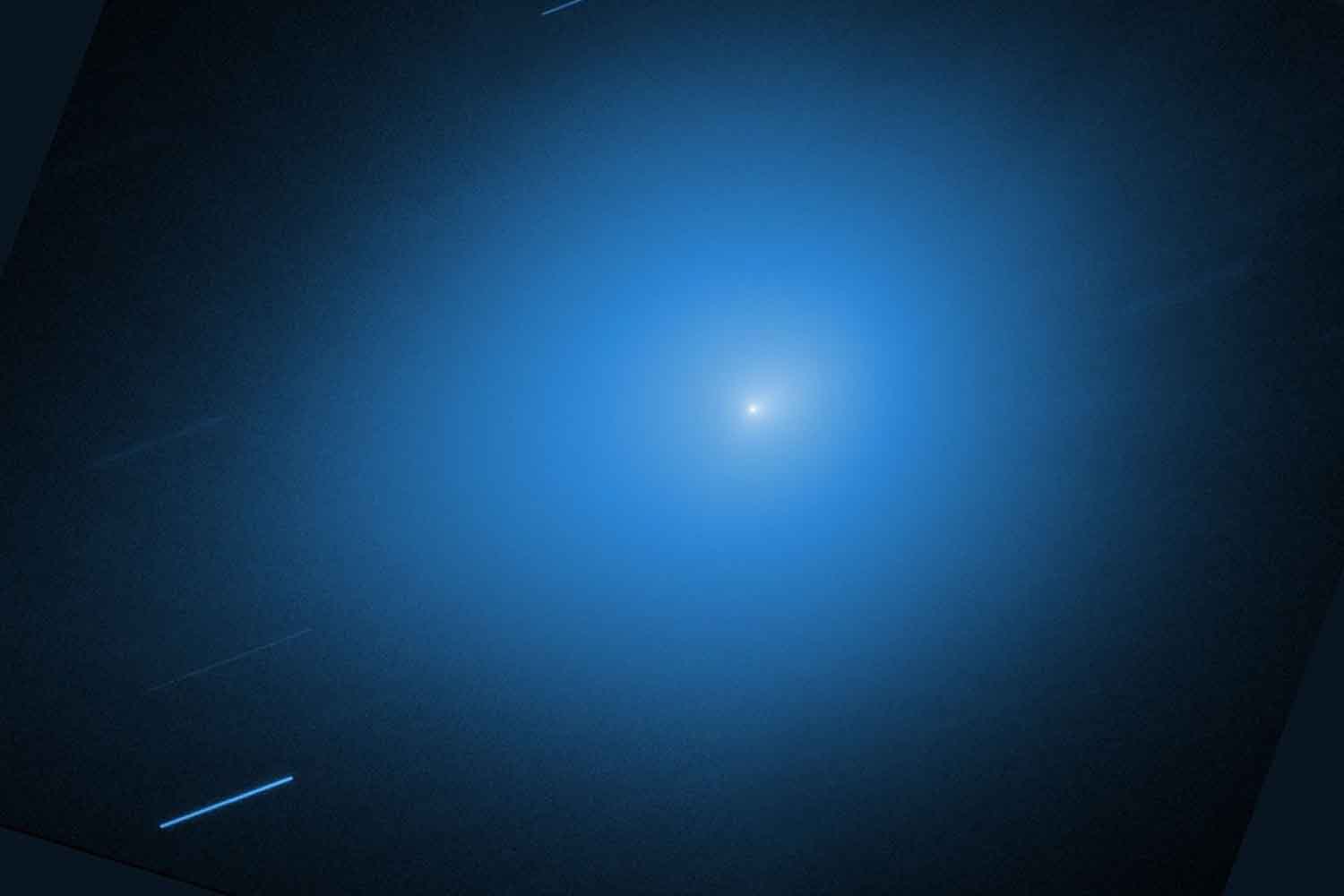
The alignment of comet 3I/ATLAS in the next few days it is one of those astronomical events that pass almost in silence, but which represent a small turning point for science. It will not be a spectacle visible to the naked eye, nor a “comet” to be photographed with a smartphone, but a precious moment to better understand what travels in deep space and, every now and then, also crosses our Solar System.
Thursday January 22, 2026at 13:00 UTCwhich in Italy correspond to 2pmthe interstellar object 3I/ATLAS will be almost perfectly aligned with the Earth and the Sun. In astronomical terms it means that sunlight will hit the object almost frontally with respect to our observation point, with a phase angle of just 0.69 degrees. It is a very rare geometry, comparable to that of the full Moon, when our satellite appears completely illuminated because it is on the same Sun-Earth line.
This setup won’t last just a few minutes. From the 19 to 26 January 2026therefore for almost a week, the phase angle will remain below i 2 degreesoffering an unusually long observation window. For those who study comets and minor bodies, it is an almost unrepeatable circumstance, especially because it concerns an object that is, but from another star system.
What makes 3I/ATLAS special and why it is not “just” another comet
3I/ATLAS is the third confirmed interstellar object never observed after 1I/ʻOumuamua and 2I/Borisov. Unlike its predecessors, however, it displays a combination of characteristics that intrigues many independent research groups, including teams working for NASA And ESA.
After the transition to perihelion, which occurred at the end of October 2025, 3I/ATLAS showed an increase in activity: the coma became enriched with dust and gas and some images highlighted an anomalous structure of the tail, sometimes described as a sort of anti-tail. This is not anything “mysterious” or artificial, but a behavior that suggests internal dynamics and dust compositions different from those of comets born around our Sun.
Astronomers agree on one point: there are no signs that suggest alien technology or artificial objects. Radio and optical observations indicate a natural body. Precisely for this reason the January alignment becomes so important: it allows you to study interstellar matter for what it iswithout shadows and without geometric distortions.
Light, dust and information arriving from afar
During the alignment, 3I/ATLAS will be at approx 3.3 Astronomical Units from the Sun And 2.35 Astronomical Units from Earthwith an apparent brightness around the magnitude 16.7. It will therefore not be visible to the naked eye, but perfectly within the reach of professional telescopes and advanced amateur instruments.
Direct light will allow us to analyze a phenomenon known as opposition effectthat is, the increase in brightness due to the disappearance of the shadows between the grains of dust and the “orderly” reflection of the light. From these measurements scientists will be able to obtain data on the particle sizeon theirs structure and even on how they aggregate, fundamental information for understanding how planetary systems far from ours arise and evolve.
A rare opportunity also for those who watch the sky from Italy
For the Italian public, know that the alignment will take place at 2pm on January 22, 2026 it helps place the event in time, even if it won’t be something to “go and see” from the balcony. However, it is one of those moments in which astronomy reminds us that the Earth is not isolated, but crossed, from time to time, by fragments of other worlds.
3I/ATLAS will continue its journey on a hyperbolic trajectory, without stopping in the Solar System. After this step, he may never return. And it is precisely for this reason that, in the days of January, many observatories around the world will point their telescopes towards a precise point in the sky, knowing that such an occasion may not occur again for decades.
