
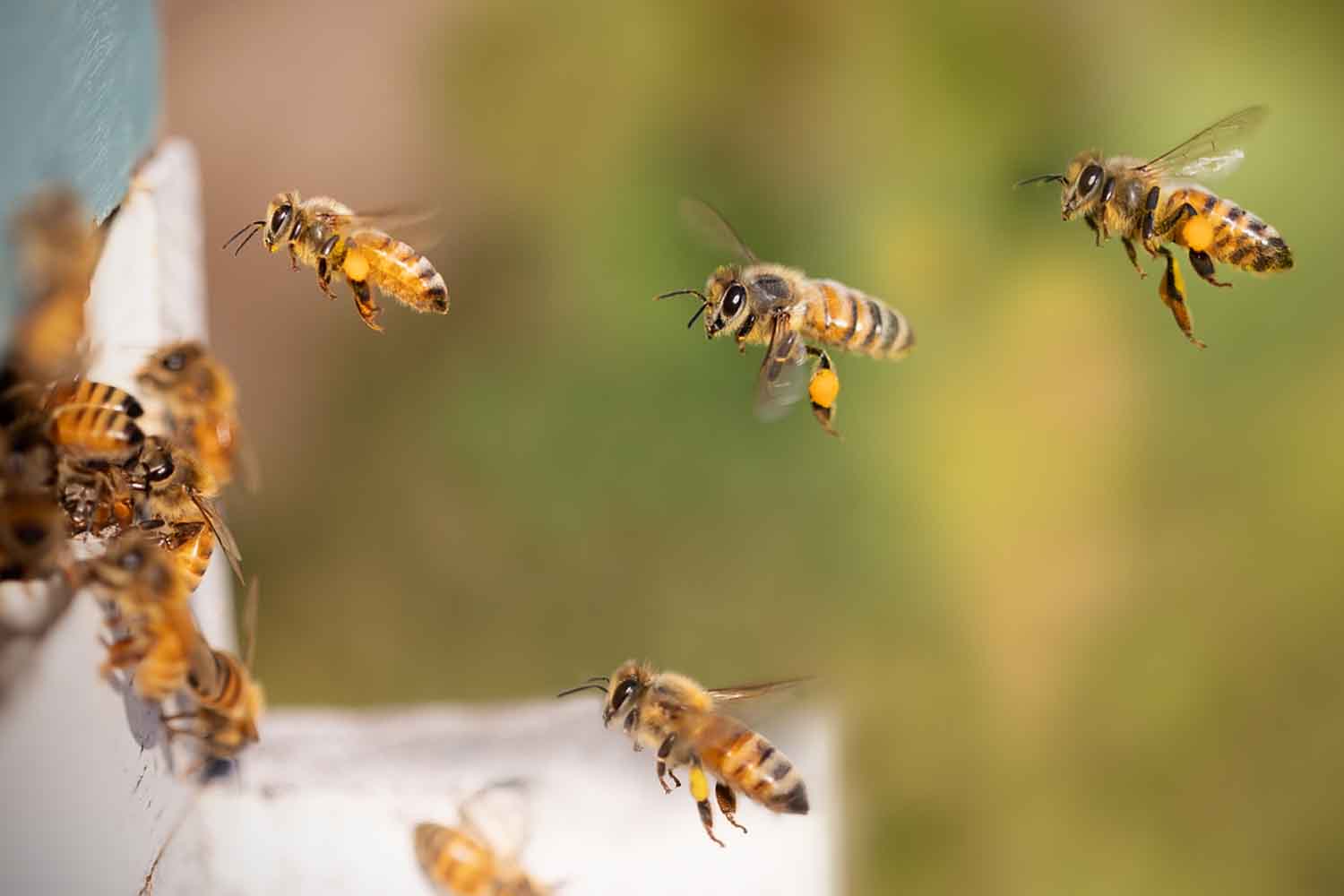
Honey bees may be much more intelligent than previously believed. A new line of international research has in fact strengthened the hypothesis that these insects do not limit themselves to reacting to simple visual stimuli, but are capable of processing actual numerical information. The study, published on Proceedings of the Royal Society B: Biological Scienceswas born from a joint work between the University of Trento and Monash University, led by neuroscientists Mirko Zanon and Giorgio Vallortigara, and by zoologist Scarlett Howard.
The experiment that reopened the debate
The central question concerns a scientific doubt that has been burning for years: do bees really know how to “count” or do they simply recognize repeated visual patterns? In previous experiments, the insects had been shown symbols and graphic patterns associated with numbers.
The bees were trained to match artificial quantities and signs, achieving an accuracy of 75–80%, which dropped to 60–65% in more complex tests. Results above chance, but not enough to convince everyone. A subsequent criticism had overturned the reading of the data, arguing that the bees could only rely on visual patterns and not on real numerical perception.
The turning point: seeing the world like a bee
The new research has changed perspective: scientists have reanalyzed the visual stimuli used in the experiments, but this time through a model that simulates the sensory perception of bees, taking into account their limited visual acuity.
The result was surprising: when the stimuli are observed “through the eyes of a bee”, a sensitivity to numerical quantities, not just graphic details, clearly emerges. In other words, the bees would not rely exclusively on shapes and contrasts, but would actually recognize the number of elements.
A more complex cognition than expected
For researchers, this changes the way animal intelligence is studied. As the scientific community involved points out, ignoring the sensory perspective of species can lead to distorted conclusions. The central point therefore becomes the method: to truly understand the cognitive abilities of animals, we need to design experiments that respect their way of perceiving the world.
The findings fit into an already surprising picture: bees are capable of complex communication, spatial memory and advanced associative learning. Now, added to this list is the possible ability to crunch numbers. A detail that not only fascinates research, but opens up new questions on the boundary between instinct and cognition even in the smallest life forms.
You might also be interested in:
