
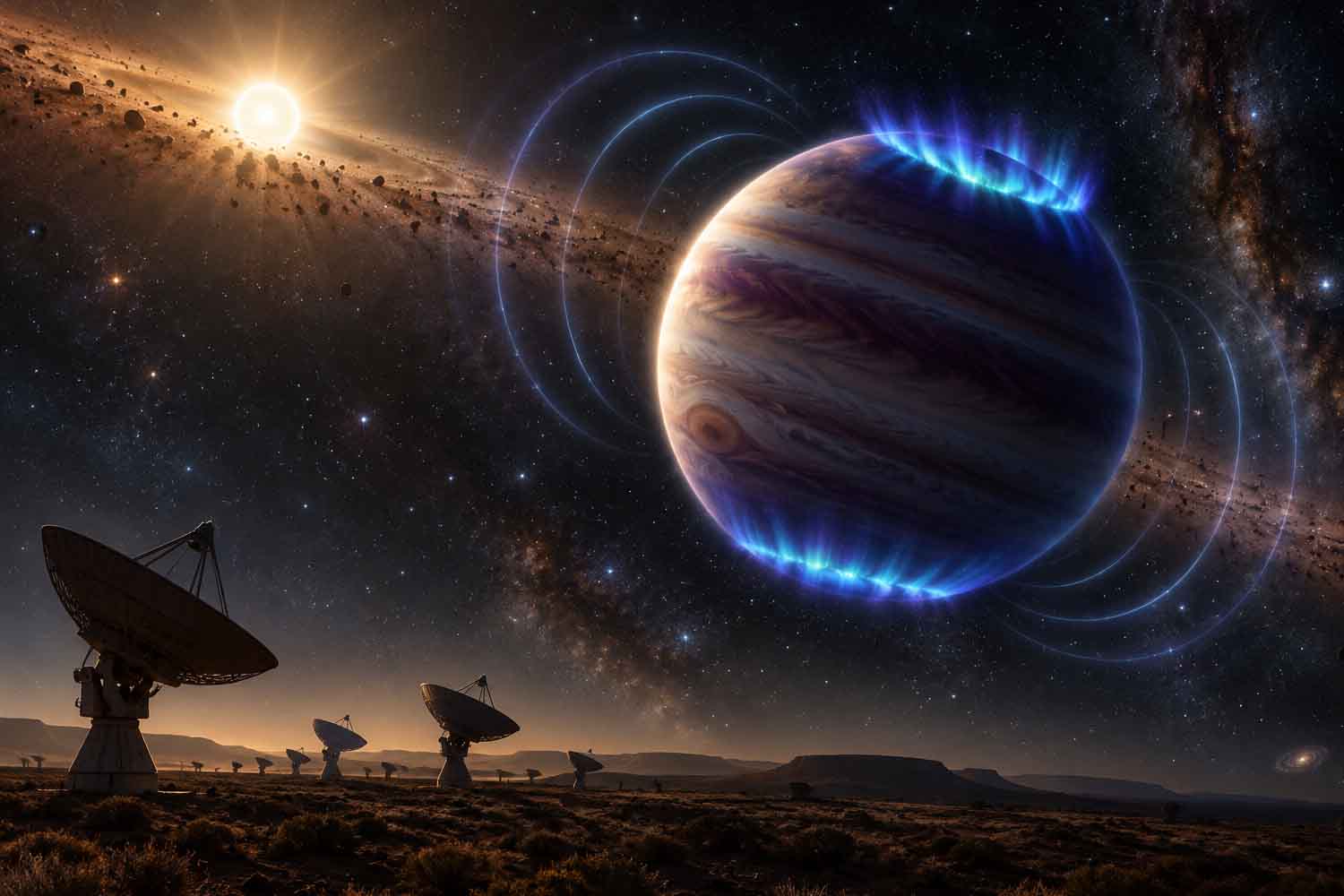
Approximately 64 light years from Eartha planet a dozen times the size of Jupiter began blinking in the radio waves. Short pulses, repeated and strongly polarized, recorded by the MeerKAT radio telescope in South Africa and traced back to the position of Beta Pictoris b. It is the first time that a radio emission of this type has been located directly on an exoplanet, separating it from its star. And its auroras would produce it. Aliens, for this time, can safely remain out of the story.
The discovery is described in a preprint published on arXiv by Kevin N. Ortiz Ceballos, Edo Berger and Yvette Cendes, from the Center for Astrophysics | Harvard & Smithsonian and the University of Oregon. The work is therefore still awaiting peer review, a detail to keep alongside the record.
MeerKAT followed the signal to the planet
The Beta Pictoris system was almost a made-for target. The star is young, about 23 million years old, and hosts at least three giant planets. Beta Pictoris b is the most massive: it orbits about 10 astronomical units from the star and completes one revolution in 24 years. Best of all, it’s far enough away from its star in the sky for astronomers to attempt a tricky thing: figure it out from which of the two bodies the radio waves actually came.
The team observed the system with MeerKAT, the South African network of 64 radio telescopes, in four sessions between February 2025 and May 2026. The observations covered frequencies between about 0.85 and 3.5 GHz. At all epochs, a radio source appeared in the same planetary system. The problem, at that point, was to assign it a precise address.
To do this, the researchers used nine quasars identified by Gaia and a radio calibrator as reference points in the sky. After correcting position and uncertainties, the source was compatible with Beta Pictoris b and strongly incompatible with the position of the star and planet Beta Pictoris c. The difference compared to the star reaches 4.4 sigma, that compared to the planet is 4.8 sigma. It is this astrometric shift that makes the detection different from previous radio candidates observed in other extrasolar systems, where planet and star remained difficult to separate.
Those radio waves look like our auroras, only much more energetic
The signal is not a continuous whistle in space. MeerKAT has recorded rapid and recurrent impulseswith a circular polarization of about 40 to 70%, along with weaker emission between pulses. This combination indicates, according to the authors, a mechanism called electron cyclotron maser instabilityor ECMI.
The name is less friendly than the phenomenon. Electrons accelerated along magnetic field lines produce radio waves: something similar happens in the magnetospheres of the planets of the Solar System. Also Jupiter emits powerful radio signals linked to its auroras. On Beta Pictoris b the mechanism simply seems to work with decidedly more muscular numbers.
In fact, the maximum frequency observed allows us to estimate the minimum intensity of the magnetic field in the region from which the signal arrives. Since the emission was detected up to 3.5 GHz, the authors derive at least 1.25 kilogauss. This is the first direct measurement of the magnetic field strength attributed to an exoplanet. And it is a field thousands of times more intense than the Earth’s measured at the surface, perfectly plausible for a young and massive giant like Beta Pictoris b.
A day on Beta Pictoris b lasts about nine hours
The speed with which the planet rotates could also contribute to giving energy to these auroras. Beta Pictoris b completes one rotation in approximately nine hours. The authors observed two pulses separated by about eight hours, an interval close enough to the rotation period to suggest possible signal modulation. For now, one indication remains: further observations will be needed to verify whether the pulses really return following the rhythm of the planet’s rotation.
And it is precisely here that radio waves become a particularly interesting tool. A magnetic field tells something about the interior of the planet, its rotation and the way it interacts with the atmosphere and surrounding environment. Until now, this information for exoplanets had largely remained entrusted to models and indirect clues. In this case the frequency of the emission itself offers a physical measurement of the field.
The authors also considered other possible origins of the energy, such as interaction with the star’s wind or with a hypothetical moon. In their calculations, however, both produce a power that is too low compared to that observed. The hypothesis considered most coherent is therefore that of a very rapid magnetosphere interacting with the ionosphere of the planet, a mechanism already studied on Jupiter and on ultracold dwarfs.
Now there are seven more planets to listen to
Beta Pictoris b could be the first of a small series. The researchers have identified another seven directly observed giant exoplanets, distributed across five systems within 45 parsecson which the same localization technique could work. The problem is above all the sensitivity of the instruments: according to their estimates, an improvement of around five to seven times would be needed, within the reach of the next generation of radio telescopes.
Meanwhile Beta Pictoris b continues to rotate every nine hours, with a huge magnetosphere and auroras that no eye could see from here, but which an array of antennas in South Africa has finally managed to listen to.
