
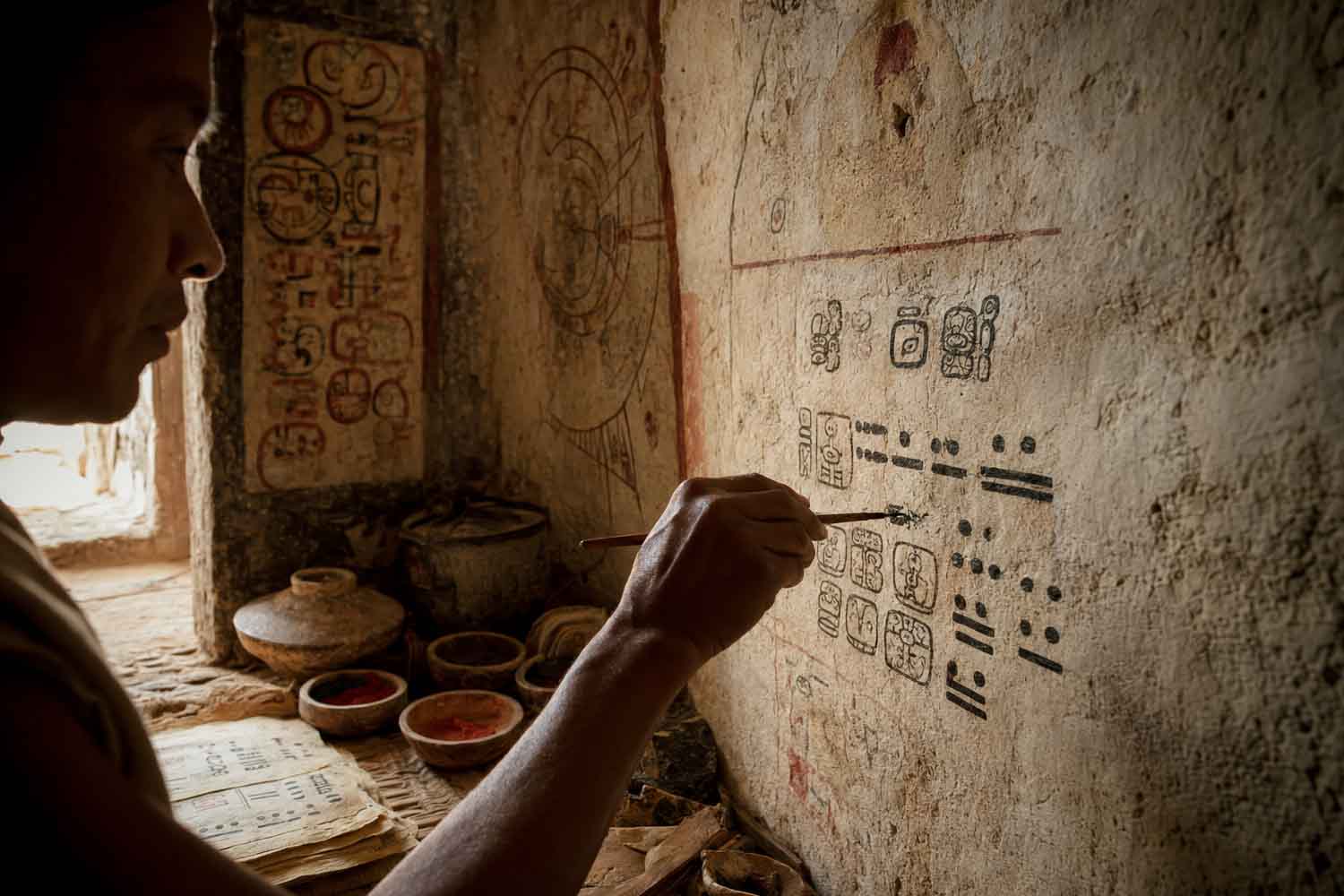
For more than 1,200 years Sak Tahn Waax he remained exactly where someone had put his name: at the bottom of a formula painted on a wall in Xultun, in north-eastern Guatemala. First the calculations, then two hieroglyphics. “So he says,” recites the first. “White-breasted fox,” replies the second. The name was there. It took us sixteen years, scans, infrared photographs and multispectral images to be able to read it.
Sak Tahn Waax lived around 781 AD and is the first mathematician-astronomer of the Classic Maya period identified by name through direct work attribution. The one preserved on the wall is a calculation that brings together Venus, Mars, the solar year and various Mayan systems for measuring time.
The discovery is described in study published on Antiquities by Franco D. Rossi, David Stuart and Heather Hurst. Some signatures of Mayan painters, ceramists and sculptors had already emerged. Those who observed the sky and squared planets, calendars and coronations remained out of the frame. Mayan kings occupied stelae, genealogies and entire walls. Astronomers were left with space under the accounts.
“So says White-breasted Fox”
The so-called Text 19 it is small: it measures approximately 19 centimeters in height and reaches just eight centimeters at its widest point. Comprehends eleven hieroglyphic blocks painted black and arranged like an upside-down L.
The first nine contain numbers, dates and time ranges. The last two change register. The penultimate one is read what-he-naor cheheenan expression that can be translated as “so he says”. Immediately afterwards a name appears written phonetically as SAK-TAHN-wa-xi: Sak Tahn Waax, “White-breasted Fox”.
The formula is thus linked to a person who actually existed. Sak Tahn Waax may have performed the calculations and made the signs himself. Another scribe may have reported his name to attribute the method to him. The precise relationship between material author and intellectual author remains open, while the attribution is clear.
Even the name says something. Rulers carried titles built to make their mark. A Mayan king of the 6th century, the researchers recall, was called K’ahk’ujol K’inich, translatable as “Fiery is the head of the serpent god”. Sak Tahn Waax came from another area of society: that of the specialists, scribes and scholars associated with the court.
The words “mathematician” and “astronomer” belong to our vocabulary. In the Mayan world, those skills passed through figures capable of observing the sky, managing calendars, developing formulas and assigning political and religious events a precise position within the cycles of time.
The room found inside a looters’ tunnel
The story begins again in 2010, when Maxwell Chamberlain, then a university student, worked at Xultun together with the archaeologist William Saturno. During the mapping activities he stuck his head in a tunnel dug years earlier by looters inside a hill covered by vegetation. On the other side he saw traces of color.
The tunnel had cut through a small brick room, about 1.8 meters wide on each side. The ancient inhabitants had filled it with earth, stones and debris before constructing a new building on top. That material had sealed the plaster, protecting part of the paintings and inscriptions.
The excavations brought to light seated and kneeling men, depicted at different ages and levels of rank. The title appeared next to them taaj“obsidian”. On the northern wall also sat the ruler of Xultun Yax We’n Chan K’inich, dressed in the attributes of a corn and wind deity and a scorpion tail.
Then came the numbers. Above the figures, in the corners and on the plaster patches applied at subsequent moments, the scholars counted approximately 52 mathematical and astronomical microtexts. Some were painted, others engraved. Among them appear a lunar table, large time intervals and calculations constructed to match calendars and celestial cycles.
Xultun is located about 40 kilometers northeast of Tikal and covers at least 16 square kilometers. Temples up to 35 meters high, squares, monuments, residential neighborhoods and water basins are still partly covered by the forest. The site was reported in 1915; systematic archaeological research began only in 2008.
The room belongs to the late phase of the classic Maya period, approximately between 250 and 900 AD. It was used before the large population movements that affected the central plains between the 9th and 10th centuries, often compressed in the formula of the “Mayan collapse”. In Xultun life continued even after the end of dynastic power, with ritual activities documented in the following centuries.
A wall used as working paper
The room was created to display court paintings. Over time it became a space in which to write, correct, rehearse and start again. The calculations cover parts of the previous images and accumulate on new layers of plaster. More than texts to be exhibited, they seem like notes intended for the eyes of those who worked there.
They were also found in the room and nearby rooms tools related to paper production. The figures identified with the title taajarranged according to different ranks, suggest a place where the most expert specialists worked alongside apprentices. Here calendar calculations could be taught and Mayan bark-paper books prepared.
Only four of those codices survive, all produced more than five centuries after Xultun’s inscriptions. The best known is the Dresden Codex, which preserves almanacs, astronomical tables and calculations on eclipses and cycles of Venus. The tropical climate has consumed almost all paper, plant fibers and wood. The walls of the 10K-2 structure retained the phase preceding the book: the attempts, the corrections, the numbers lined up while someone tried to make them come back.
The plaster also paid for the time it spent underground. Water infiltration, roots and loss of pigment have made some inscriptions almost invisible. During excavations conducted between 2010 and 2012, the surfaces were cleaned, consolidated and documented. The room was then covered to protect it.
To recover Text 19, archaeologists combined scale drawings, photographs, 400 dpi scans, infrared images, and multispectral imaging. The colors were separated and digitally enhanced until the eleven hieroglyphs remaining on the wall could be distinguished.
Within 2,920 days there are Venus and Mars
The formula covers an overall range of 2,920 days. That is eight solar years of 365 days, or five synodic cycles of Venus of approximately 584 days. The synodic cycle indicates the time it takes for a planet to return to the same apparent position relative to the Earth and the Sun.
Sak Tahn Waax had inserted six different temporal units into that count: theUinal of 20 days, the Tzolkin 260 day ritual, the Tun of 360, theHaab solar cycle of 365, the Venus cycle of 584 and the Mars cycle of 780.
The five dates are separated by precise intervals. The sequence starts from one Uinal, continues with one Tzolkin, two Mars cycles and three Haab years, up to a total of five Venus cycles. The result is a 1, 1, 2, 3, 5 progression, similar to what in Western mathematics we call the Fibonacci sequence. The preserved elements allow us to recognize the pattern; the meaning attributed to it by the Mayan scholar remains outside the wall.
The paleographic reconstruction indicates as the most probable initial date November 7, 781 in the Julian calendarcorresponding to November 11, 781 in the Gregorian calendar used today. The scholars arrived at this by working backwards from the best preserved signs and comparing the intervals with the rules of Mayan calendar mathematics.
Inside the first nine hieroglyphs there are almost only numbers and dates. No battles, no genealogy, no ruler busy talking to the gods. Someone was doing math on a wall.
Mayan astronomers observed visible planets with the naked eye and used numerical systems capable of pushing dates thousands of years into the future. Monumental buildings could follow the equinoxes and other celestial events. The Long Count arranged human life into enormous time sequences. Those calculations also served to choose the moment to build a temple, dedicate a building or crown a ruler. The results ended up on the stone, but the intermediate steps remained in a room less than four meters square.
A name recovered at the bottom of the accounts
Other texts in the stanza show similar graphic characteristics. Sak Tahn Waax may have made several and left their name only under the most complete formula. This too remains a hypothesis: over fifty microtexts have been identified, while only a part has been deciphered in detail.
During the 8th century, Mayan painters, sculptors, and scribes began signing pottery and monuments more often. Calendar specialists kept disappearing behind the results delivered to the court. The history of ancient astronomy has preserved the names of scholars who lived in India, Mesopotamia, China, Greece and Europe. The Americas had equally sophisticated observations, formulas, and calendars. This time there was also a name left.
The archaeoastronomer Anthony Aveni, already involved in the study of Xultun astronomical tables published in 2012 and unrelated to the new research, considers this identification one of the most important steps in understanding Mayan science. For Heather Hurst, that name allows an entire intellectual tradition to resurface through a single person. On the wall of Xultun the kings already occupied all the necessary space. The last two hieroglyphs were enough for Sak Tahn Waax.
