
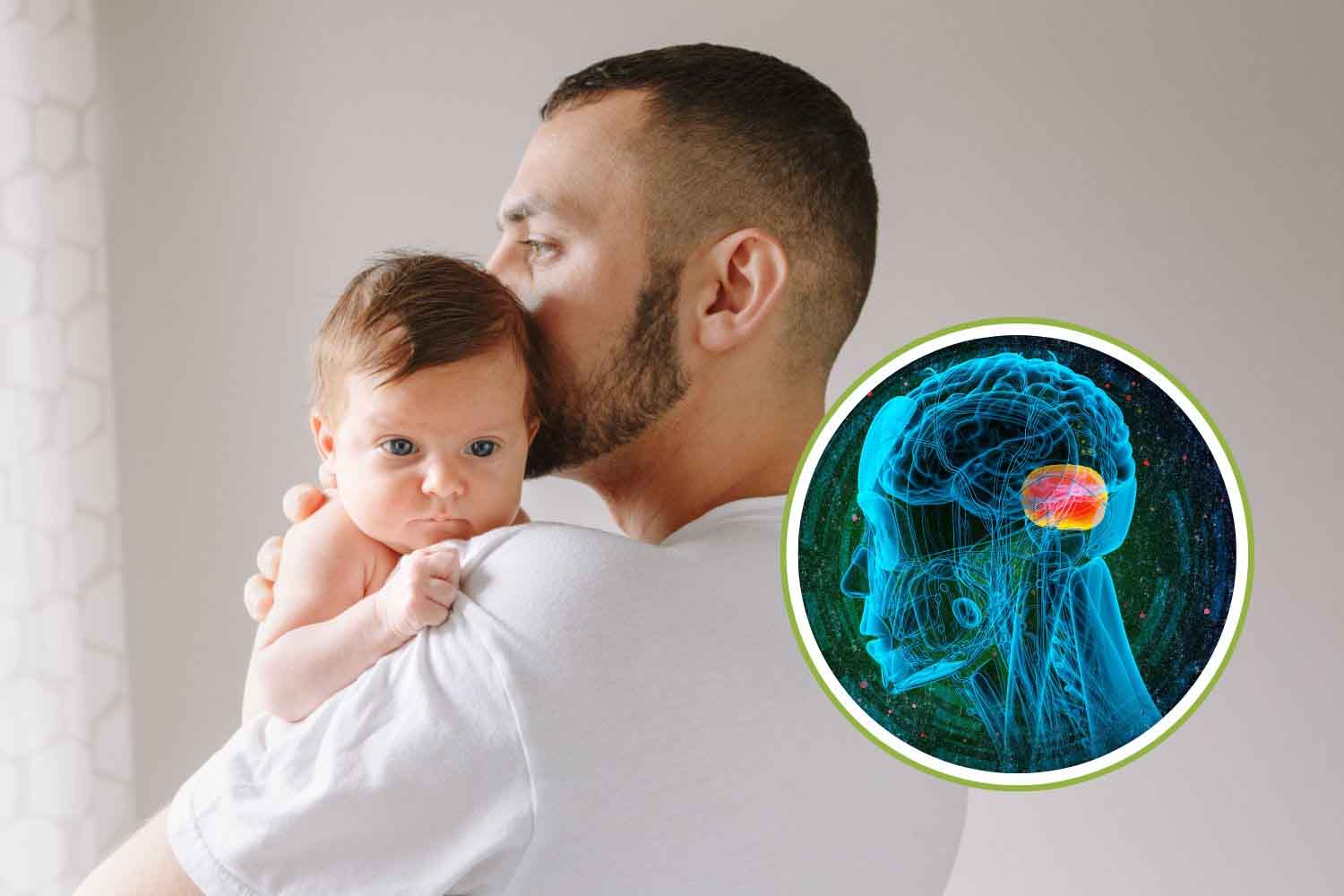
For years we have talked about parenting as if it had only one entrance door: biology. Pregnancy, hormones, childbirth, the changing body. All true, all huge. However, the human brain has a stubborn characteristic: it continues to change even afterwards, when faced with the things we repeat every day. And raising a child is one of the most powerful repetitions there is.
Research published in PNAS showed just this: fathers’ brains can adapt profoundly to caring for children. And in gay fathers raising a child as the primary caregiver, certain brain areas activated very similarly to those seen in biological mothers.
The point, however, must be handled well. The research does not say that pregnancy and childbirth are irrelevant details. He says something more interesting: daily care has real biological weight. Changing diapers, consoling a cry, preparing food, recognizing a grimace, waking up at night, being there. All this trains the brain to become a parent.
The study on fathers
The group led by neuroscientist Ruth Feldman involved 89 parents: biological mothers who were primary caregivers, heterosexual fathers and gay fathers who were raising their child without a mother involved in daily care.
During the experiment, parents watched videos of their children inside a functional magnetic resonance imaging scanner, a technique that allows them to see which brain areas are activated during a task.
In biological mothers, the amygdala, a region associated with emotional processing, vigilance and response to the baby’s signals, was particularly involved. In heterosexual fathers, networks linked to social cognition were especially activated, including the superior temporal sulcus, which is important for interpreting intentions, movements and expressions.
Something different happened in primary caregiver gay fathers: The brain showed both responses. The amygdala was activated in a manner comparable to that of mothers, while the cognitive networks were as active as in heterosexual fathers.
The cure leaves a trace
The strongest data concerns time. Among all the fathers observed, the more the hours dedicated to direct care of the child increased, the more the connection between the amygdala and the superior temporal sulcus grew. In other words, the emotional and cognitive areas began to talk to each other more. It is a small silent revolution, because it shifts the discussion from “nature” understood as destiny to the plasticity of the brain. The parental brain isn’t just born in the delivery room. It can also form in routine, in repeated gestures, in constant presence.
Other studies have also confirmed this direction. A review published in Brain Sciences collected neuroimaging research on fathers, showing that fatherhood involves a complex network of areas linked to empathy, emotional regulation, attention and response to infant signals. A more recent study in Translational Psychiatry then described a trajectory of neuroplasticity in fathers during the first few weeks after birth.
You become parents
The study on gay fathers is important because it shows that the brain organizes itself around the actual caregiving role, not just around the gender of the parent. If a father is the primary caregiver, his brain adapts to that task. If a family is made up of two fathers, the care system does not disappear because there is no biological mother in the home. It takes shape through those who take care of the child every day.
This also applies to single fathers, adoptive families, same-sex couples and all those family situations that are often described as exceptions to be justified. Research suggests one concrete thing: the parental bond is also built through experience.
Pregnancy remains a unique biological event. Biological motherhood involves profound changes, already documented by much research. But care is not a decoration around biology. It is an experience capable of shaping the adult brain made up of hours, effort, attention, responsibility. The one that consumes, of course, but also builds.
Neuroscience is adding an important piece to the way we look at parenting: being a parent does not only depend on the body that generated a child, but also on the body that picks it up, on the mind that learns its signals, on the hands that repeat care gestures until they become a memory. The brain records everything. Even sleepless nights.
You might also be interested in:
