
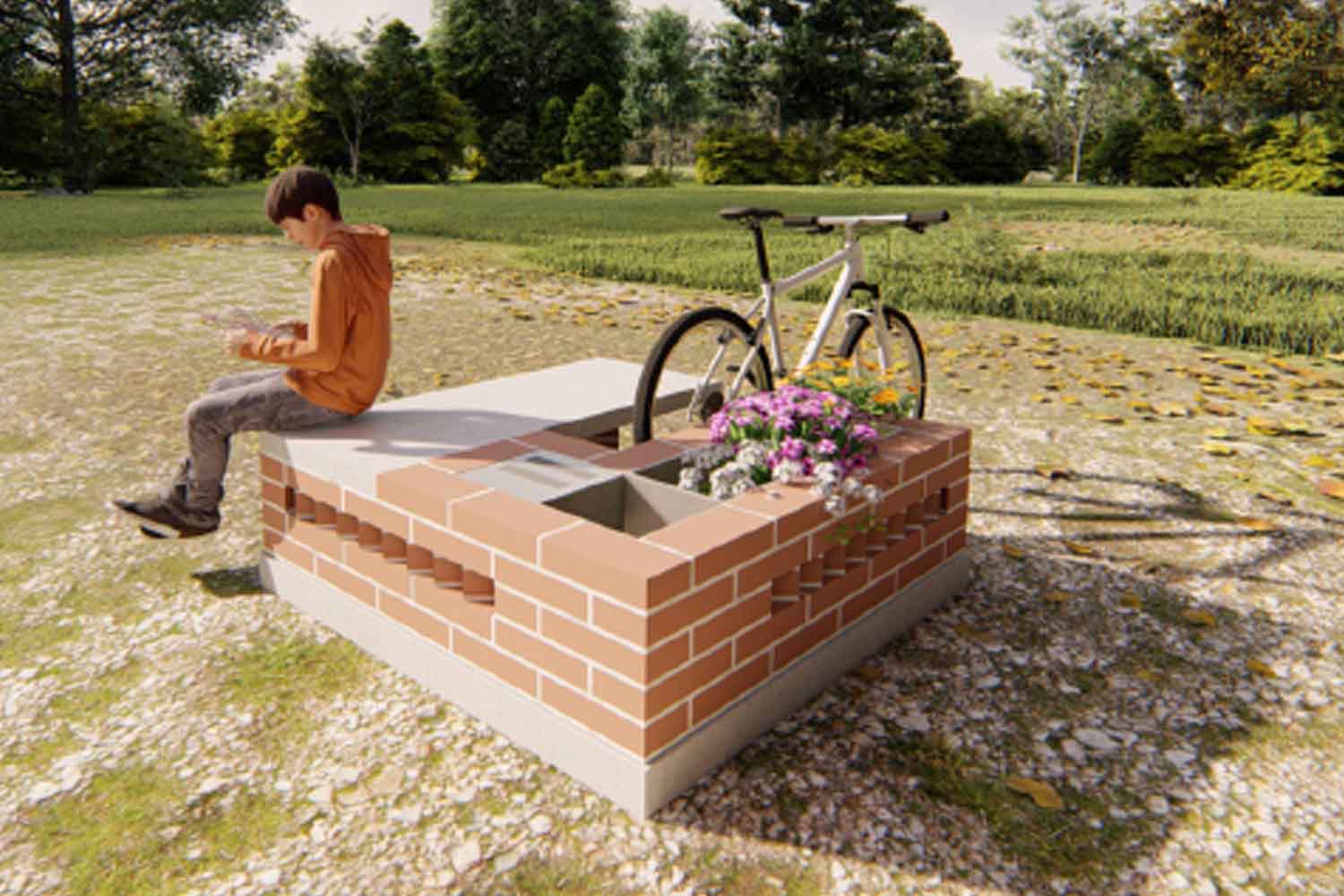
Four third-graders took up several free afternoons to design the place where, one day, someone else could sit, tie up their bike and charge their phone. The result is called Bench Brick: an exposed brick bench with solar panel, planter, basket and bike rack. At the moment there is an executive project on the boards, already solid enough to bring the Andrea Palladio Construction School of Vicenza to second place in Ediltrophy 2026, in the Junior category.
I am the one signing it Edoardo Formica, Filippo Lain, Ettore Menon and Matteo Tovothird year students of the Construction Operator course, led by the architect and construction technology teacher Matteo Tozzo. They were looking for something that hadn’t already appeared in dozens of more or less successful versions in the cities. Challenging mission, especially when the starting object is a bench.
“The most complicated part was thinking of an element of street furniture that had not already been created,” they explained. To arrive at the final version they also worked outside school hours. Afternoons taken away from free time to design, correct measurements and understand how to make bricks, vegetation, solar energy and daily services coexist within the same building.
A bench that tries to make itself useful
Bench Brick collects in a few meters different elements that usually live separately on a street or in a park. The seat is flanked by a planter and a basket; the bicycle is placed next to it. The photovoltaic panel should provide the energy needed to charge cell phones and illuminate the structure after dark.
It does several things and, an almost revolutionary detail for certain contemporary street furniture, also allows you to sit.
The project released so far does not report public data on the power of the panel, the presence of a storage battery or the times required for charging. These are aspects that should be defined during the possible transition to construction, together with resistance to atmospheric agents, maintenance and protection of the systems.
The idea, however, was born with a very concrete function: to transform a simple stop into a small service point. No monumental architecture. A person stops, leaves the bike, recovers a few percentage points of battery and starts again.
Behind the rendering there was a project to build
The recognition obtained at Ediltrophy concerns precisely the part that often disappears behind the most captivating images. The competition rules asked students to design an artefact mainly made of brick, complete and suitable to become an element of street furniture.
It wasn’t enough to design a nice bench and add a solar panel to it. We needed dimensioned plans, four elevations, sections, construction details, renderings, calculation of materials, list of tools and sufficient operational instructions for implementation. A three-dimensional model was also requested for the multimedia space of the SAIE in Bologna.
The jury assessed originality, technological validity, durability of the materials, clarity of the designs and complexity of construction. The product had to be designed for a construction test lasting a maximum of between four and six hours. In short, the bench had to have some chance of surviving outside the computer.
Ediltrophy is promoted by Formedil Italia and involves students who are training in architectural design and the construction sector. The Andrea Palladio Construction School offers a three-year course that alternates lessons, workshops, internships and educational visits, at the end of which the professional qualification of Construction Operator is obtained.
From prize to curb
Second place is worth a prize of 1,500 eurosgross of applicable withholdings. The official delivery will take place on 10 October at SAIE in Bologna, the fair dedicated to construction, design and systems.
Formedil has announced that the selected works will be shared with the local authorities involved in future implementation tenders, so as to evaluate their possible implementation. Bench Brick, therefore, could leave the technical tables.
The four students would like to build it and donate it to the city of Vicenza. It would be the step capable of giving a precise measure to the project: rain, sun, badly placed bicycles, telephones always out of charge and real people who sit down. Bench Brick has already passed the jury. Now it must cover the most difficult distance for any urban project: the distance between the rendering and the sidewalk.
