
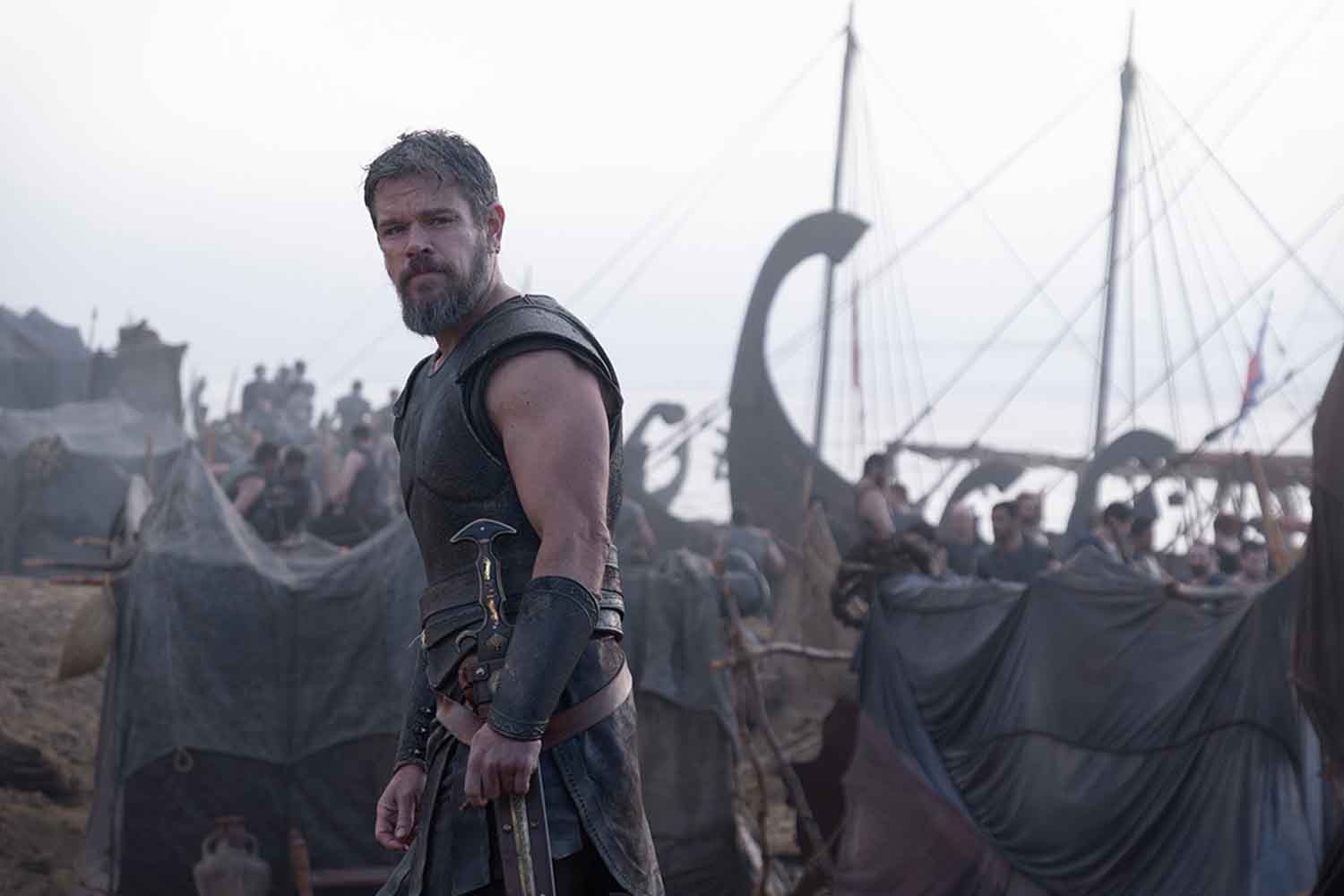
The ship sets sail without a helmsman. It has no bar, it doesn’t ask for directions and it already knows the cities, fields and intentions of the men it transports. It is a Phaeacian ship described in book VIII ofOdyssey and, read today, it looks a lot like an autonomous vessel driven by artificial intelligence. Homer, however, was not filing a patent.
With theOdyssey Of Christopher Nolan arrived in Italian cinemas on 16 July 2026, the poem has also returned outside the classrooms. Behind Cyclopes, spells and touchy gods appears a very material world, made up of workshops, trade routes, medicinal plants, observations of the sky and people trying to get back to life after the war.
THE’Odyssey it remains a literary work, built through centuries of oral transmission and composed of different layers. It cannot be read like the technical manual of Mycenaean Greece. It can, however, preserve images born from the observation of objects, practices and phenomena that the poet and his audience knew well. The boundary between memory and invention is mobile. After all, we are still in the poem in which a man takes ten years to return home.
The Phaeacian ships know the destination
In the story of Alcinous, ruler of the Phaeacians, the boats do not have pilots or rudders like those of other peoples. They understand the thoughts of men by themselves, they know every city and they cross the sea even in the fog, without risking shipwrecks.
The passage from Book VIII contains one of the oldest literary examples of a machine capable of receiving a human intention, finding a destination, and reaching it. Talking about it as an ancient artificial intelligence would be an anachronism: the ship belongs to the sphere of the marvelous and continues to have a crew. The technological imagination, however, is difficult to ignore. The vehicle knows the route better than those who get on it, a detail now familiar to anyone who has argued at least once with a satellite navigator.
The poem also offers less fantastic information about navigation. Odysseus’ ships are long, narrow, powered by numerous oarsmen, and built for speed. They do not coincide with the small merchant boats known to archaeologists, but they tell of a Mediterranean crossed by men, goods and knowledge long before the classic trade routes studied in school books.
Polyphemus’ eye ends up in a blacksmith shop
When Odysseus and his companions blind Polyphemus with a red-hot olive pole, Homer compares the sound of the eye to that of a glowing blade immersed in cold water. In book IX ofOdyssey the blacksmith quickly cools an ax or carpenter’s ax to make it stronger.
It is an early description of the temperthe heat treatment used to increase the hardness of steel. The similarity does not demonstrate that every workshop in the Homeric world mastered standardized procedures, nor does it allow the technique to be dated to the time of the Trojan War. It at least shows that the scene of the metal submerged in water, with its sudden hiss, was recognizable enough to turn a skewered eye into an image that everyone could understand. Elegant it is not. Effective, unfortunately, quite a lot.
Excavations around the Palace of Nestor, near Pylos, also yielded objects that interact with the poem. In the tomb of the so-called Griffin Warrior, dated around the mid-15th century BC, archaeologists from the University of Cincinnati found weapons, armor, jewelry and vessels made of bronze, silver and gold. In some Mycenaean depictions, fenestrated axes also appear, equipped with openings that could help interpret the competition narrated in book XXI: Ulysses must shoot an arrow through twelve aligned axes. The reconstruction remains controversial, because Omero did not attach the assembly drawing.
The wreck confirming the routes of the late Bronze Age
For a long time, the immense distances traveled by Homeric heroes seemed primarily the stuff of fiction. Then, in 1982, a sponge fisherman spotted what he described as metallic eared biscuits off Uluburun on the Turkish coast. They were ingots.
The wreck, sunk around 1320 BC and excavated by the Institute of Nautical Archaeology, carried copper and tin in the proportions needed to produce bronze, along with raw glass, ivory, jewellery, ceramics, ostrich eggs and ebony wood. Materials and objects came from areas very distant from each other; the ship, built of Lebanese cedar, appears to have had a Syro-Canaanite crew and passengers with ties to mainland Greece.
The cargo does not prove that Ulysses’ voyages occurred. It confirms a less cinematic and much more solid fact: in the late Bronze Age there were maritime networks capable of connecting the Levant, Aegean, Anatolia, Egypt and even more distant regions. Isotopic analyzes published in recent years have even traced some of the tin back to Central Asia. The Homeric Mediterranean was not a collection of villages waiting for the next singer. It was crossed by a complex commercial chain, with all the associated risks. Uluburun still keeps track of it on the seabed.
The mole could hold the memory of a true antidote
Circe mixes a potion, Ulysses’ men lose the memory of their homeland and are transformed into pigs. Hermes intervenes by giving the hero the molesa plant with a dark root and a flower as white as milk, capable of protecting it.
For decades, doctors and botanists have been trying to understand whether this sequence can preserve the memory of poisoning by plants with anticholinergic effects, such as henbane and mandrake. These substances can cause confusion, amnesia, delirium and hallucinations. The transformation into pigs remains magic; losing orientation, identity and behavioral control requires much less imagination.
A study published in 2024 on Journal of Ethnobiology and Ethnomedicine proposes that moly did not indicate a single species. It may have been the name given to a group of related Mediterranean plants, recognizable by their white flowers, bulbs covered in dark scales and the ability to inhibit acetylcholinesterase. Among those that may have contributed to the description are the genus sea lilies Pancratium.
It’s one ethnobotanical reconstructionbased on morphology, geographical distribution, phylogeny and known properties of plants. No residues of Circe’s potion were found, nor a label saying “moles” on a Mycenaean bulb. The authors themselves define the hypothesis as speculative. However, a fascinating possibility remains: an oral tradition may have fused several medicinal species into a single mythical plant, leaving the blurry memory of an antidote in the poem.
The wine-colored sea and the disappearing sun
Homer defines the sea as “wine-colored”, speaks of purple rainbows and uses a chromatic vocabulary very distant from ours. In the 19th century, someone even hypothesized that the ancient Greeks had less developed eyesight and could not distinguish colors correctly.
Subsequent studies have moved the question from eyes to language. In the Greek world, color could include brightness, consistency, reflections, movement and material qualities of the object. The “wine-colored” sea could recall depth, darkness and instability, more than a precise box of the modern chromatic scale. The Greeks saw blue; they just didn’t organize and name the viewing experience the way we do.
More controversial is the astronomical hypothesis. In book XX, shortly before the massacre of the suitors, the soothsayer Theoclymenus describes the Sun having disappeared from the sky and a darkness descending on the world. In 2008, Constantino Baikouzis and Marcelo Magnasco compared other astronomical references in the poem—the new Moon, Venus, the Pleiades, and Bootes—with celestial configurations between 1250 and 1115 BC.
According to their study published in Proceedings of the National Academy of Sciencesthe combination would be compatible with the total solar eclipse visible on the Ionian islands on 16 April 1178 BC. The authors themselves make it clear that everything depends on the identification of the verses with real astronomical phenomena. Other scholars have disputed the reading, noting that the prophecy may merely be a metaphor for death and ruin. The date, therefore, does not certify the historical return of Ulysses nor does it allow us to place the eclipse in the calendar of the Trojan War. It offers a precise astronomical coincidence, within a text that may have preserved observations much older than its writing.
Ulysses returns home, but the journey remains with him
The knowledge preserved in the poem also concerns the mind. Ulysses spends years isolated, cries on the shore of Calypso’s island, loses all his companions and returns to a house that he must regain by pretending to be someone else. Before being recognized, he tells his story to the Phaeacians. Words become the means by which he puts events, losses and identities back into order.
Classics and scholars of the mind have compared these passages to modern research on trauma, complex mourning, isolation and reintegration of veterans. The volume Human Minds and Homer’s Odyssey analyzes the role of story, memory and action in the protagonist’s recovery. Diagnosing Ulysses with post-traumatic stress disorder, however, would be a retrospective reading: the ancient categories of mind, emotion and responsibility were different from ours. The poem offers parallels, not a three-thousand-year-old medical record.
The Phaeacian ship already knows where to go. Almost three thousand years later, scholars are still reconstructing from which workshops, plants and skies that route was born.
