
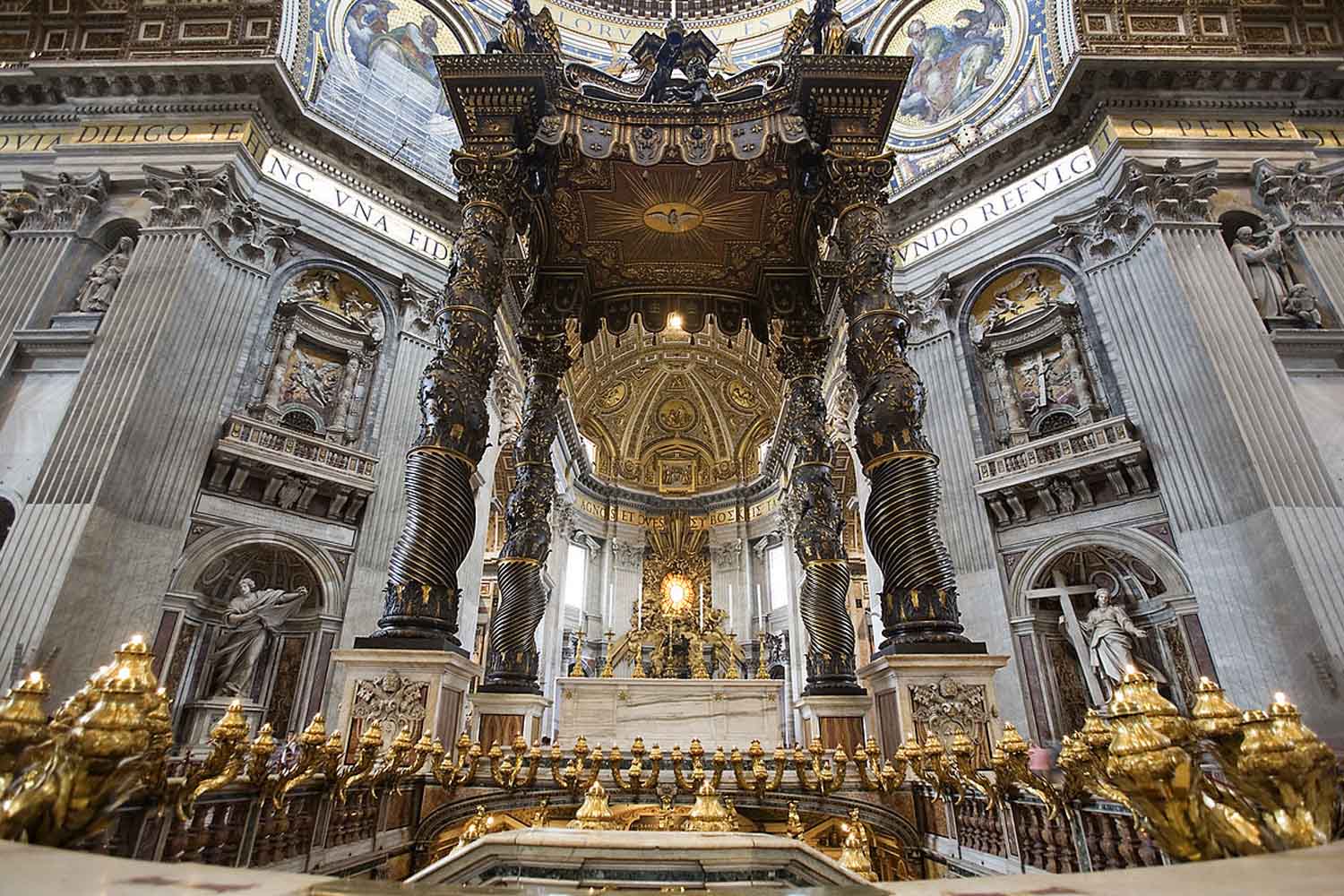
Under the high altar of St. Peter’s Basilica, in the Vatican, and sheltered from the magnificence of Bernini’s Baldachin, the surprising story of a mural on the Gospel dating back to the period between the end of the 3rd and the beginning of the 4th century. It is not a recent discovery, yet it returns to the center of attention today thanks to a book that has resurfaced after decades of silence, delivered in the 1990s to the only direct witness still alive: the Spanish priest Don Alfredo Fernández Martin.
The work in question has not been visible for a long time. It was about graffiti drawn on the stucco of a pagan funerary nicheinside the vast necropolis that extends under the floor of the basilica. About twenty-two meters from the burial site attributed to Saint Peter, the signs outlined the silhouettes of the heads of Christ and the apostle Peter, accompanied by four Greek words with unequivocal theological value: katabasis, anabasis, anastasis And dexiost(a)sisthat is to say descent into hell, ascension, resurrection and “sits at the right hand of the Father”. An extraordinarily early synthesis of the profession of faith.
The archaeologist who rewrote the history of Vatican burials
The merit of the discovery is linked to the imposing figure of Margherita Guarducciborn in 1902 and died in 1999, an epigrapher today considered a disciplinary giant, although not always recognized in her lifetime. At just twenty-nine years old, already full professor of “La Sapienza”, researcher in Crete, director of the National School of Archaeology, member of the Lincei since 1956: a career that to define as sensational is an understatement.
In the 1950s he was also the protagonist of the identification of the relics attributed to Saint Peter, a discovery which led Paul VI, in June 1968, to publicly declare that he had obtained “the few but sacrosanct mortal remains of the Apostle”.
The volume in which the scholar recounted the existence of the mural, Christ and Saint Peter in a pre-Constantinian document from the Vatican necropoliswas printed in 1953 by the State Polygraphic Institute. However, it remained almost forgotten, until Don Alfredo Fernández Martina Roman parish priest for half a century, did not mention having received it directly from the author’s hands. Today, with the renewal of the debate around the Nicene Creed and early Christianity, the priest believes it is his duty to bring it back to light.
The timing is not coincidental: between November 27 and December 2, Pope Leo XIV will be in Türkiye and Lebanon to celebrate the 1700th anniversary of the Council of Nicaea (325-2025), who gave definitive form to the prayer of the Creed. A coincidence that gives relevance to the document deciphered by Guarducci.
The image of the Christ-Phoenix and the four words that anticipate the Creed
The scholar described the scene with surprising precision at the time. In the central niche appeared a head of Christand above it an enigmatic figure formed by two birds with one body. According to the archaeologist, that united creature represented the phoenixsymbol of rebirth from death. For Guarducci, the artist had wanted to restore the ineffable moment of palingenesis: a Christ-Phoenixpowerful image of the Risen One destined to live forever.
From that same head radiated the four words in Greek, arranged like a theological fan and, according to the scholar, connected “directly with the teachings of the primitive Church”. A fragment, he stated, which anticipates essential parts of the Creed many decades before the Council.
Many years after her discoveries, Guarducci’s figure was finally re-evaluated. Tiziana Lupi’s recent book, The tomb of Saint Peter. The forgotten story of Margherita Guarducci (Minerva, 2025), brought the decisive role of the archaeologist back into the limelight, also obtaining the Rapallo Prize in the “Costume and non-fiction” section.
A recognition that comes late, but which illuminates the impact of his research: not only the reconstruction of the Vatican necropolis and the first centuries of Christianity, but also the ability to see, in a simple graffiti, the ardent core of the Christian faith.
