
Global warming is now a problem for both poles: after decades of stability and even growth in Antarctica, the South Pole is now also “falling” under the weight of climate change. This is what emerges from a series of recent studies that do not leave much room for different interpretations.
As you read above Science news For decades, sea ice in the Arctic Ocean has steadily decreased, while that surrounding Antarctica has inexplicably increased during the winter, apparently in contrast to global warming.
The collapse of the Antarctic ice
Then, in 2015, the extent collapsed: Ice failed to form over an area twice the size of Greenland. Since then, the decline has continued, reaching new lows in 2022 and 2023. Researchers believe the same process that is eroding Arctic sea ice is now underway in Antarctica.
In particular, in the Arctic the layer of cold water that insulates sea ice has been eroded by the intrusion of warm, salty water from the Atlantic Ocean, while some recent studies suggest that a similar cold layer in the Southern Ocean has been thinning for years, exposing the ice to melting from below.
As a result, sea ice at both poles appears destined for a similar fate, as seen in a recent study published in the journal Bulletin of the American Meteorological Society.
The Antarctic cold layer, now weakened, shows no sign of recovery – explains Theo Spira, lead author of the study – It will be difficult to restore it
The contribution of the winds
However, the behavior of Antarctic sea ice had left scientists perplexed, since neither the decades of growth nor the sudden contraction corresponded to the constant increase in greenhouse gases. In other words, its trend did not seem linked to greenhouse gases, which in turn were strongly influenced by human activities.
Scientists now believe that the temperature contrasts fuel the violent westerlies that blow around the continent, and that these contrasts have intensified due to ozone depletion, which cools the Antarctic stratosphere, while global warming heats the surface.
In reality, the infamous hole in the ozone layer has been shrinking recently, but, due to the Earth’s rotation, stronger winds would push surface water northward, away from the continent towards the open ocean, where water freezes easily. And this would explain the years of sea ice growth.
According to this theory, the warm, salty water, moved north, would then end up migrating south, generating a sort of “heat bomb” capable of causing the reduction of sea ice.
Only in recent years have scientists been able to verify whether heat was actually accumulating beneath the ice.
The predominant role of the ocean
©Nature Climate Change
Last March a research published in Nature Climate Change analyzed over 100,000 profiles collected over almost twenty years from floats: the results showed that the cold layer, which regenerates every year when winter cooling spreads downwards from the surface, thinned by about 2 meters per year in the decade preceding the collapse recorded in 2015, despite the growth of the ice.
In 2015, the first year of contractions, exceptionally strong winds actually stirred the ocean waters, causing the stratification to break down and allowing the warm waters below to rise.
This heat continues to erode the sea ice, as also explained in another work published on Proceedings of the National Academy of Sciences (PNAS), which reaches the same conclusion.
The researchers found, in particular, an almost threefold increase in the upwelling of deep waters (upwelling) induced by the winds between 2014 and 2016, a phenomenon that compromised the stratification and freed the warm waters.
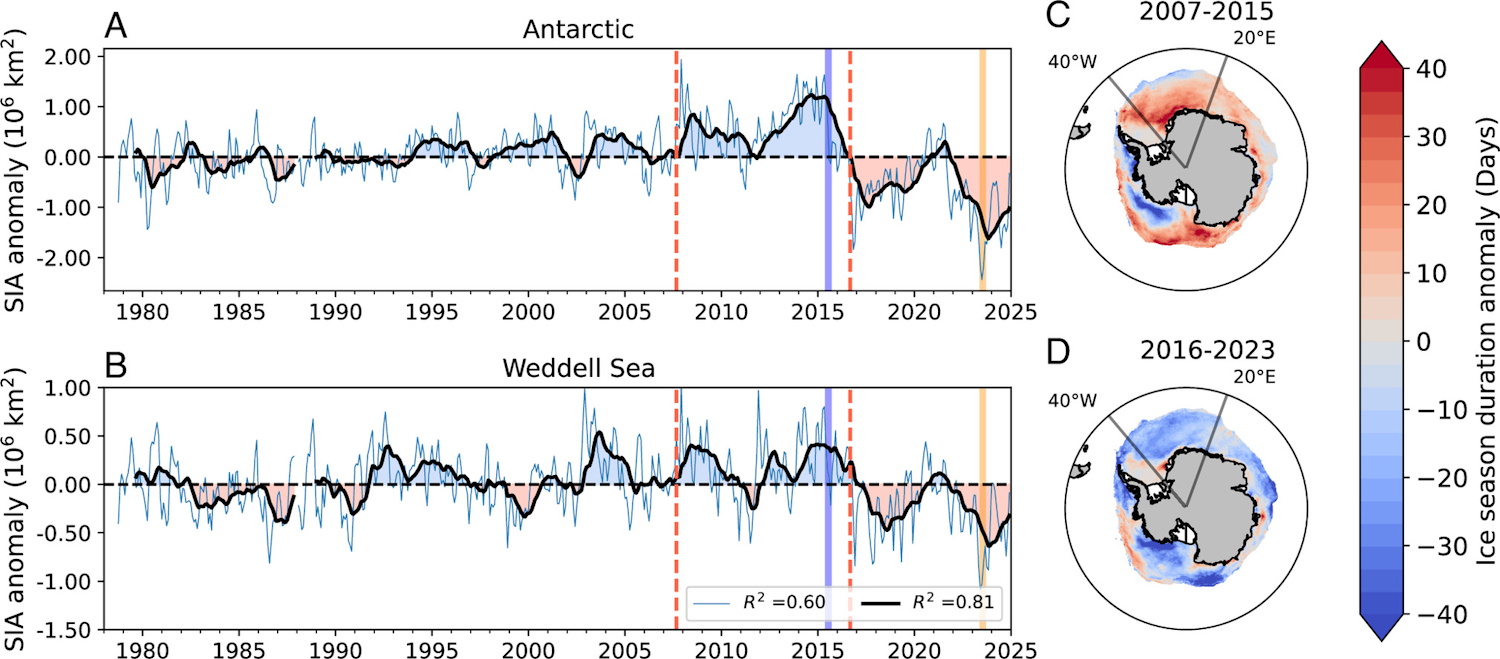
©PNAS
All these studies confirm the predominant role of the ocean
he claims Earle Wilsonoceanographer physicist at the Stanford University (United Kingdom)
Concern about sea ice may seem abstract when compared to the heat waves plaguing lower latitudes, but researchers are increasingly seeing it as a visible manifestation of climate warming.
Today this is one of the most evident signs of climate warming – concludes Aditya Narayanan, oceanographer physicist at the University of New South Wales (Australia) and first author of a coherent work published in Science Advances – This is a relevant phenomenon in itself, and not only for the fate of polar bears
We continue to ask ourselves what else needs to be studied and demonstrated than to convince everyone that climate change not only exists but is truly dangerous for life on Earth.
