
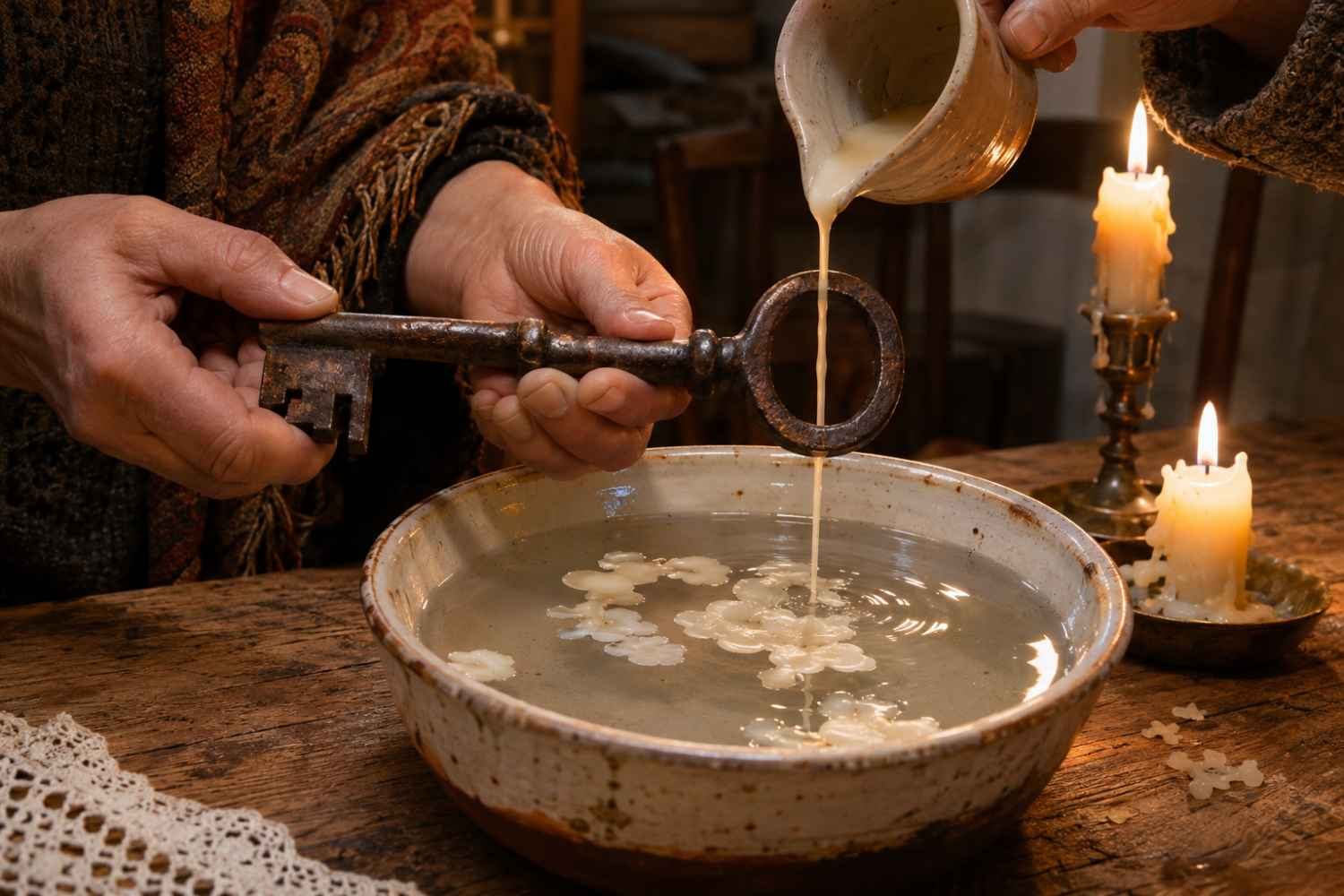
If you have some worn candles at home and an old key forgotten in a drawer, this evening you could use them for something unusual. In fact, on the night between 29 and 30 November, according to an ancient popular belief, it is possible to question the future by observing the shapes that the wax takes on in contact with cold water.
A bit like what happens with the water of San Giovanni or with the boat of San Pietro, the night of Sant’Andrea also preserves traditions in which water, everyday elements, desires and superstitions are intertwined.
That of the wax and the key is particularly evocative, it has been handed down for centuries and does not require purchasing anything special. All you need are a few objects, a little imagination and the desire to carve out a different moment than usual, just as we approach winter and the end of the year.
Because St. Andrew’s night is considered magical
In several regions of Central and Eastern Europe, the eve of St. Andrew the Apostle, which is celebrated on November 30, was considered a particularly auspicious time for questioning fate.
In the past, the period preceding Advent represented a sort of transition between two moments of the year. The days became increasingly shorter, work in the fields slowed down and the long evenings spent at home favored the birth and transmission of popular stories, beliefs and rituals.
In Germany this night was known as Andreasnachtwhile in Poland the tradition still survives today under the name of Andrzejkiwhose first written testimonies date back to 1557.
It was mostly young, unmarried women who gathered on the evening of November 29 to try to find out who they would marry and what the future would hold for them.
Among the many practices handed down, the most fascinating is precisely the one that involves pouring melted wax through the opening of an old key, leaving it to solidify in cold water.
How to do the St. Andrew’s wax and key ritual
To revive this ancient custom at home you can recover what you already have, including the small leftovers of candles that you would normally throw away.
You need:
On the evening of November 29th, gently melt the wax in a bain-marie. Place the key over the bowl and slowly pour a small amount of liquid wax through its opening, dropping it into the cold water.
Upon contact with water, the wax will begin to solidify, creating an irregular and unpredictable shape. When it has completely cooled, remove it from the bowl and bring it closer to a light source, so that its shadow is projected on the wall.
It is precisely by observing that shadow, slowly rotating the figure, that according to tradition one can glimpse symbols and clues about one’s future.
Of course, be careful with hot wax, do not melt it directly over the flame and entrust this operation exclusively to adults.
View this post on Instagram
What do the wax shapes mean?
The most curious part of the ritual is the interpretation of the shadow. There is no universal dictionary of the figures that can appear: much is left to the imagination and sensitivity of those who observe them.
Wanting to reinterpret this tradition today, we can imagine some symbolic associations:
It doesn’t matter if the resulting figure does not immediately resemble something recognizable. Sometimes just changing the angle of the wax is enough to discover a completely different image.
The symbolic meaning of the key
View this post on Instagram
The presence of the key makes this ritual even more suggestive. An object that belongs to our everyday life, but which has always evoked the idea of a threshold to cross, of something hidden to discover, of a door still closed.
In a contemporary symbolic reading, the key represents what we do not yet know, while water and wax give shape to the unpredictability of the future.
Naturally, it is not a religious practice nor a method capable of truly predicting events, but a popular belief that tells of the human need to find answers to one’s uncertainties.
From the water of San Giovanni to the wax of Sant’Andrea
Even in Italy we have traditions that give a particular meaning to water and the shapes created within it. Let’s think of St. Peter’s boat, which is prepared on the night between 28 and 29 June by pouring an egg white into a container of water, or of St. John’s water, made by leaving a bowl with herbs and flowers outdoors on the night of the solstice celebrated by popular tradition between 23 and 24 June.
They are different customs, born in different cultural contexts, but united by the desire to find a link with the passing of the seasons in small gestures and in the elements of nature.
That of St. Andrew’s wax could become a small autumn ritual to share with loved ones, without necessarily believing in omens. After all, rather than discovering what the future holds for us, observing those strange figures could help us understand what we really want.
And what better time than the last Sunday of November, which this year also coincides with the beginning of Advent, to do so?
Sources: University of Wroclaw – University of Łódź – Museum of Polish History – Rituals of St. Andrew’s Night
