
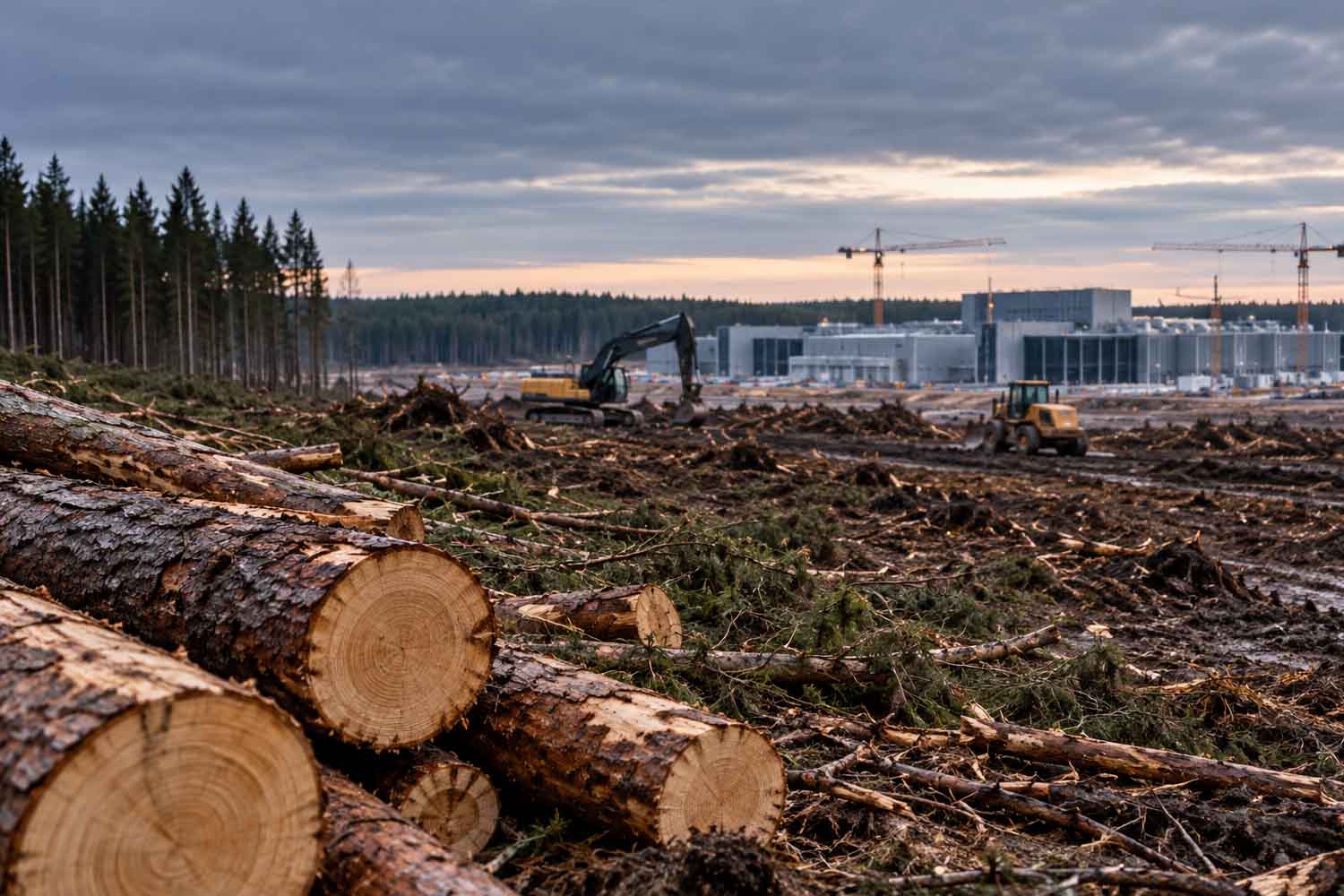
In Muhos, northern Finland, 330 hectares of forest have been cut down to make room for a Google data center. According to the estimate of ecologist Mari Annala, of the Finnish Association for Nature Conservation, we are talking about around 250 thousand trees. On 6 October 2026, when the forest had already been cut down, the Finnish Licensing and Supervision Authority (LVV) asked to suspend the work: the environmental impact assessment was still incomplete.
And it’s not the only site affected. In Otanmäki, near the town of Kajaani, just under 200 hectares have been deforested, with an estimated 150,000 more trees. Overall, therefore, around 400 thousand trees could be cut down for the two projects. A number estimated by environmentalists, because an official count does not yet exist.
The two data centers are part of the investment program announced by Google on September 9: at least 13 billion euros between 2027 and 2028, destined for digital infrastructure, energy and other interventions in various Finnish locations. The figure concerns the entire program, not just the Muhos plant. Google talks about responsible technological development and promises investments in clean energy. Meanwhile, in Muhos, it still needs to be established whether nine kilometers of ditches dug to prepare the ground are compromising the waters of the area. Those trees have already been cut down.
Trees felled before environmental assessment
The story began in September, when the Finnish Association for Nature Conservation denounced the deforestation carried out by Tuike Finland Oy, the Google company that manages the projects. Finnish legislation requires an environmental impact assessment for interventions that involve the permanent transformation of over 200 hectares of forest through the removal of trees. In Muhos that threshold was exceeded, while the procedure was still ongoing.
The Finnish authority’s provision of 6 October therefore asked to stop activities that significantly modify the environment: felling of trees, removal of soil, excavations, construction roads and drainage works. Only checks and design activities with limited environmental effects can continue.
Google said it had suspended work at both sites. The company’s head for Finland, Antti Järvinen, apologized publicly, claiming that the company had acted according to its own interpretation of forestry legislation and in cooperation with local authorities.
A version that is partially confirmed in the reconstruction published by the Municipality of Muhos on 16 October. The administration confirms that the cuts had been notified to the relevant forestry authority and that some preparatory work had been deemed permitted. He specifies, however, that he has not issued specific authorizations to Google.
The problem therefore also concerns the relationship between the different procedures established by law. The legitimacy of the interventions is still being investigated and the LVV authority has submitted a request for an investigation to the police. At the moment there is no definitive decision that establishes criminal liability.
Nine kilometers of ditches and the risk to the water
Another communication from the authorities arrived on October 22nd. This time it’s about water. According to the documentation examined by the Finnish authority, approximately nine kilometers of new drainage ditches have been designed in the Muhos area, most of which have already been built. The communication relating to these works should have been submitted at least 60 days before the start of the interventions. According to LVV, the works also require authorization under the Water Act.
The terrain, then, has a not very reassuring characteristic: in the area there are black shale formations which may contain sulfur minerals. When excavated and exposed to oxygen, these materials can cause acidification and increase the concentration of metals in wastewater.
Variations compatible with acidification processes have already been observed in the monitoring data provided by the company. This does not prove that the nearby river system has already suffered damage, but the measures proposed so far by the company have been deemed insufficient to guarantee adequate risk prevention. By November 5, 2026, the company will have to present a new plan for water management, specifying the necessary interventions, the times and a monitoring system entrusted to an independent party.
The authorities also asked for clarification on the conditions of a breeding and resting area for the heath frog, a protected species present on the site. In short, the artificial intelligence project still has to deal with decidedly less virtual issues. Starting with the water that flows in the ditches.
Google’s 13 billion and the race for data centers
The Finnish Government considers these investments a great economic opportunity. According to Google estimates, the program could support over 37 thousand jobs during the construction phase, also considering the employment generated in related activities. These are company projections referring to the entire investment, not as many permanent jobs already created.
Finland is particularly interesting for technology multinationals. The cold climate allows some of the energy needed to cool servers to be reduced, land is available, and the electricity system has a high share of low-emission generation. Land consumption, however, remains. As well as the demand for electricity, water and new infrastructure.
There are around 145 data center projects in the planning or construction phase in the country, according to a survey published on October 23 by the Finnish Association for Nature Conservation. The association calls for a national strategy to evaluate the overall effects and encourage the reuse of existing industrial areas, avoiding sacrificing other forest areas.
The issue has also reached citizens. A Finnish popular initiative has already gathered over 96 thousand members to ask for stricter rules on data center access to the electricity grid and an economic contribution proportionate to the resources used and environmental impacts, also intended for local communities. Google, for its part, has announced investments in wind power, energy storage and the recovery of heat produced by servers. Per Muhos said he wants to plant new trees on 130 hectares.
A surface area smaller than that deforested, even if the numerical comparison only tells part of the problem. Planting new trees does not automatically mean rebuilding a forest: recovering habitat, soil and ecological functions takes years, sometimes decades, and the effects also depend on the species used and the conditions of the territory. On November 5th Google will have to present the new water management plan. It will still take time to complete the environmental assessments, while the authorities are verifying the interventions already carried out. The 330 hectares of Muhos forest, however, were cut down first.
