
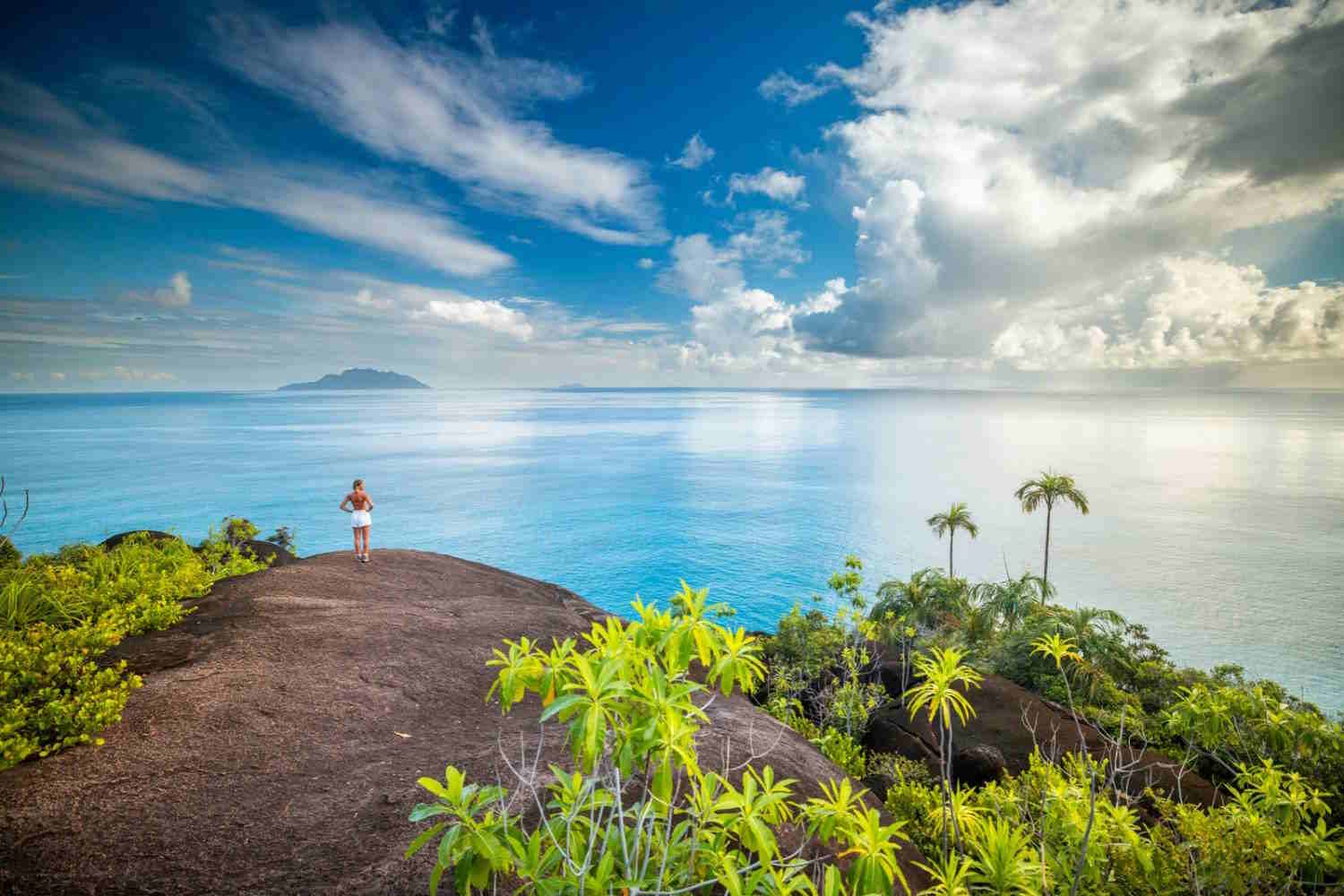
On the island of Praslin, among the palm trees of the Vallée de Mai, lives a black parrot (whose scientific name is Coracopsis barklyi) that almost no one can see. The cry betrays it, sharp and insistent, which after a couple of hours of walking you learn to recognize, the point is that being able to see it among the foliage is really difficult. This is enough to understand that the postcard Seychelles, those of white sand and granite smoothed by the sea, only tell half the story. The other half can be found in the interior of the islands and under the surface of the water, and to see it you have to set out.
The archipelago has 115 islands scattered in the Indian Ocean. The largest, Mahé, Praslin and La Digue, are granite, covered in forest and marked by paths that go up towards the interior. Millions of years of isolation have done the rest, with plants and animals found nowhere else on the planet.
On this heritage, the tour operator Seychelles Trekking has built two itineraries, Seychelles Trekking and Seychelles Adventure, which cross the three main islands among forest paths, out-of-the-way bays and snorkelling. The species described here are those that can be encountered along those routes, with a warning: nature does not sign contracts, and no sighting is guaranteed.
Mahé, in the forest of carnivorous plants
Mahé is the largest island of the archipelago, and much of its interior falls within the Morne Seychellois National Park, a protected area of mountains, humid forest and granite outcrops. The Seychelles Trekking program enters with the Copolia Trail, about three kilometers and two hours of walking through dense vegetation, up to a rocky plain overlooking the eastern coast.
Right on the granite slabs, above 350 meters above sea level, the Nepenthes pervilleithe carnivorous plant endemic to the Seychelles. It captures insects in small urns filled with digestive fluid and can be seen quite easily on the Copolia. A little further on Splendid Verschaffeltia it stands on stilt roots: it is one of the six endemic palms of the archipelago, and here it grows directly along the path.
As we walk, the Seychelles bulbul can be heard, one of the most common and noisy birds in the forest. The Sun Bird (Cinnyris dussumieri) passes from one flower to another in search of nectar, and the males, when caught by the light, send out metallic green reflections. The Seychelles kestrel, one of the smallest falcons in the world, also lives in the highest areas of the island. Further down there are geckos on the trunks, skinks that disappear between the rocks and, in the damp undergrowth, tiny frogs that you can hear long before you see them.
The Seychelles Adventure tour goes deeper, with the crossing of the forest to Port Glaud: a dozen kilometers and about six hours between waterways, natural pools and the Sauzier waterfall. In both programs, trekking and adventure, there is Anse Major, a hidden bay reachable by a coastal path of about six kilometers between granite boulders and vegetation.
Praslin, the Vallée de Mai and the black parrot
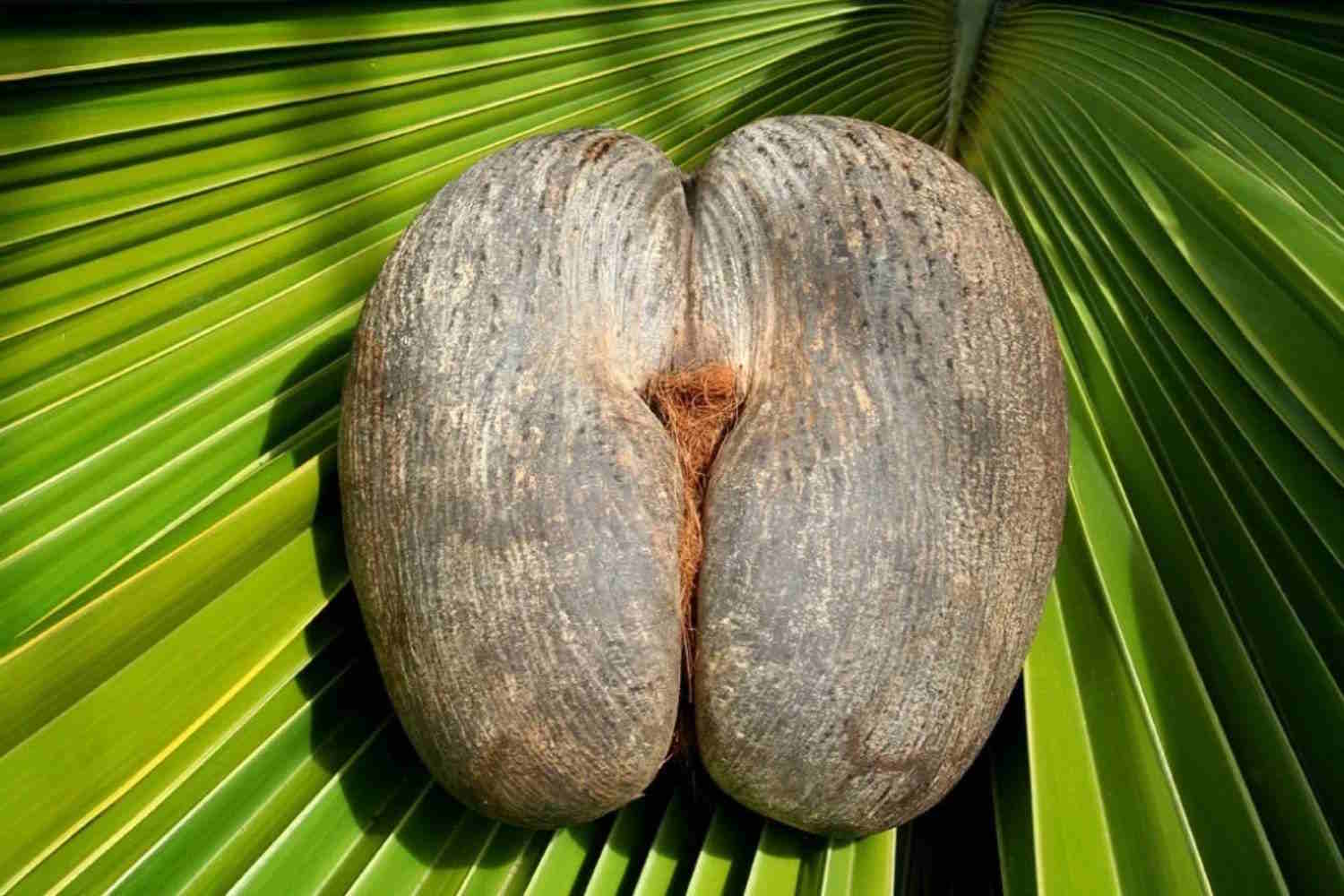
Coco de mer
The Vallée de Mai is a palm forest of just 19.5 hectares, which has remained almost as it was in prehistoric times and has been listed as a UNESCO World Heritage Site since 1983. It is dominated by the coco de mer (Lodoicea maldivica), the palm that produces the largest seed in the plant kingdom, and the other five endemic palms of the Seychelles also grow alongside it. According to UNESCO, it is the only place in the archipelago where all six are found together.
The black parrot depends on this forest for food and nesting, and this is why the guided tour, included in both Seychelles Trekking itineraries, is done with the ears before the eyes.
Much more lives among the palm trees. The reserve’s UNESCO fact sheet lists three endemic species of bronze gecko, the Seychelles blue pigeon, bulbuls, sunbirds, salangs, caecilians (legless amphibians that live in the soil) and tree frogs. There is also the tiger chameleon, small and so well camouflaged among the low branches that finding it in front of you is a matter of luck rather than skill.
La Digue, among granite boulders and giant turtles
On La Digue the Seychelles Trekking program covers approximately four kilometers of paths between Grand Anse, Petit Anse and Anse Cocos, in the tropical vegetation and next to the natural pools that form between the rocks. Day geckos, emerald green with red spots, bask on the boulders, while skinks cross the trail at a speed that would discourage any photographer.
Seychelles Adventure adds Anse Marron on the southern coast. No road reaches us, and the route passes through rocks, vegetation and stretches close to the water; the Seychelles tourist board recommends tackling it only with a guide, because here knowledge of the terrain counts as much as legs.
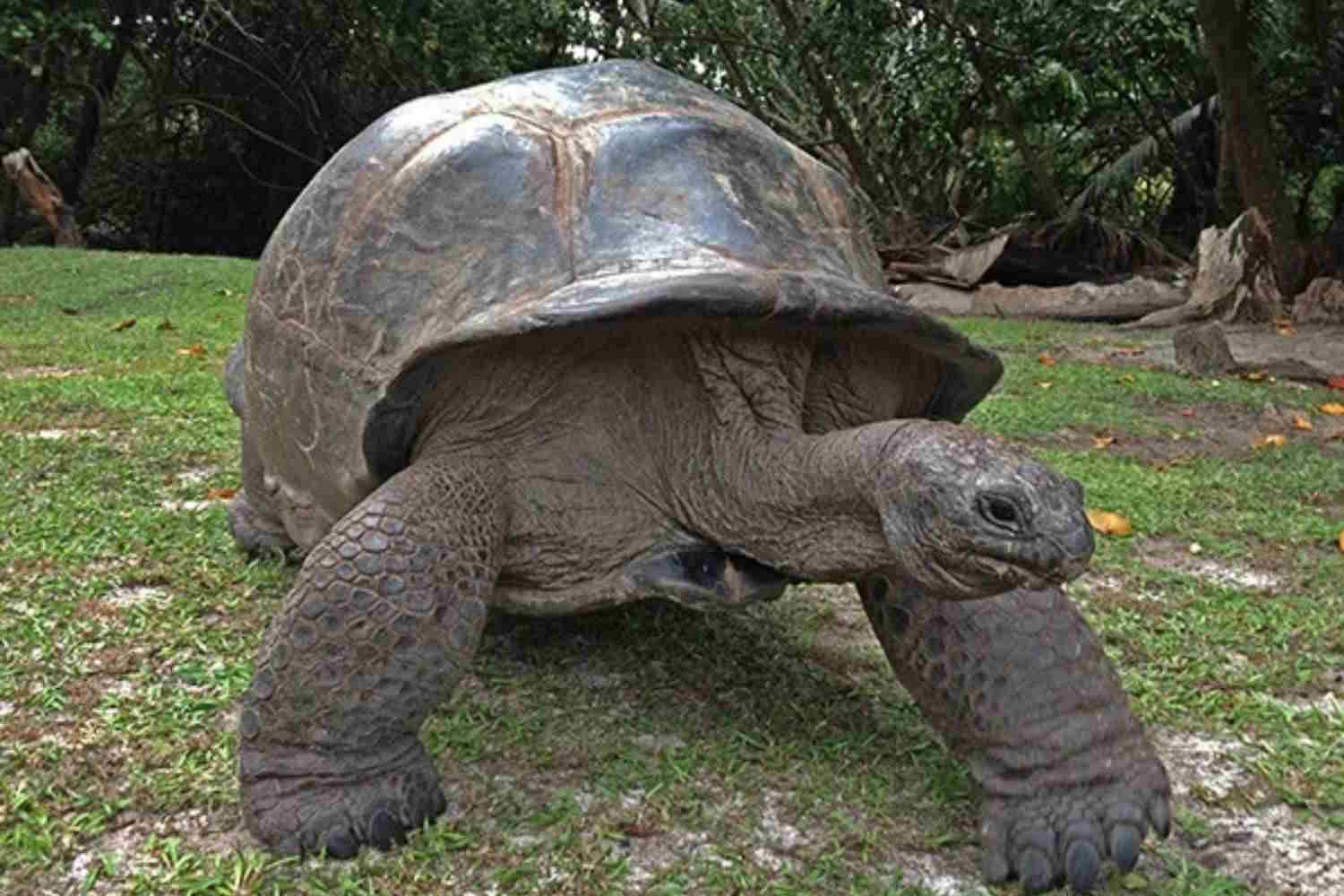
La Digue is also one of the most convenient places to see the Aldabra giant tortoise up close (Aldabrachelys gigantea), although the best place to see it in the wild is on the uninhabited island of Curieuse, the island of the lepers, a boat excursion that is not to be missed on both tours.
The wild population, however, lives elsewhere, on the Aldabra atoll, much closer to Madagascar than to Mahé. A study by the University of Exeter with the Seychelles Islands Foundation, published in Ecology and Evolution, estimates that around 180,000 turtles live there, based on counts made between 2018 and 2022. The figure that has been circulating so far, 100,000, dates back to the late 1990s. The researchers point out that this is not a doubling: the old counts ignored the animals hidden in the bush or in the shade, which the new statistical model instead estimates. The fact remains that in the nineteenth century, after years of intense exploitation, there were less than a thousand left.
Below the surface, among corals and sea meadows
Around the granite islands the seabed is constantly changing, between coral reefs, expanses of sand and seagrass meadows. Parrot fish, butterfly fish and surgeon fish swim in the shallow water, you can see stingrays on the sand, and some small reef sharks can appear around the rocks.
The most awaited encounter remains the one with a sea turtle. The most frequent species are two: the hawksbill (Eretmochelys imbricata), which moves among the corals in search of sponges, and the green turtle (Chelonia mydas), which as adults is herbivorous and grazes in underwater meadows.
Seychelles Adventure takes you snorkeling to the Sister Islands, off La Digue. Not far away is the Île Coco National Marine Park, three granite islets surrounded by very clear waters, which can be reached by boat from La Digue or Praslin. The sightings depend on the sea, the visibility, the season and the mood of the animals, which no program is able to predict.
The rules for not disturbing
When a species only exists on one island, the behavior of a hiker also matters. On the paths you stay on track, because outside you trample on superficial roots and delicate habitats. Flowers, seeds and stones remain where they are, also because Seychellois law protects them. The animals do not touch each other or feed each other, including giant tortoises, no matter how docile they seem.
In the water, sea turtles are not chased and corals are not used as support, because they are living organisms and a few blows are enough to ruin them. The sunscreen should be chosen from those that do not damage the barrier.
This is also why it is best to walk with a guide. He knows where to look for Nepenthes, distinguishes the call of the black parrot from that of the bulbul and knows the passages to avoid when the sea is rough.
Two itineraries to choose from
The two travel programs touch the same three islands at a different pace. Seychelles Trekking is also suitable for those with little experience of hiking and alternates walks in the reserves with beaches, snorkeling and stops in the villages, where the Creole cuisine becomes a piece of the story.
Seychelles Adventure lasts two days more and raises the level, with the crossing of Mahé to Port Glaud, the Anse Marron trail and snorkeling at the Sister Islands. In both cases the groups are small and the guides are Italian, with decades of experience in the archipelago.
The differences between the two programs are explained in detail in this article.
Information on programs and departures is on the official Seychelles Trekking website. The black parrot of our opening, however, doesn’t have a site: for him you have to go to Praslin, wait, keep quiet and cross your fingers.
