
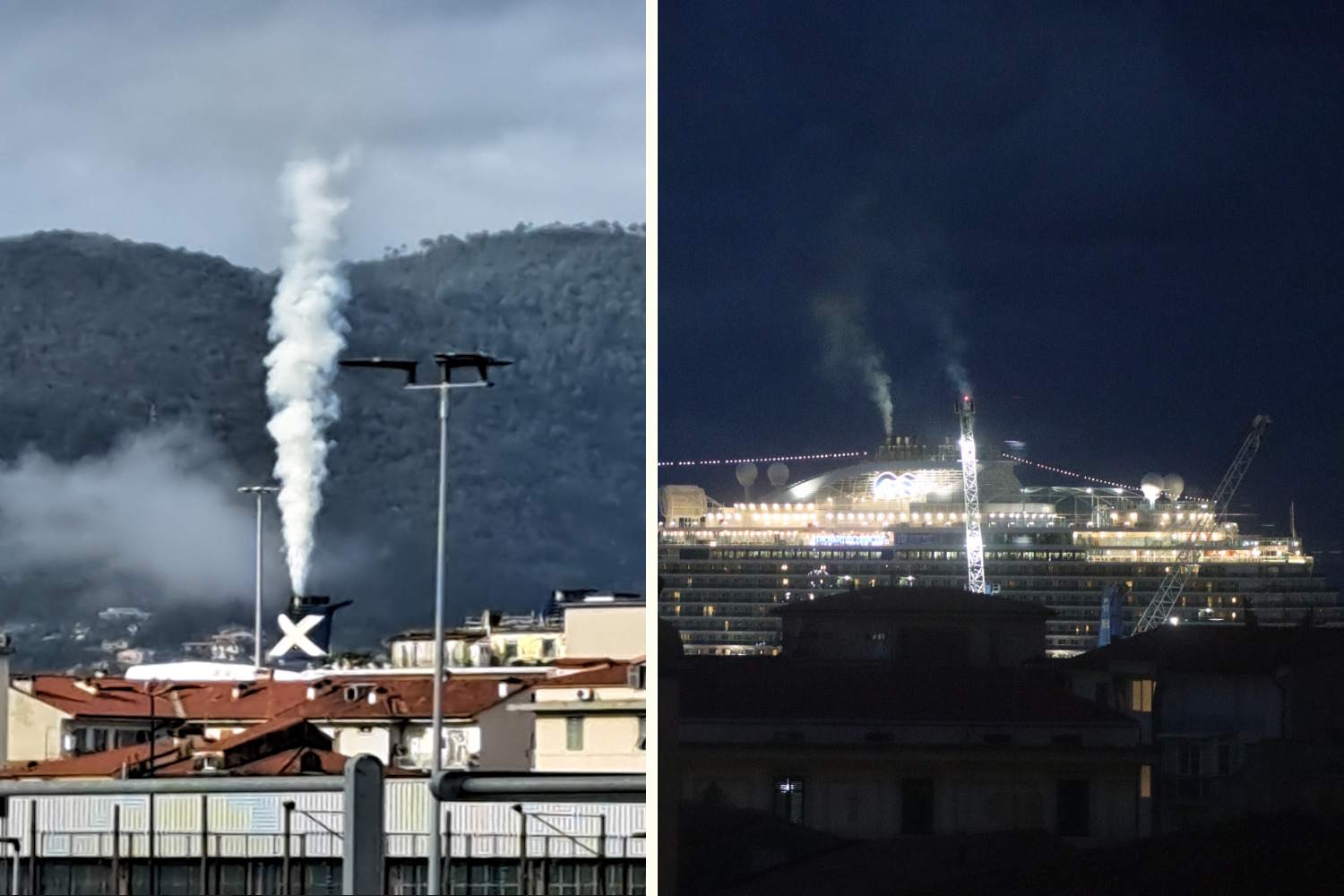
They arrive from the sea, unload thousands of tourists in a few hours and leave for the next destination. In the meantime, however, they leave something that does not appear in the price of the holiday: polluting emissions, greenhouse gases, pressure on port cities and environmental and health costs that fall on the community.
It is the great paradox of cruise tourism, a sector that continues to grow, while the cities that host the Great Ships have to deal with the consequences of their presence, starting with the pollution produced.
Cittadini per l’Aria is reigniting the debate, together with the associations of the Let’s Breathe the Mediterranean network, who are calling for the introduction of a national tax of between 20 and 40 euros per passenger at each airport. According to their calculations, a tax of just 20 euros would have made it possible to collect, in 2025 alone, around 141 million euros considering only eight Italian ports.
An important figure, but still far from the overall cost of pollution generated by cruises.
Grandi Navi, over 30 thousand hours in Italian ports
In 2025, according to AIS data processing (Automatic Identification System) presented by the associations, cruise ships made more than 2,500 calls in eight Italian ports: Civitavecchia, Naples, Genoa, Palermo, Livorno, Trieste, Ancona and Portoferraio. Overall, they spent over 30 thousand hours in port (these are not the hours of a single ship, of course, but the sum of the stops recorded in the eight ports of call).
@Citizens for the Air
A figure that reflects the pressure exerted by this activity on coastal cities, because a cruise ship, even when stationary, continues to need energy to power lighting, kitchens, air conditioning, swimming pools and all the services intended for passengers. If it cannot connect to the shore power grid, it generally has to produce energy on board, resulting in additional emissions.
Of particular concern are nitrogen and sulfur oxides and particulate matter, pollutants that contribute to worsening air quality and are associated with respiratory and cardiovascular problems. And then there is water pollution: many ships use scrubbersystems that wash exhaust fumes using water, often taken directly from the sea. In open-loop systems, the water is subsequently discharged into the environment and may contain contaminants, including heavy metals and hydrocarbons.
The result is that part of the ship’s impact does not remain on board, but is transferred to the air breathed by residents and the marine environment.
How much does a cruise really cost us?
The Floating Hotels study, published in July 2026 by the European organization Transport & Environment (T&E), quantifies the problem. According to estimates, in 2025 alone, emissions from cruise ships produced 503 million euros in environmental and health costs in Italy. A cost that the ticket price does not fully reflect.
The European ETS system, which requires companies to purchase quotas for greenhouse gas emissions, already represents a tool for attributing part of these costs to operators. But, according to the calculations reported by the associations, compared to the 503 million estimated external costs, the ETS system would cover around 106 million, leaving 397 million euros uncompensated.
The question, therefore, is not simply how much the cruise sector generates, but how much of the costs it produces is actually borne by those who profit from it.
Why is a night on a cruise taxed less than a night in a hotel?
Not everyone knows that cruise ships are considered, from a fiscal point of view, means of maritime transport, despite the fact that for passengers they represent a form of holiday and stay. A classification that allows the sector to benefit from more favorable tax regimes compared to traditional hospitality, from exemptions on excise duties on maritime fuels to concessions on VAT and business taxation.
According to the comparison drawn up by Transport & Environment and taken up by Cittadini per l’Aria, on a 100 euro overnight stay the estimated tax levy reaches 25% for an Italian hotel, compared to 15% for a cruise. For some luxury cruises, the incidence would even drop below 3%. They are estimates of the overall tax burden, not VAT rates directly applicable to each individual overnight stay. But they highlight a disparity that T&E also notes at a European level: on average, a night on a cruise bears a tax burden that is 40% lower than a night in a hotel.
Yet today, on a 100 euro overnight stay, in Italy those who stay in hotels pay 25% in taxes, while those who choose a cruise ship pay (…) 15%, underlines Anna Gerometta, president of Cittadini per l’Aria.
Why then should a tourist activity characterized by such a high environmental footprint benefit from a more advantageous tax treatment than that reserved for land-based accommodation facilities?
The association’s proposal
By applying a tax of 20 euros per passenger at each port of call, in the eight ports analyzed, according to the associations’ estimates, 141 million euros could have been collected in 2025. A 40 euro tax would have brought the theoretical revenue to 282 million.
The tax must be decided at a national level to help cities compensate for the impact of this unsustainable tourism, argues Anna Gerometta, indicating among the possible interventions also the removal of moorings from inhabited centers.
The resources could be allocated to the protection of coastal ecosystems, the monitoring of air quality and the reduction of the impact of port activities.
But the question is also another: can we really limit ourselves to taxing Big Ships without questioning the number of ships arriving in our cities?
From Venice to Barcelona, the cities that try to put a limit on large ships
For its part, Venice has demonstrated that intervening is possible, even if complex. From 1 August 2021, ships that exceed certain dimensional or environmental limits can no longer cross the San Marco Basin and the Giudecca Canal. A decision that came after years of mobilization to protect the lagoon and the historical heritage of the city.
Other European destinations have also introduced restrictions or are reorganizing cruise traffic. Barcelona has started interventions to reduce docking near the town centre, while Dubrovnik has chosen to regulate arrivals to contain tourist pressure.
The Italian associations ask to follow this path, setting daily limits on passengers, reducing stopovers in the most congested locations and prohibiting the access of large ships to the most sensitive marine areas.
Among the requests there is also a ban on the discharge of scrubber water in the identified areas and the obligation to use shore power when the infrastructure is available.
On this last point, the European Union has already envisaged, starting from 2030, specific obligations to connect to the electricity grid for passenger and container ships in the ports affected by the legislation. The associations ask to accelerate the transition, without waiting any longer.
The cruise sector generates employment and economic activity for ports, workers and local businesses. It would be wrong to ignore it. But it would be equally wrong to consider these benefits sufficient to justify any environmental impact. Moving moorings away from historic centers can reduce some problems, but does not eliminate the emissions produced during navigation. And replacing traditional fuels with liquefied natural gas does not automatically equate to making a cruise sustainable, also considering the methane emissions associated with this fuel.
Different and complementary interventions are therefore needed: reducing emissions from ships, limiting traffic where the pressure is excessive and rebalancing the economic contribution of the companies to the territories that host them.
The proposal of 20 euros per passenger brings to the center a question that too often remains unanswered: how much does a cruise really cost, when damage to the environment and health is not included in the price of the ticket?
