
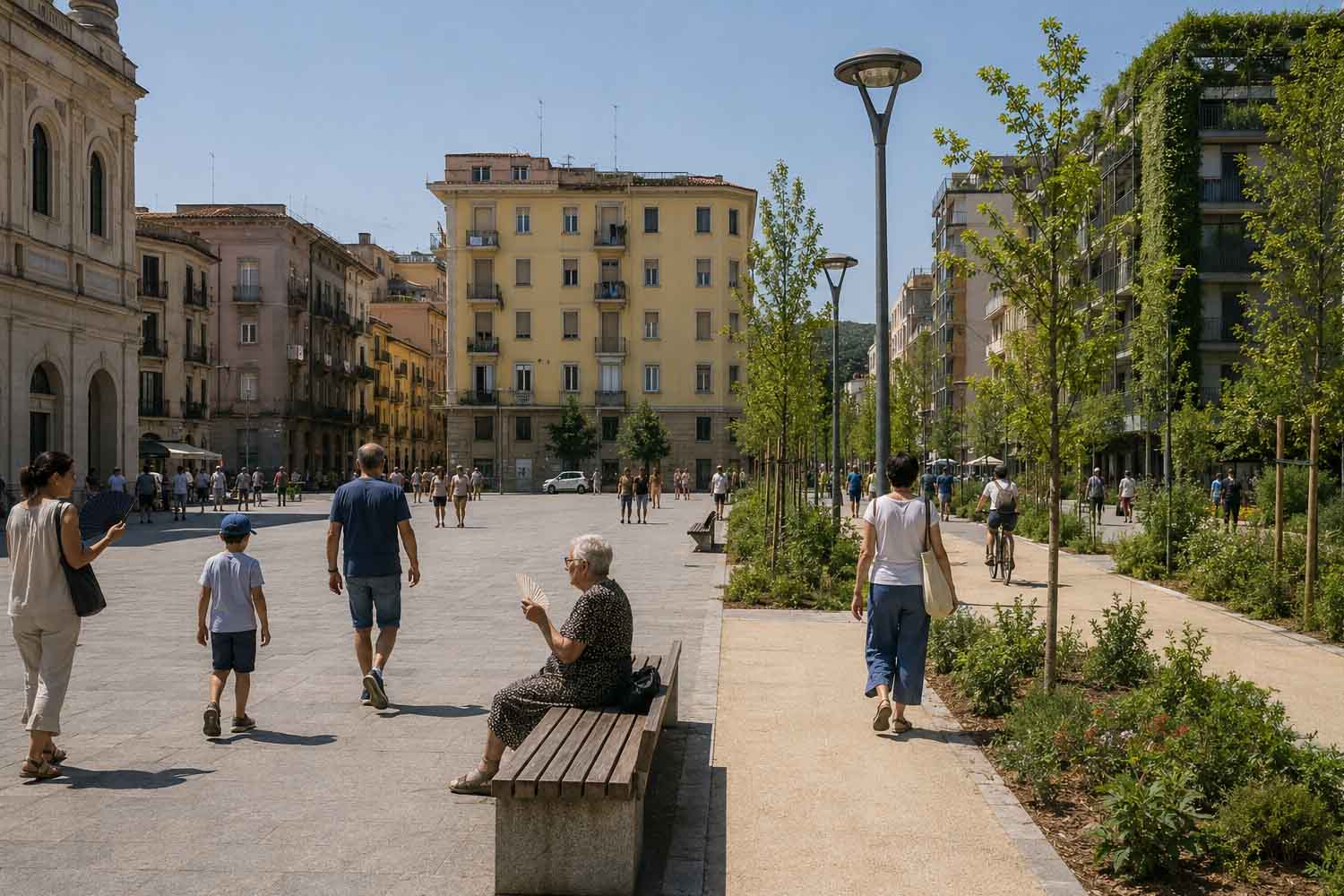
The missing tree can be seen immediately. You feel it when you cross a square at two in the afternoon, when the asphalt releases heat from your shoes, when the storm fills an underpass in a few minutes and what seemed like a normal street becomes a fragile part of the city. The green city, for many Italians, now has this very concrete form: more shade, less concrete, neighborhoods capable of withstanding the heat, water, waste, abandoned buildings left there to rot.
According to the Ipsos-Legacoop survey presented on the occasion of the national meeting of the Observatory on the ecological transition in cities, citizens’ request is very clear: 89% consider it important to increase green areas and trees and reduce land consumption; 89% also believe it is important to make production and consumption more circular, cutting waste and also recovering existing building stock; 85% ask for climate adaptation measures to reduce the impacts of flooding and heat waves; 82% give weight to the progressive reduction of greenhouse gas emissions.
The demand is high
The most interesting data comes when we move from desire to evaluation of what is happening in cities. Here the photography changes tone. Satisfaction with the interventions already carried out remains below half: 47% say they are very or quite satisfied with the improvement and increase in green areas, 43% with the interventions on the circularity of production and consumption, just 38% with the initiatives for climate adaptation and mitigation.
Ergo, the citizens have understood very well what is needed, they see the heat rising, they see the streets flooding, they see the parks worn out or insufficient, and they still judge the response to be too weak. The urban ecological transition is perceived as a large, almost transversal priority, especially in large municipalities and among people in the 61-64 age group. Satisfaction, however, remains much lower than the importance attributed to the topic. That’s where the gap opens up.
In the meantime something is moving. The Observatory on the ecological transition in cities, born in 2025 with the participation of over 60 Italian cities, research institutions, universities, businesses and institutional entities, works to collect and disseminate good practices on four fronts: climate adaptation, mitigation, circularity and natural capital. The direction is sensible: sharing experiences already tested, making them replicable, making them part of the administrations’ strategies. The problem, seen by citizens, lies in the speed and real presence of these interventions in the neighborhoods.
The rating remains low
A green city is measured less in documents and more in ordinary maintenance that changes lives. An abandoned area transformed into a green space with high ecological value, a row of trees planted where previously there was only full sun, a square redeveloped with natural solutions that reduce the waterproofing of the soil. In fact, the survey indicates a very broad consensus on these interventions: one interviewee in two considers it very important to redevelop public spaces with natural solutions and reduce the capping effect of cement.
The energy chapter enters the same game. Among the measures considered most important to reduce the effects of climate change are the Renewable Energy Communities, designed to increase distributed production from clean sources and make access to renewable electricity more convenient; deep renovations of buildings, with very low consumption and adequate materials; energy self-sufficient condominiums, with photovoltaics on the roofs, heat pumps for heating, cooling and hot water, and forms of self-consumption among residents.
Then there is waste and waste. Here too the consensus is strong: more than one interviewee in two considers it very important to improve the management of urban waste, reduce waste through the recovery of food surpluses and increase the collection of small electronic waste with dedicated eco-points. Urban circularity, therefore, also involves very practical gestures: recovering what remains, repairing, reusing, intercepting materials that today too often end up in the wrong circuit.
You need money and skills
Citizens, however, also indicate the conditions to make all this effective. Over 90% consider clear rules, stable objectives over time, public funding and adequate technical skills to be important. Percentages between 87% and 90% also concern correct information on problems and solutions, the involvement of local businesses, the ability to generate benefits on multiple aspects of the ecological transition and the coordinated direction of national, regional and municipal governments.
This step weighs a lot. The ecological transition in cities is often described as a matter of big plans, and plans are certainly useful. But citizens also ask for an administrative machine capable of bringing them to the ground: technicians, funds, certain times, stable rules, understandable construction sites, visible interventions. The difference between a promise and a habitable green city lies there.
The work margin is enormous. Italian cities have to deal with more intense heat waves, extreme rainfall, land consumption, energy-intensive buildings, neighborhoods with too much concrete and too little shade. At the same time they have a ready-made social demand, much more mature than is often imagined. Citizens are asking for trees, permeable soil, recovery of what already exists, shared renewable energy, better managed waste, more livable public spaces.
The distance between that almost 90% of consensus and that 38-47% of satisfaction is a precise measurement. Inside there are the good practices that are advancing, the delays, the Municipalities that are trying to get serious, those that are left behind, the funds to be found, the skills to be built, the trees still to be planted. And even the summers that come anyway.
You might also be interested in:
