
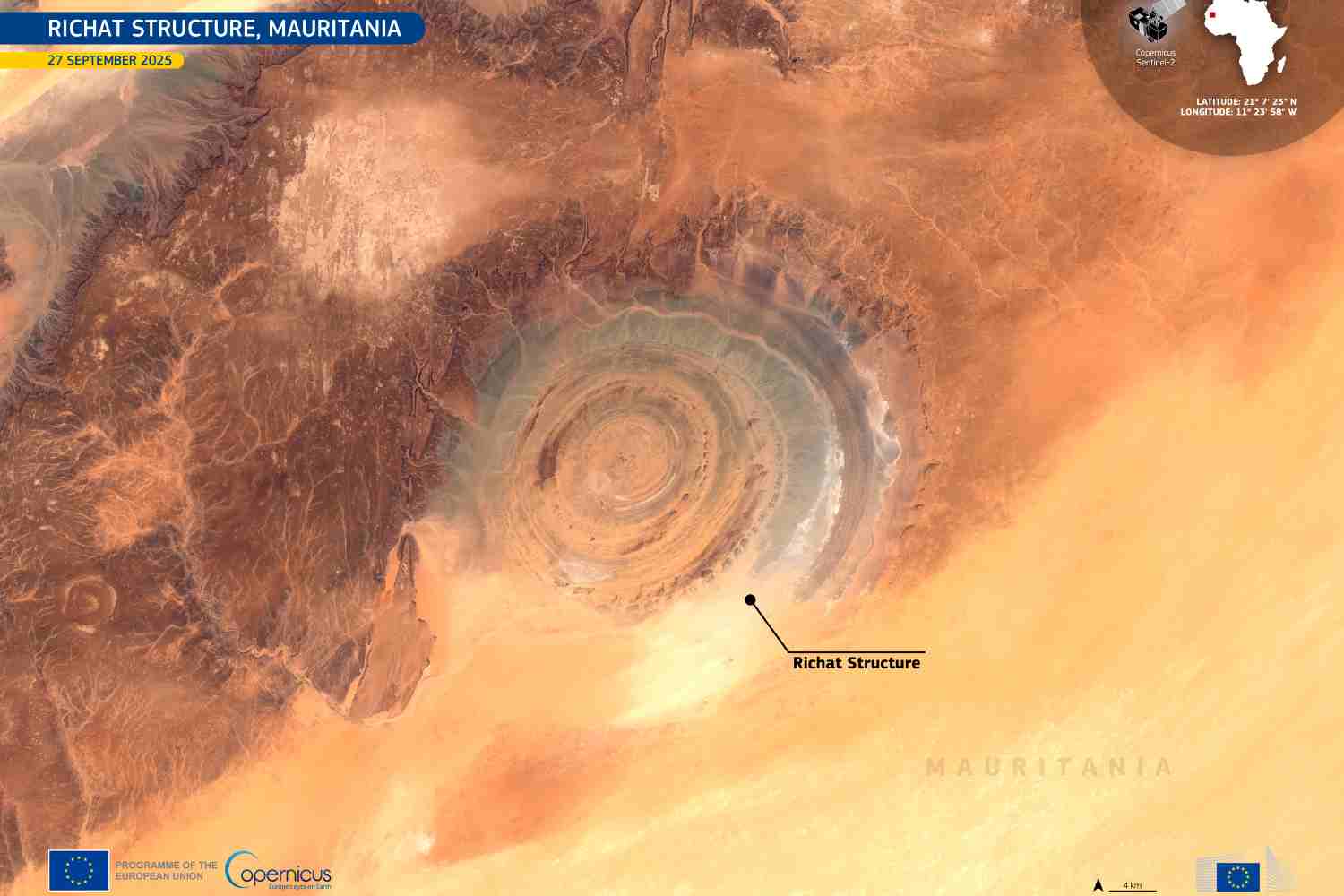
In the center of the Sahara, among the dunes of the Mauritaniahides one of the most enigmatic geological wonders of the planet: the recall structurealso known as Sahara eye or Eye of Africa. From above, it appears as a huge spiral in the desert, so perfect that it seems artificial. But this formation of about 40-50 kilometers in diameter is entirely natural, as confirmed by the satellite image acquired on September 27, 2025 by the satellite Copernicus Sentinel-2widespread by the European Union as “Image of the Day”.
👁️ The Richat Structure, the "Eye of the Sahara", a striking circular geological formation in 🇲🇷 Mauritania, is among the most distinctive landforms visible from space.
Captured by a #CopernicusEU #Sentinel2 on 27 Sept.
Learn more: https://t.co/X08lxpIhbH#ImageOfTheDay pic.twitter.com/pOXToYQQL0
— Copernicus EU (@CopernicusEU) October 4, 2025
For years, scientists believed that the structure was an impact crater: the raised edge and the most depressed center seemed to indicate the explosion of an ancient meteorite. However, geological investigations have denied this hypothesis. No trace of fused rocks or a central peak, typical characteristics of an impact. Today the scientific community recognizes the recall structure as one erosa geological domeformed by internal processes of the earth during the Cretaceous, between 145 and 66 million years ago.
The concentric rings, even visible from space, are composed of alternating layers of sedimentary and igneous rocks. The most tender portions – sandstones and scans – have eroded more quickly, while the hardest rocks, such as Quartzi and Basalti, resisted the time and wind of the desert, sculpting the circular form that today fascinates geologists and observers. Some central rings rise up to 80 meters high, a newly perceptible relief on the ground but extraordinarily clear in the satellite images.
In addition to the scientific value, the recall structure preserves traces of the human past. In this area Acheuleni and Preacheulean tools were foundas a stone axes, which testify to the presence of prehistoric communities. His isolated and recognizable position made the eye of the Sahara a point of reference for the pilots during the Second World War, and the French geographer Jacques Richard-Molard He described it for the first time in 1948, calling him “Le Boutonnière de Ricat”.
The image of the structure became famous in 1965, when the astronauts James Mcdivitt and Edward White, aboard the Gemini 4 mission, photographed it from space. Since then, it has become one of the symbols of the ability of the satellites to tell the earth from a new perspective. Today, thanks to the data of the Copernicus program, the Sahara eye is monitored continuously, offering precious information on the evolution of rock formations and on the impact of erosion in remote regions.
Although its natural origin is now ascertained, the perfect form of the structure has fueled numerous alternative theories, including the one that identifies it with the mythical Atlantis of Plato. But scholars agree: there is no evidence in support of this interpretation. Sahara’s eye remains a geological wonder, not a relic of lost civilizations.
