
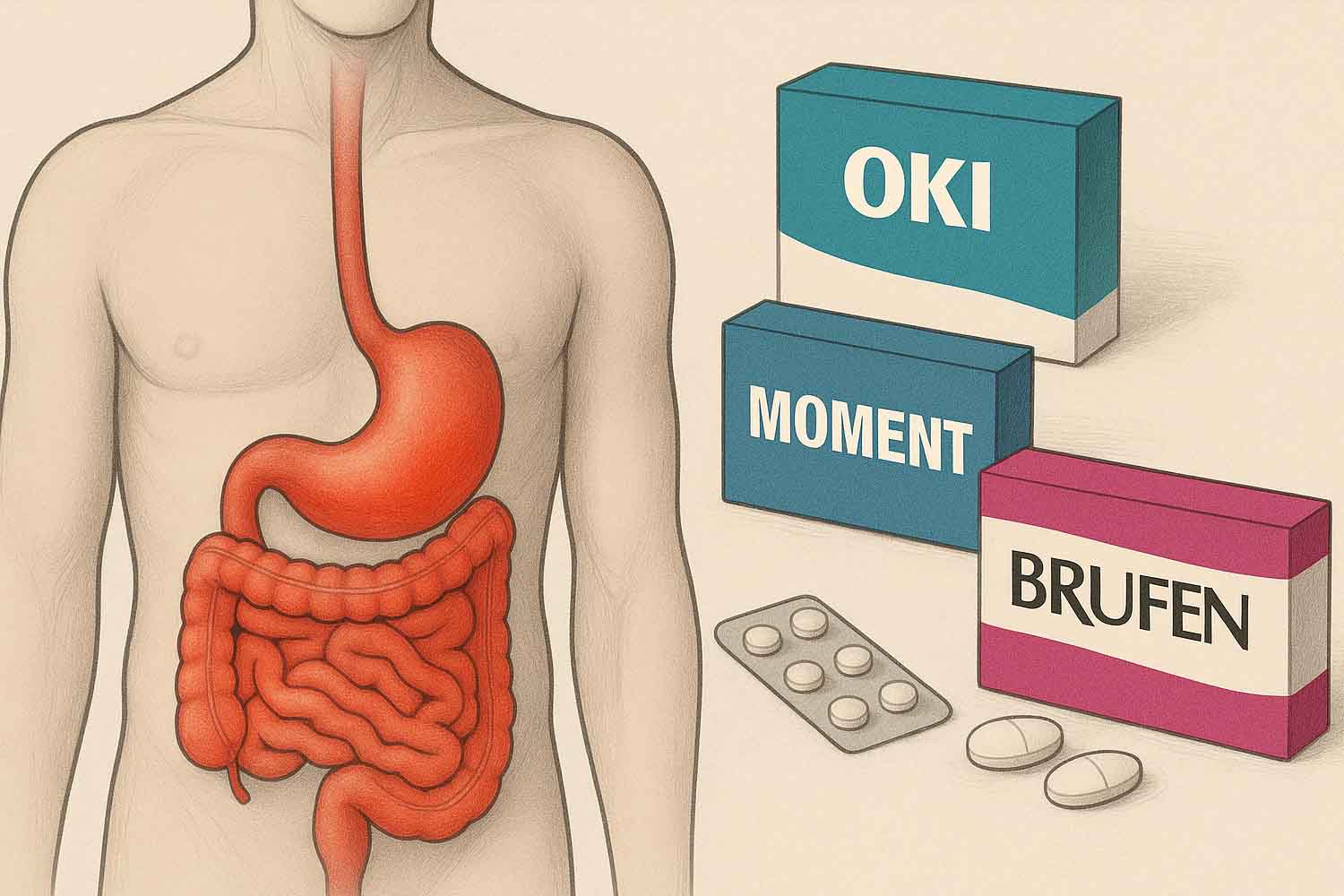
When a headache, menstrual or muscle pain hits us, many of us rush to grab an Oki, a Moment or a Brufen. They are over-the-counter drugs, we find them everywhere, and their effectiveness is undoubted. But not everyone knows that these medicines belong to the family of NSAIDs (Non-Steroidal Anti-Inflammatory Drugs) and that, if taken without due precautions, they can cause serious damage to the gastrointestinal tract.
An extensive scientific review published on Rheumatology by gastroenterologist Angel Lanas analyzed decades of clinical data, revealing how these drugs – although essential for many pathologies – pose a significant risk of ulcers, perforations and bleeding in both the stomach and intestines.
What really happens to the gastrointestinal tract with the use of NSAIDs
Lanas explains that NSAIDs, even at doses commonly used for joint pain or headaches, can increase the risk of peptic ulcers by about five times and the risk of gastrointestinal bleeding by four times compared to those who do not take them.
These side effects are not limited to the stomach: in recent years, in fact, medicine has discovered that “low” intestinal complications – such as inflammation, blood loss, perforations or obstructions of the colon – are on the increase.
According to the study, among patients treated with NSAIDs:
But the most worrying fact is another: many patients do not feel any symptoms before a serious complication. In a study of 235 people with perforated or bleeding ulcers, more than half (58.2%) had never experienced gastric discomfort before the episode.
Can COX-2 and gastroprotectors reduce damage?
To reduce these risks, COX-2 selective NSAIDs have been introduced over the years, such as celecoxib, which act on inflammation while partially sparing the gastric mucosa. However, as Lanas points out, the benefit of COX-2 disappears if taken together with aspirin or other cardiovascular drugs.
International guidelines recommend two main strategies for those at risk:
- Take a traditional NSAID together with a gastroprotector (such as a proton pump inhibitor, e.g. omeprazole or esomeprazole);
- Use a COX-2 alone, always under medical supervision.
A clinical study conducted on 441 high-risk patients demonstrated that the association between COX-2 and gastroprotector is the one that offers the most effective protection against the risk of bleeding and recurrent ulcers, without increasing side effects.
Not just the stomach: NSAIDs also damage the intestine, often silently
For a long time it was thought that the damage from NSAIDs was limited to the stomach. Today we know that the small intestine and colon can also be severely affected.
The review reports that:
And that’s not all: up to 70% of patients can develop intestinal microlesions visible only with advanced diagnostic techniques, such as capsule endoscopy. These lesions, often asymptomatic, can cause chronic anemia, reduced muscle strength and fatigue, with a significant impact on quality of life.
For years, studies on NSAIDs have focused only on gastric and duodenal ulcers. Today, however, researchers have introduced a new evaluation parameter: CSULGIEs (Clinically Significant Upper or Lower GI Events), or “clinically significant, higher or lower gastrointestinal events”.
This new approach takes into account the entire gastrointestinal tract — from the stomach to the colon — and includes not only bleeding and perforations, but also anemia or occult blood loss of intestinal origin.
The CONDOR study, which applied this method for the first time, showed that the drug celecoxib causes fewer global gastrointestinal complications than the combination diclofenac + omeprazole in patients with arthritis.
@doc_carlo_gofor360 IBUPROFEN
Ibuprofen is among the most used painkillers, but how many mistakes do you make without knowing it? Learn to avoid them! I explain the 5 mistakes you should NEVER make, from mixing with other drugs to taking too many doses. Find out everything in the video and ask me more on WhatsApp. #ibuprofen #moment #supplements #fyp #perte
♬ original sound – Pharmacist Carlo Gofor360
What can we do in practice?
There is no need to demonize NSAIDs: they are precious drugs and, if used well, safe for most people. But it is essential to remember some rules:
As Lanas points out, awareness is the true form of prevention:
NSAIDs are useful drugs, but they must be respected.
You might also be interested in:
