
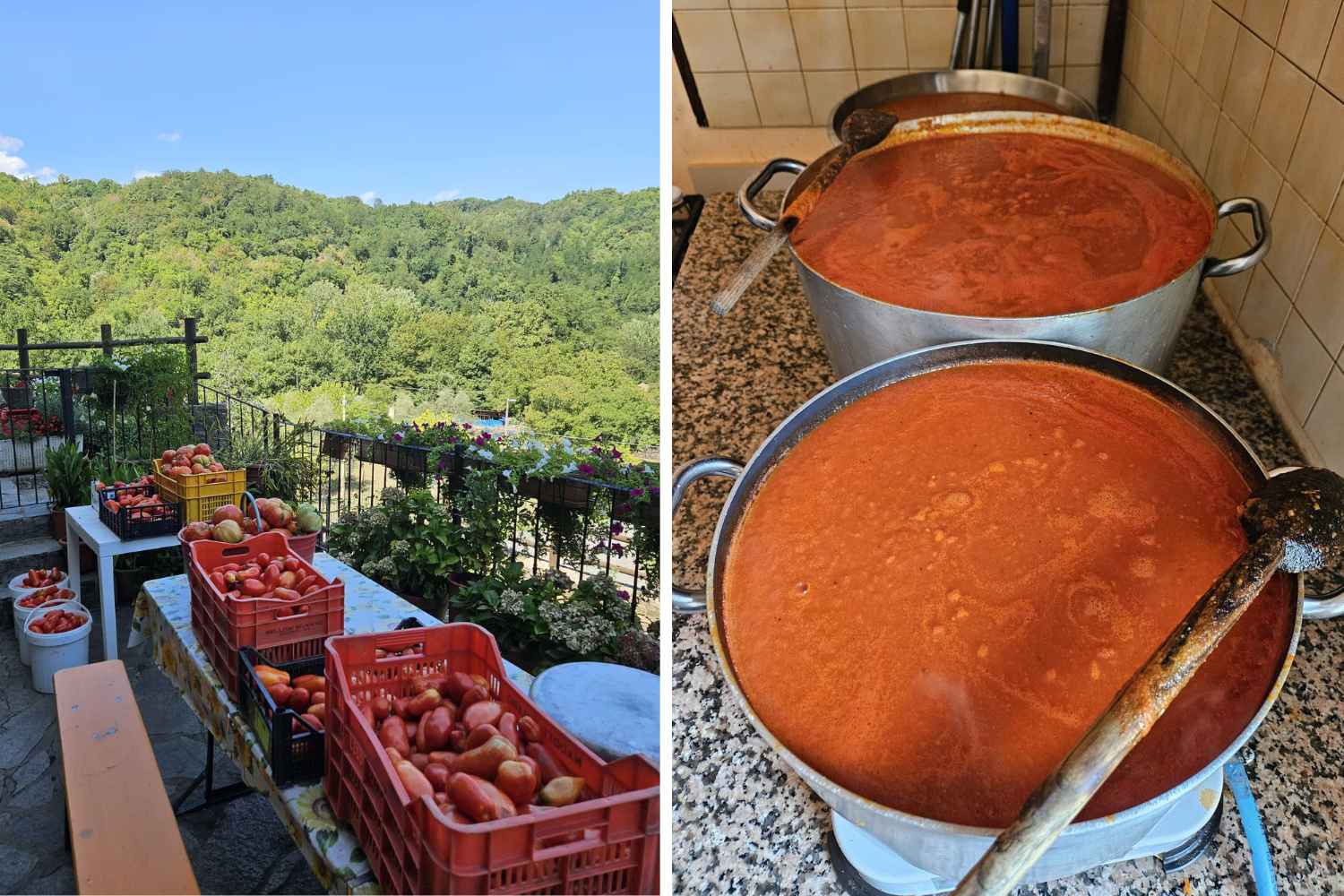
These days, in many Italian homes, the kitchen is changing its face. The boxes of ripe tomatoes arrive, the pots become larger, the scent of the tomato invades the rooms and what might seem like a simple preparation turns into a small family ritual.
Homemade tomato puree is one of the traditions that best describes the Italian summer, an event that for many is repeated every year and which often involves several generations, between handed down gestures and utensils, family recipes and perhaps some discussion on the best method to use.
It’s also a way to preserve a little of the summer when the tomato season is over, bringing the flavor to our tables in the following months. But precisely because puree is a preserve destined to remain in the pantry for a long time, it is not enough to rely on tradition or what has always been done at home.
From the choice of tomatoes to cooking, from the hygiene of containers to pasteurization, there are some steps that deserve particular attention, also to reduce the risk of contamination and botulism. So let’s see 10 mistakes not to make when preparing tomato puree at home.
Use tomatoes that are overripe, bruised or with damaged parts
The safety of the puree begins long before turning on the stove, directly from the choice of tomatoes. For a preserve destined to remain in the pantry for a long time, it is important to start from healthy, intact and good quality raw materials.
It is therefore better to avoid tomatoes with mould, rot, deep dents or visibly altered parts. It is not enough to eliminate the area that appears damaged with the knife and use the rest; when a vegetable shows significant signs of deterioration it is preferable not to use it for a preserve.
The degree of maturation also matters. The tomato must be ripe and tasty, but not mushy or spoiled. Furthermore, once purchased or collected, it would be better not to leave them for days before processing them because the fresher the raw material, the better.
Wash tomatoes little and neglect the hygiene of hands and utensils
Once brought into the kitchen, the tomatoes should be washed carefully under running water, especially if they have soil residues. But it’s not just vegetables that need to be cleaned.
Before starting it is important to also take care of your hands, work surface, knives, pots, food mill, ladles and all the tools that will come into contact with the puree. An apparently clean surface is not necessarily sufficient when preparing food that will then have to be stored for months.
The Ministry of Health, in its indications on domestic food safety, recommends washing hands frequently during preparation and cleaning surfaces and materials that come into contact with food.
Even tea towels and sponges deserve attention, they should not become a source of contamination while we are trying to prepare a safe preserve.
It is a step that may seem trivial, especially when preparing large quantities of tomatoes and the kitchen is already in full swing. But the safety of the puree also begins with the cleanliness of the environment in which it is prepared.
Thinking that all tomatoes have the same acidity
The tomato is naturally acidic and this characteristic makes tomato preserves less favorable to the development of Clostridium botulinum compared to other domestic preserves. But not all tomatoes have exactly the same acidity.
The ISS guidelines report that the pH of tomatoes can vary approximately from 3.9 to 4.6 and indicate that more acidic cultivars with a pH lower than 4.3 are preferable for the preparation of puree. If the tomatoes are not sufficiently acidic, the same guidelines provide for the possibility of acidifying the preparation with lemon juice or citric acid.
Why is this so important? Because botulinum finds favorable conditions especially in low-acid foods. The ISS indicates pH below 4.6 as one of the main conditions that prevent the growth of botulinum toxin-producing clostridia.
Add ingredients without considering that you are changing the preserves
The tomato puree can be left plain or enriched with onion, garlic, celery, carrot, chilli pepper and other ingredients. But if the goal is to prepare a preserve to be kept at room temperature for months, it is not a good idea to freely modify the recipe without considering that each ingredient can change the characteristics of the final product.
It’s one thing to prepare a simple tomato puree, it’s another to put a ready-made sauce in a jar with different vegetables and perhaps meat or fish.
The official indications underline this difference: the addition of meat or fish to tomato, for example, can increase the pH of the preparation and make it more favorable to the proliferation of botulinum. For this reason, the Ministry of Health does not recommend the home preparation of gravies and sauces to be stored in jars when adequate treatment cannot be guaranteed.
For a home preserve intended for the pantry, therefore, it is better not to improvise. If you want to prepare a sauce with many ingredients, it is preferable to follow a recipe specifically designed for preservation or choose a different method, such as freezing.
Cook the tomatoes over too high a heat
We arrive at the phase that everyone associates with the preparation of the puree: the large pot on the fire. Here haste can be a bad advisor. Too high a flame can easily cause the tomatoes to stick to the bottom of the pan, especially when the mass is very dense and is stirred little. The result is a paste with a burnt hint, altered taste and caramelized or charred parts which inevitably end up compromising the result.
It is therefore better to proceed with regular cooking, stirring frequently and using a sufficiently large pan. The tomatoes must gradually soften until they reach the consistency necessary to be pureed.
There is no need to turn the preparation into a race against time, the puree is one of those preserves where patience is part of the recipe.
Aggressive cooking, among other things, does not automatically make the preserve safer as one might think. Ultimate safety depends on a combination of factors, not simply whether the tomatoes have been boiled for a long time.
Use dirty, damaged jars or inappropriate caps
After hours spent choosing, washing, cooking and pureeing the tomatoes, it would be a shame to compromise everything just when it’s time to put them in pots.
The containers must be clean, intact and suitable for storing food. A chipped, cracked or damaged jar should not be used, just as you should not rely on closure systems that no longer guarantee a good seal.
Particular attention should be paid to caps: an old, deformed or damaged closure can compromise the airtightness of the container.
Overfilling the jars or dirtying the edges
Even the moment when the puree ends up in the jars requires some attention. One of the most common mistakes is filling containers to the brim, leaving too little space between the product and the lid. However, it is important to respect the head space required by the procedure used, because during the heat treatment the contents can increase in volume.
The edge of the jar must also remain perfectly clean. If during potting a few drops of puree remain on the surface on which the lid will adhere, the closure may not be correct and the airtightness of the container may be compromised.
For this reason it is useful to use a funnel suitable for preserves and, before closing the jar, carefully check the edge, removing any tomato residues with a clean material.
Correct closure is essential for successful conservation and must also be checked after heat treatment. Potting should therefore be considered as a real step in the preparation, not as the last gesture to be done quickly after hours spent at the stove.
Skip or improvise pasteurization
This is probably one of the most important mistakes to avoid. Once the containers have been filled and closed, the puree should not simply be left to cool and then transferred to the pantry. For tomato preserves, the ISS guidelines provide for a pasteurization treatment, with methods and times that also depend on the size of the containers.
For example, for the puree contained in one-litre containers, a treatment of at least 40 minutes is required, while for half-litre containers at least 35 minutes are indicated, calculated from the moment of boiling of the water, in the case of the procedure described by the guidelines.
However, it does not mean that these numbers can be applied without distinction to any container, quantity or procedure. It is important to follow an official procedure that is consistent with the method used, without shortening the time or inventing a different system.
Pasteurization is in fact one of the steps through which we contribute to making the preserve safer and more stable over time.
Thinking that vacuum packing automatically means “safe preservation”
When the lid makes that characteristic “click” and remains slightly curved inwards, you naturally think: perfect, the jar is safe. Vacuum packing is certainly important, but it is not an absolute guarantee of safety.
After pasteurization, the ISS recommends waiting 12-24 hours, when the containers are completely cooled, and checking the airtightness of the closure. The cap should appear slightly concave and, when pressed in the centre, should not produce the characteristic “click clack”.
This check, however, serves to verify that the container has maintained a correct closure but does not allow one to establish on its own that the preserve is microbiologically safe.
This is why you should never think that “it made a vacuum, so I can rest assured” and skip the other preparation steps.
Keep or taste a puree that presents anomalies
The last mistake is perhaps the one that needs to be remembered most of all: never taste a suspect preserve to understand if it is still good.
Before bringing the puree to the table, you need to look at the container and the product. A jar that has lost its vacuum, has a swollen lid, leaks, mold, bubbles, gas, unusual odors, or noticeable changes in color or consistency should be treated with extreme caution.
And above all you don’t need to do the classic teaspoon test, tasting a little.
The Ministry of Health recalls that botulinum is particularly insidious precisely because the presence of the toxin is not necessarily recognizable from the characteristics of the food.
Even a tomato puree, despite being an acidic preserve and therefore generally less favorable to the development of botulinum compared to other domestic preparations, must be prepared carefully. The objective is not to give up the tradition of homemade puree, but to make it following procedures that combine quality, taste and safety.
Sources: Ministry of Health / ISS
