
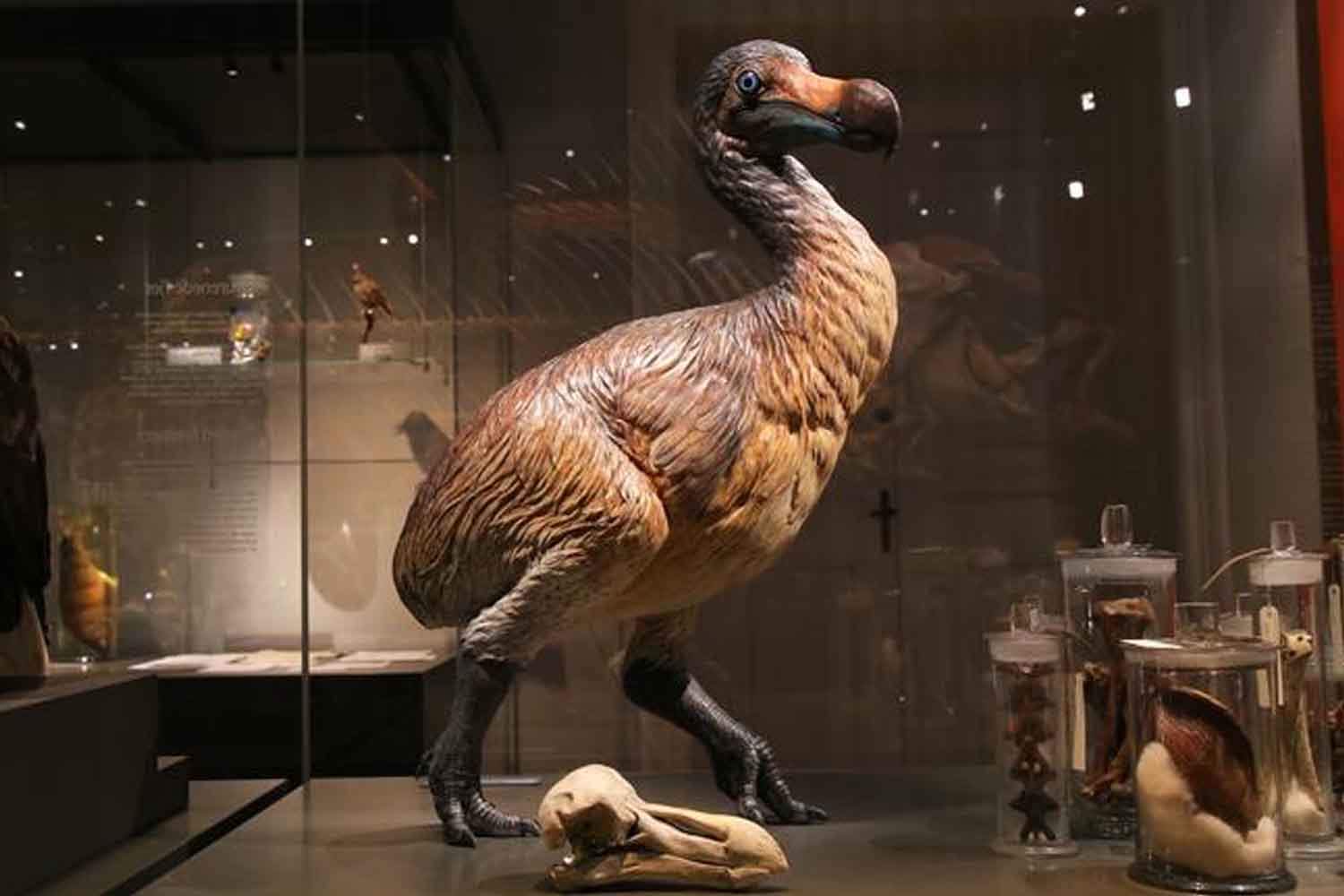
Three dodo skulls end up under a CT scan and the old insult comes out a little bruised. The dodo (Raphus cucullatus), transformed over the centuries into the clumsy, dumb bird almost predestined to extinction, in fact shows no signs of a lower cognitive capacity than other pigeons and doves. Its skull rather tells something much more interesting: an animal with a very unusual sensory system, perhaps active even in the hours of weakest light and capable of relying on smell, hearing and beak more than we imagined.
This is what emerges from a study published in Zoological Journal of the Linnean Societycoordinated by Sara Citron of the University of Lethbridge, Canada. The researchers used CT scans to digitally reconstruct the insides of the skulls and compare dodos and Rodrigues solitaire (Pezophaps solitaria) with living pigeons and doves. The dataset included 57 specimens, including three dodo skulls and four solitaire skulls. Two of the dodos analyzed are the only complete skulls of the species known today, preserved in Copenhagen and Oxford.
Above all, the “stupid” dodo has a very bad reputation
The research immediately raises an important bar. The brain region that includes most of the structures involved in cognitive processes, the telencephalon, is not proportionally smaller in the dodo compared to the other columbiforms analyzed. The authors write that the idea of reduced cognitive capacity compared to pigeons and doves currently lacks empirical support.
This does not suddenly transform the dodo into the puzzle-solving crow of recent prehistory. The study does not measure intelligence with behavioral tests, which were impossible for an animal that disappeared at the end of the seventeenth century. He says something more limited: the cognitive inferiority that we have stuck on him for centuries does not emerge from the brain that can be reconstructed through the skull.
The reputation of being a silly animal could have much simpler roots. The dodo lived on Mauritius, in an island environment where large predatory mammals had been lacking for millions of years. The lack of fear of humans observed in historical accounts would therefore have been a perfectly sensible adaptation in that world. Then the humans arrived. Trust, at that point, abruptly stopped being a good evolutionary strategy.
Big eyes, tiny optic lobes: the strangest detail is in the sight
The biggest surprise comes by putting together two features that almost seem to argue with each other. Compared to the Nicobar pigeon (Caloenas nicobarica), its closest living relative, the dodo’s eye sockets were about 9% larger in relation to the size of its skull. Yet the optic lobes were more than three and a half times smaller than in the same pigeon.
Relatively large eyes can increase sensitivity to light. A very reduced optical roof, however, indicates a different organization of visual processing: this structure contributes, among other things, to processing movement, brightness, attention and orientation towards stimuli.
Comparison with other birds offers a clue. Marked reductions in this brain region are also observed in species adapted to low light conditions and have been used to reconstruct crepuscular or nocturnal habits in some extinct birds.
Hence the authors’ hypothesis: the dodo may not have been exclusively diurnal and may have continued to move or look for food at dawn and dusk. It would have been a plausible way to avoid the hottest hours of Mauritius and, perhaps, encounter fewer competitors over food resources. However, the researchers themselves define this reconstruction as highly speculative: we can obtain clues from the skull, not the daily diary of a seventeenth-century dodo.
Smell and hearing also reveal an animal that is not very “cartoon-like”
Smell remains even more difficult to read. The dodo’s olfactory bulbs appear relatively developed and could indicate a greater weight of odors in the search for food or in interactions with other individuals. The problem lies in the sample: in the two skulls sufficiently intact for this comparison the dimensions of the bulbs differ quite a lot. The authors therefore ask for other specimens before transforming the possible good nose into a certain characteristic of the species.
Then there is the beak. The branch of the trigeminal nerve that collects tactile information from the upper part is more developed than expected. It could simply have to do with the enormous surface area of the dodo’s beak, or it could indicate a greater amount of information gathered through contact. Here too, caution is mandatory: the preserved bones do not allow us to reconstruct all the receptors present in the soft tissues.
And finally the ears, or rather what remains of them written in the bone. The dodo’s cochlear duct was proportionally longer than that of the Nicobar pigeon, and the models used in the study estimated a frequency of maximum sensitivity around 0.7 kHz, unusually low for a bird. The authors consider it plausible that dodo and solitaire produced mainly low-frequency sounds, also compatible with their large body size. Estimates of the entire hearing range, however, are unrealistic and the work explicitly points this out: models built on living birds start to creak when they are pushed that far.
What the skull can tell, and what remains in the seventeenth century
The dodo thus continues to do something that it has done very well for four centuries: forcing us to rebuild it with tiny pieces. There are no preserved skins, contemporary descriptions are few and often inaccurate, and the animal’s behavior remains largely unattainable. High-resolution scans at least allow us to observe the imprint left by the brain inside the skull without damaging very rare findings.
The same authors indicate the next path: other skulls, when available, and above all genetic analyses. Genes involved in vision could clarify whether eyes were truly adapted to dim light conditions; those of the olfactory receptors could say something more about the importance of odors in his daily life.
For now, it remains an animal with relatively large eyes, strange visual processing, possibly developed olfactory abilities, and perhaps a lower voice than we might imagine. Of the dumb dodo, however, the skull continues to stubbornly fail to provide evidence. A reputation that lasted four centuries and was built, it seems, with much less material than the remaining bones.
