
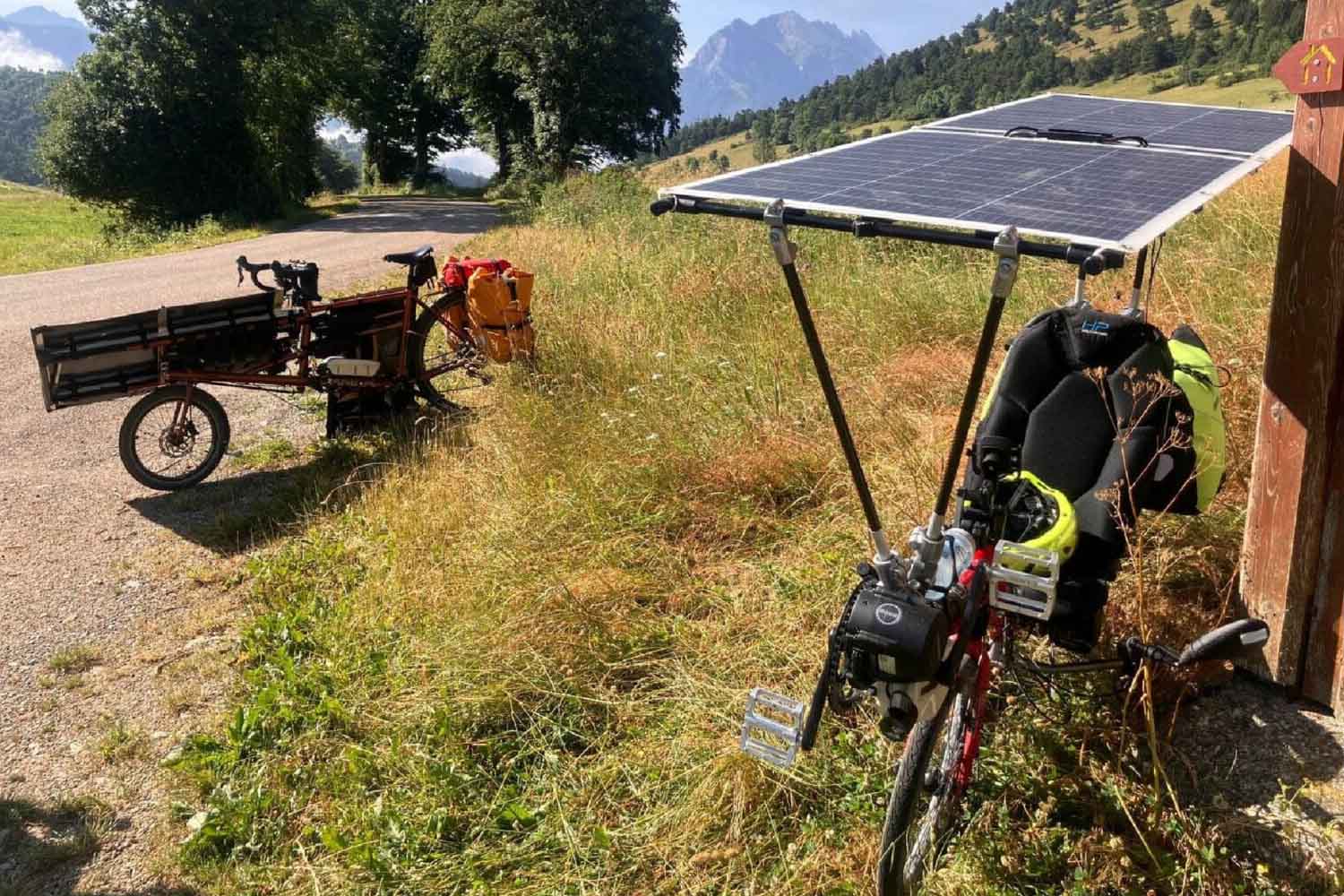
Two 100W panels fixed above the front rack, a 250W central motor and two 36V batteries. With this configuration Shawn Ryan traveled approximately 1,300 kilometers in France during the 2026 Sun Trip, also tackling the large Alpine passes. The bike, fully loaded with camping gear and photography supplies, weighed 61 kilos. The least romantic part of the trip is that the sun didn’t do everything: during the entire trip Ryan had to connect to the electricity grid twice.
The result remains quite interesting, especially because the one that Ryan describes in the complete account of the construction of his solar bike was born from a normal Omnium cargo bike modified in a few weeks. The Sun Trip Auvergne-Rhône-Alpes 2026, which started from Lyon on 22 June and ended in Albertville on 4 July, took 33 participants from six countries along an official route of around 1,400 kilometres, with stops on the Galibier and Iseran. Ryan traveled about 1,300 with his prototype.
Three panels were too many, so he left two
The initial design featured three 100W solar panels mounted on the front floor, for a total power rating of 300W. On paper, it looked better. A little less on the road: during the tests the bike had become too long and awkward to manoeuvre, especially in traffic and in narrow spaces.
Ryan therefore left only two panels fixed, for 200 W, taking the third with him. During stops he took it out, pointed it towards the sun and used it as an additional charger. More photovoltaic surface helps, in short, until the moment when you also need to be able to turn the corner.
The cargo bike lent itself well to the experiment due to its large front platform. Ryan points out, however, that you don’t necessarily need that model: a sturdy bike can work, as long as there is a secure system for attaching the panels. A trailer offers even more available surface area, paying something in terms of space and handling.
How solar energy gets to the battery
The electrical part is simpler than the appearance of the bike suggests. Ryan avoided the panel-inverter-charger chain, which would involve several conversions and additional components. Its scheme is much shorter: solar panels, boost MPPT regulator, battery.
The component used is a 41.7 V Genasun GVB-8, designed to increase the voltage coming from the panels and adapt it to charging 36 V lithium batteries. The motor is a central 250 W Tongsheng TSDZ2B. While driving, the panels power the system while the motor takes energy from the battery. If they produce less than what is needed at that moment, the battery provides the difference; when demand drops, available energy can come back to charge it.
But here the cheerful DIY part ends. Ryan recommends first checking with the manufacturer that the battery can be charged through the connection you choose and, importantly, that the system allows charging while the engine is running. Not all integrated systems allow this. Protections and fuses must also be sized correctly. Connecting a panel to a random e-bike battery remains a great way to turn a Sunday ride into something a lot less relaxing.
The 200W became 70-100W as he pedaled
The power written on the panel and the power available while moving are two different things. The nominal 200W fitted to the bike generally produced between 70 and 100W while riding, depending on the weather and the position of the sun. When Ryan stopped and also placed the third panel in the best direction, the typical output rose to about 150W.
The most interesting test came during a day of around 130 kilometers on very hilly terrain. Ryan reset the meter connected to the MPPT regulator output before setting off: at the end of the stage he had recorded 985 Wh of solar energy injected into the system, equal to approximately 7.58 Wh per kilometre.
The battery was full in the morning and, after a final solar charge in the evening, it was back to basically the same level. Meanwhile the 61 kilo cargo bike had been traveling at an average of 21-22 km/h. The sun therefore did not push a 250W motor alone: it continuously eased the load on the battery, while Ryan naturally continued to pedal. It is the sum of those tens of watts collected for hours that makes the difference.
At 41 °C even the battery said enough
The margin, however, was small. Ryan himself considers 200W close to the minimum necessary to tackle similar distances and height differences. On some days the batteries were unable to completely recover the energy consumed and twice, in the approximately 1,300 kilometers in total, an electrical socket was needed.
Then came the heat wave. With temperatures around 41°C, one of the batteries absorbed enough heat to trigger the internal management system, which temporarily blocked charging to protect the cells. The journey therefore also showed a fairly concrete limit of solar mobility: a lot of sun helps the panels, too much heat can start to create problems for the rest of the electronics.
Ryan now wants to lighten the bike and luggage by about ten kilos, use more efficient and lighter panels, improve engine cooling and better accommodate aerodynamics and luggage. Sun Trip is already preparing a new crossing between Lyon and Guangzhou, China, for 2028. The distance will be on a completely different scale.
For the Alpine prototype, meanwhile, the most interesting test has already arrived: 200 W fixed in front of a bicycle does not replace a battery or eliminate climbs, clouds and heat. But they can gather enough energy, hour after hour, to carry a heavy cargo bike much further from the power outlet. Twice, out of 1,300 kilometres, the grip still had the last word.
