
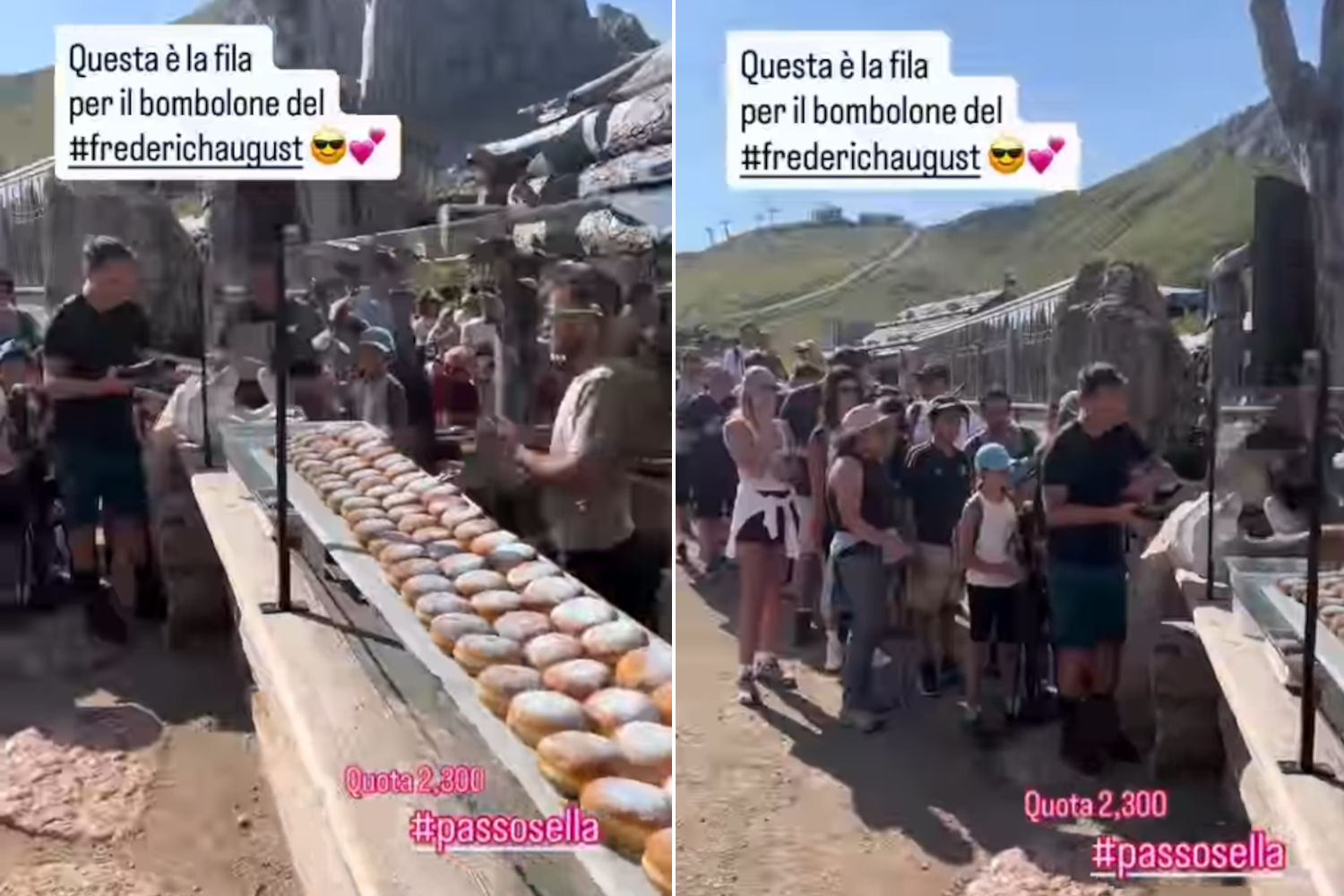
The altitude rises, the air thins, but the silence of the peaks disappears under the buzz of a human coil that patiently awaits its turn. At the Friedrich August refuge, nestled at over two thousand meters between Col Rodella and Passo Sella in Val di Fassa, people don’t line up to contemplate a sunset or breathe in the solitude of the pastures, but rather to get their teeth into a cream krapfen.
This collective madness was immortalized by a video released by Tiziano Tito HD Panisi’s Instagram profile. The mountain, historically understood as a space irreducible to human frenzy, undergoes a radical metamorphosis: it is packaged, branded and served on a silver platter like any theme park attraction.
View this post on Instagram
Algorithm tourism and domesticated nature
The phenomenon goes far beyond the gluttony of those queuing. It responds to the iron laws of algorithmic tourism, where the choice of an excursion does not arise from a geographical or introspective impulse, but from a TikTok feed or an Instagram reel designed to maximize attention span. In this perverse mechanism, the Dolomites cease to be a fragile and wild ecosystem to be approached with respect and discretion.
Instead they become a scenic backdrop, a highly photogenic and sweetened backdrop, functional solely to the social validation of the visitor. You no longer travel to explore an authentic territory, but to collect a visual trophy and be able to tell your followers that you have been in the exact spot suggested by the platform.
View this post on Instagram
The transformation of the landscape into a consumer product
This spectacularization of nature raises urgent questions about the future of the Alpine valleys and the profound meaning of environmental protection. When tourism promotion policies and marketing tools push indiscriminate masses towards a single panoramic point, the environment is subjected to unsustainable pressure.
The real risk is the taming of the peaks: biodiversity, erosion of paths and high-altitude traffic are systematically ignored in the name of immediate profit and engagement. Converting the sacredness of the peaks into a catalog of “not to be missed” products means mortifying the very essence of nature, suffocating its wild dimension under a blanket of mass homologation.
The loss of the unexpected and the hunt for the perfect postcard
In this pre-packaged scenario, the real defeat is the death of the journey understood as adventure, discovery and the unexpected. Those who set out with a smartphone in their hand desperately try to superimpose their real experience onto the ideal image already seen and stored on the display. Direct visual contact with the valley is constantly filtered by the camera, emptying the present moment of its unrepeatable magic. Thus we all find ourselves lined up along the same path, taking the same shot and repeating the same gestures. The landscape is deprived of its mystery and the tourist is deprived of the ability to be amazed when faced with the unexpected.
Rediscover the sense of limits to save the peaks
The urgent need is not to demonize those who give in to the temptation of tasting a donut at altitude, but to decisively redefine our relationship with the mountains. Loving nature means accepting its roughness, obstacles, silence and, above all, not being subject to the logic of impulse consumption. It is necessary to restore the mountain territories to their wild dignity, freeing them from the obligation of having to please social algorithms at all costs. Only by rediscovering the slowness, the effort of the climb and the charm of exploration outside the routes traced by virtual trends, will it be possible to safeguard what makes the Alpine environment truly unique.
