
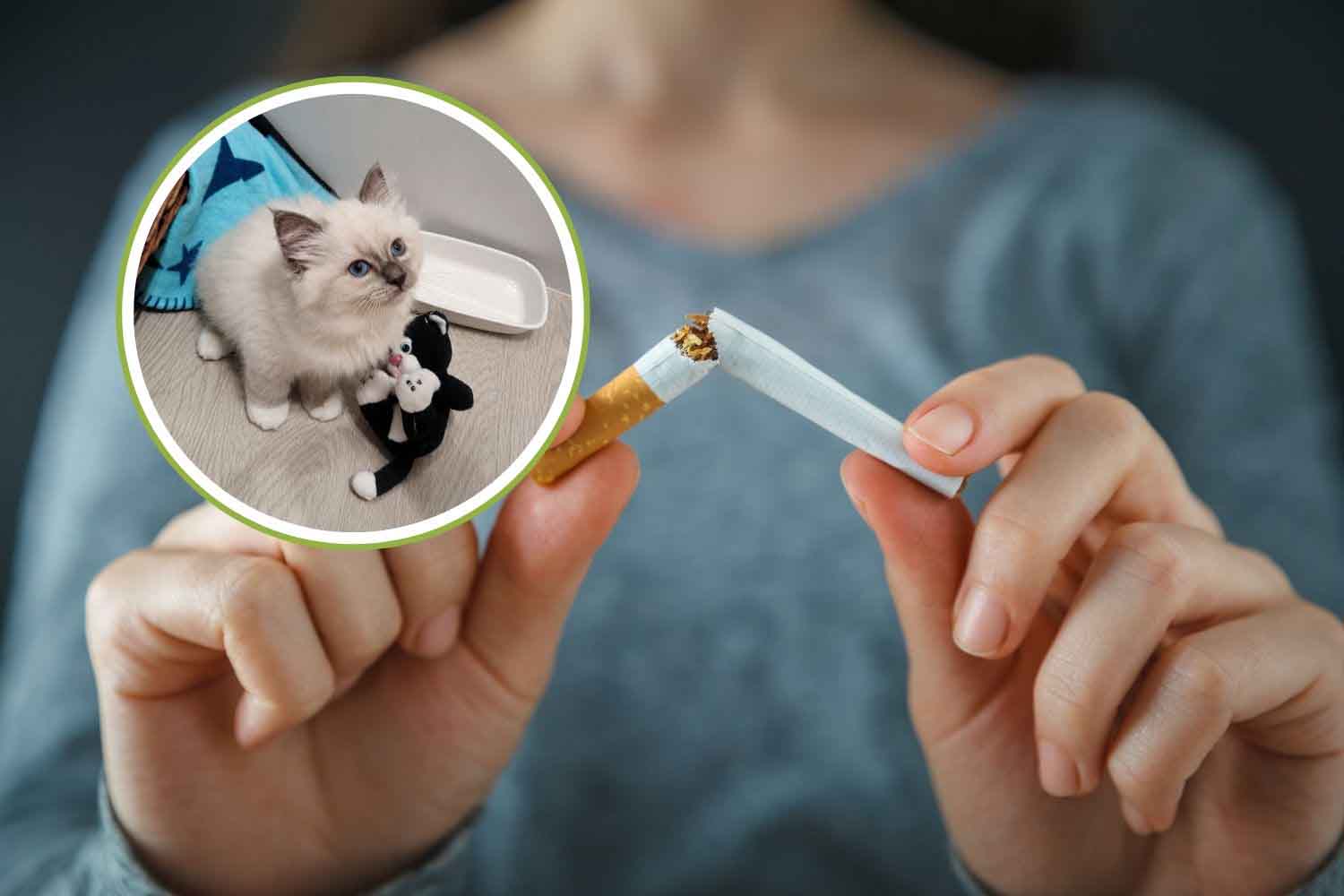
I had a lit cigarette in my hand and a tiny cat in front of me. Romeo looked at me with those blue eyes of a creature who had just landed on Earth, still too small to understand the world and already cat enough to judge it. He was there, in the middle of the house, with the air of someone who had taken possession of every available centimeter without signing contracts, paying mortgages or asking permission. I took a puff, then noticed the stench.
Before it was just smoke. One thing of mine. A habit, an automatic gesture, a kind of nervous punctuation between one thought and another. From that moment it became something that I was imposing on a living being who weighed less than a shopping bag and had no possibility of saying to me: “Sorry, could you avoid turning the air into a condominium ashtray?”. Here, I stopped like this: with a ball of fur that looked at me as if I had just committed a crime against feline decorum.
A house full of smoke
In 2011 I was twenty-three years old and had moved in together. The house was small, about forty square meters: bedroom, kitchen, bathroom. Ground floor. No balcony, no garden, no external vent. An apartment where if you fried a courgette the smell remained permanently present until the next day, let alone the smoke.
I smoked seventeen cigarettes a day. My ex-husband smoked too. The mathematics is simple, the scene a little less so: two people, a tiny house, windows open when necessary, cigarettes lit as if the air had to make do. When you’re in your twenties, your body feels like an illegal condominium: you do what you want with it and you think it will hold up. Smoking is bad for you, you know. But it remains an abstract thing. The future, that convenient landfill where we throw away everything we don’t want to look at today.
Then one day we found a newborn kitten. He still had the umbilical cord attached. A tiny, fragile thing, almost impossible to handle without feeling like you’re breaking it. I called him Leo, even though I didn’t even know if he was a boy or a girl. There are times when you give a name because you need to believe that that creature already has a place in the world, even when the world seems intent on spitting it out.
We brought him home and tried to save him. Milk, attention, attempts, anxiety, that ridiculous and stubborn hope that lights up when faced with small beings. As soon as I saw him in there, I stopped smoking in the house. It came naturally to me. The thought came clean, almost brutal: I might not care enough about myself, but I was hurting him. So I went out. Then I went out less and less. Then I bought fewer and fewer cigarettes.
Leo died after nine days. He stopped eating, we tried to do everything, it wasn’t enough. This also happens with newborn animals: you delude yourself that you can win against fragility just because you put love into it, and instead love sometimes stays there, with the bottle in your hand, with no one to feed. After that loss, I went back to smoking. A little, a lot, enough. The cigarette returned through the ajar door that the pain had left open. But he was no longer innocent.
Then Romeo arrived
Romeo arrived shortly after, from an amateur kennel. They entrusted it to me, rather than selling it. He was less than three months old, with blue eyes, light fur, that face of both promise and threat that cats have when they are puppies: they look like stuffed animals, then in three days they explain to you the concept of private property applied to the sofa, the bed, your face and possibly your soul. I lit a cigarette. Automatic gesture. He looked up.
Now, anyone who lives with a cat knows it: cats don’t look, they pass judgment. Even when they are ten weeks old and still tripping over their whiskers, they can stare at you with the authority of an offended notary. Romeo looked at me like that. A mixture of disgust, curiosity and “is this the premium air you offer me in this establishment?”. It made me laugh, sure. Then it made me think.
©GreenMe
Because at that point the issue stopped being about my health, my willpower, my eventual death with a tragic soundtrack and relatives around saying “we told them”. It was about him: his little lungs, his growing body. The fact that a cat lives a few centimeters from the floor, licks its fur, sleeps on fabrics, spends the day inside surfaces that we believe are clean only because we opened a window for ten minutes.
That feeling today also has a concrete basis: according to the FDA, second-hand smoke and third-hand smoke are also harmful to pets. The second remains on skin, clothes, furniture, carpets and fur. In cats the matter becomes even more treacherous: they clean themselves by licking, so what falls on their coat can end up in their mouth.
And we’re talking about serious risks. A study published in the American Journal of Epidemiology observed an association between exposure to household smoke and increased risk of malignant lymphoma in cats. At the time, I didn’t know all this precisely. I felt it in a much cruder and perhaps more effective way: in my head, I was “smoking” Romy. And then I stopped.
The nervousness had to come out somewhere
Quitting smoking only seems romantic when you talk about it later. As it happens, it’s a war of nerves with yourself, with your mouth, with your hands, with downtime, with coffee, with the end of dinner, with the phone, with waiting, with everything that’s ever had a cigarette next to you.
I was also afraid of moving everything onto food. I knew quite well my tendency to fill the gaps with something, and the refrigerator seemed like an overly willing accomplice. So I looked for another outlet and found it in spinning. Pedaling while standing still, in a room, sweating as if you were escaping from a destiny written by a sadistic personal trainer. Perfect.
There is a basis here too. The CDC recommends keeping busy and staying active when smoking cravings hit. The logic is very simple: moving the body helps to shift attention, release tension and get through those minutes in which the head asks for nicotine as if it were asking for oxygen.
For others, it may help to keep their mouth busy: water, flavored water, sugar-free gum, something to munch on without turning nervousness into a permanent move into the pantry. NHS Inform also suggests, in times of abstinence, to drink water, exercise and keep busy.
A small thing
The cigarette took up space. Spinning took up another one. Romeo took care of everything else. It was growing. It destroyed. He was asleep. He was looking at me. It slipped in where it shouldn’t. He was taking the house that, technically, would have been mine. I still didn’t smoke. The funny thing is, I’ve never felt like a hero. I have met people who say they stopped smoking as if they had climbed Everest in flip flops. I was just afraid of hurting a cat. But it worked more than any talk about health, more than the images on the packages, more than the statistics, more than the remote thought of the disease.
Maybe because I have often been a terrible administrator with myself. I put it off, I treated the body as something that could wait, I pretended that the bill always reached someone else. Then I loved a puppy and saw him breathing in the same room as me. There I realized that the air wasn’t just mine.
It’s been fifteen years since cats entered my life. Romy is no longer that tiny wad with the blue eyes of a sentence. Today the house is bigger, there is also a new partner, and the hierarchy still remains very clear: Romy is in charge, we organize ourselves around it. He also conquered those who arrived later, with the normal colonial efficiency of senior cats.
I haven’t smoked since then. No pills, no patches, no motivational plan. Only a cat that entered the house and an ashtray that, at a certain point, stopped making sense. Romeo didn’t save me by talking: he saved me by breathing next to me.
You might also be interested in:
