
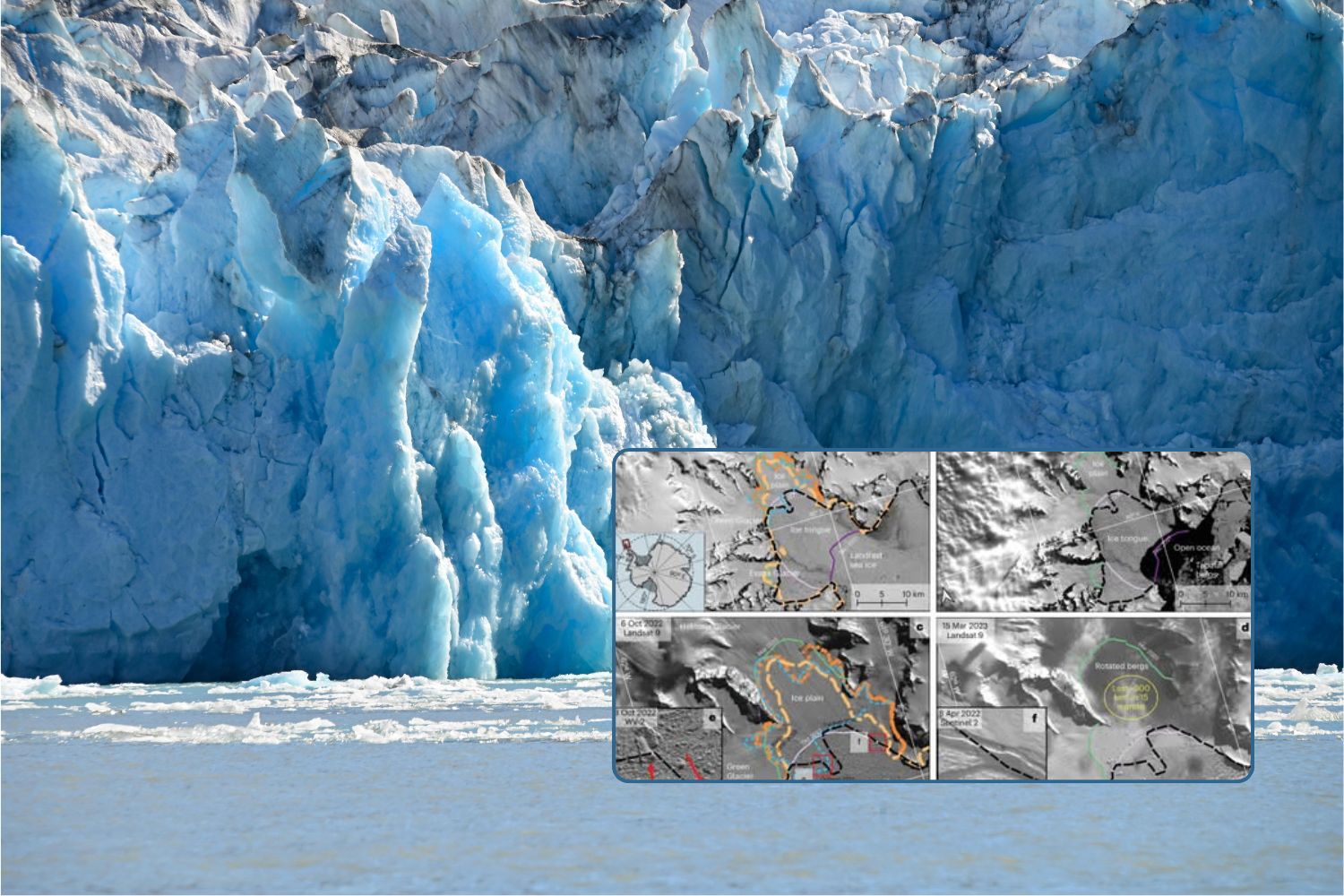
In Antarctica, on the Antarctic Peninsula, the glacier Hektoria it is experiencing a rapid and dramatic decline: between November and December 2022 it retreated by 8 kilometers, losing about half its mass. Overall, between 2022 and 2023, the retreat reached 25 kilometers, the fastest ever documented in modern history.
This was revealed by a study conducted by researchers at Cooperative Institute for Research in Environmental Science (CIRES) of the University of Colorado Boulder – published in the journal Nature Geoscience – which calculate a retreat rate ten times higher than that normally observed in glaciers anchored to the bedrock.
When we flew over the area, I couldn’t believe the enormity of the collapse,” said Naomi Ochwat, lead author of the research. “Seeing firsthand the absence of ice where it previously stretched for kilometers was shocking.
The Hektoria glacier: a gigantic, rapidly collapsing tongue of ice
The Hektoria glacier covers an area of approximately 295 km², similar to that of a large city. It is a tidal glacier, which rests on the continent but extends into the sea with a long tongue of floating ice. Its retreat, however, is not just due to global warming.
In fact, the researchers discovered that the main cause of the collapse was the conformation of the land on which the glacier rests, combined with a sudden change in marine conditions.
At the beginning of 2022, a strong wave destroyed the band of sea ice that until then stabilized the terminal part of the glacier. At that point, enormous icebergs began to break off one after the other, while sea water infiltrated under the glacial tongue, lifting and fracturing it.
Within a few weeks, the structure collapsed, retreating at ten times the speed of any other glacier so far.
An alarm signal for the entire planet
Needless to say, the Hektoria case is far from isolated. Many other Antarctic glaciers rest on submerged rock platforms and could react in the same way if ocean and temperature conditions change rapidly. The main concern is that these sudden collapses contribute to sea level rise, putting coasts and cities around the world at risk.
For this reason, scientists are calling for intensified satellite monitoring and field studies to identify the most vulnerable glaciers and predict similar events before it is too late.
Even though Hektoria is located in one of the most remote places on the planet, its fate concerns us all. The rapid retreat of Antarctic ice is a clear signal: the fragile balance of our climate can change suddenly.
What happens down there, among the icy winds and thousand-year-old ice, will end up influencing us too – from the tides to the coasts, from the climate to the seasons.
