
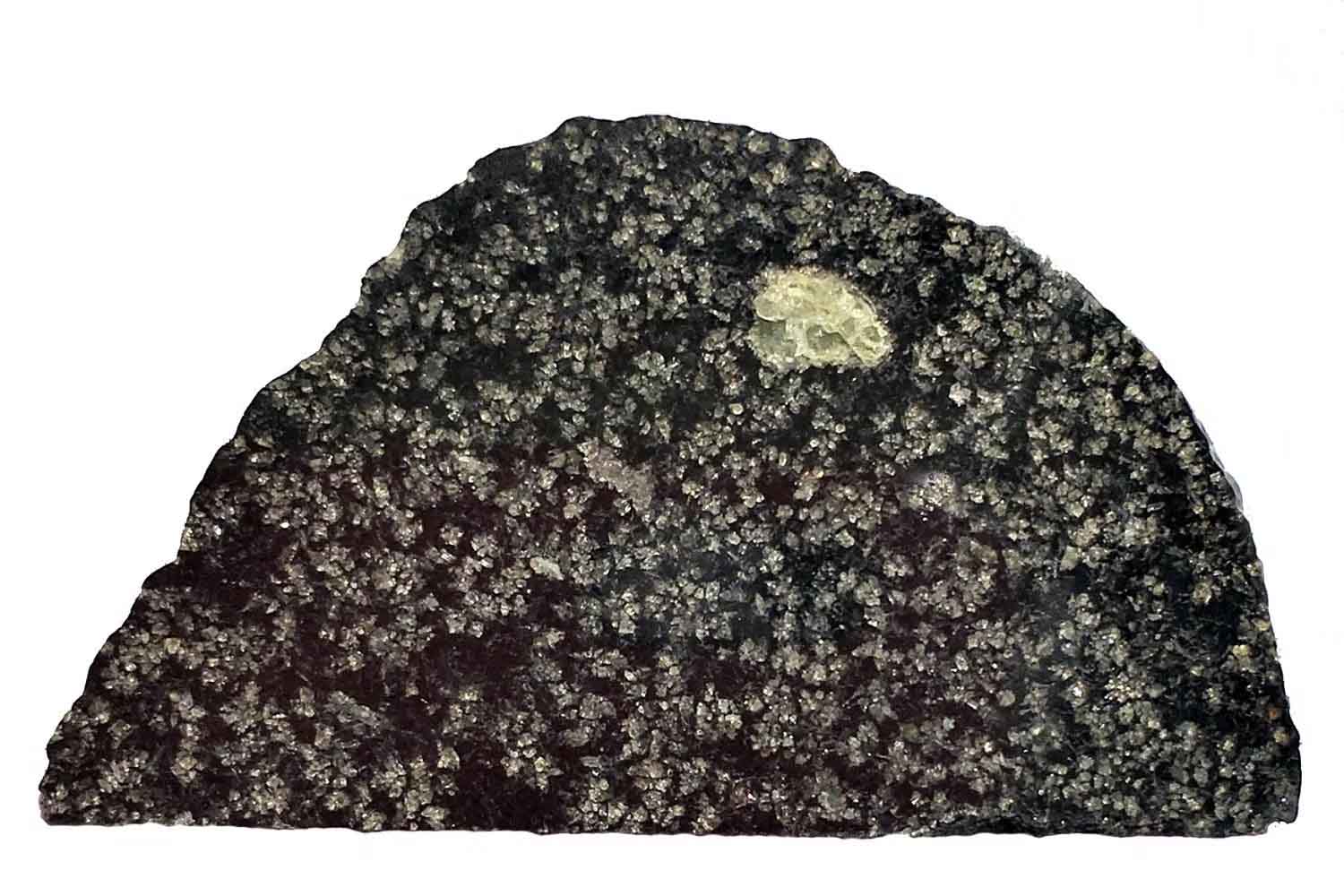
A piece of rock found in the desert may seem like a silent thing. It stands there, dark, broken, collected from the ground like many other fragments that have fallen from the sky. Then someone cuts it, observes it under a microscope, measures the minerals it contains, and that stone begins to tell a story much bigger than its weight. A story that takes us back 4.5 billion years, when the Solar System was still a kind of extremely violent construction site, full of newly formed bodies, collisions, incandescent matter and planets that still had to understand whether they would become real worlds or just debris.
The protagonist of this story is called Northwest Africa 12774often shortened to NWA 12774. It is a meteorite discovered in 2019 in the Sahara desert and, according to a new study published in Earth and Planetary Science Lettersit could be the fragment of an ancient planetary body that disappeared: a protoplanet at least as large as a large dwarf planet and, in the most likely scenario, close in size to the Moon. Researchers speak of a possible direct testimony of a primordial world that orbited the Sun in the early stages of the history of our planetary system, before being destroyed by a catastrophic impact.
A rock out of place
NWA 12774 belongs to the class of angritiextremely rare and precious meteorites for those who study the formation of planets. They are very ancient volcanic rocks, born in the first few million years after the formation of the Sun, when the rocky bodies of the inner Solar System were still taking shape. The rarity already gives the measure of the problem: out of over 80 thousand meteorites recovered on Earth, only 68 are classified as angrites.
For years these rocks have created more than a few headaches. Their chemical composition is different from that of Earth, Mars and other known rocky planets. In particular, they contain little silica, one of the most common components of planetary crusts. Precisely this strangeness had pushed many scholars to imagine a more modest origin: a small asteroid, perhaps with a radius between 100 and 200 kilometers, large enough to produce volcanic rock, small enough to disappear without leaving too many clues.
The Sahara meteorite cracked this reconstruction. Crystals of clinopyroxenea mineral also present in the earth’s crust and mantle. So far nothing so unusual. The decisive detail lies in the aluminum: those crystals contain exceptionally high quantities of it. In planetary geology, a similar signature indicates formation that occurred under enormous pressures, much higher than those that a small asteroid could have generated within itself.
Pressure changes everything
The analyzes reconstructed the conditions necessary to form those crystals. The result is surprising: at least they were needed 17.5 kilobars of pressure. To have a terrestrial comparison, at the bottom of the Mariana Trench, the deepest point of the oceans, the pressure is around 1 kilobar. Here we are therefore talking about a compression more than 17 times higher. A number like that completely shifts the scale of the celestial body the meteorite came from.
A small asteroid, no matter how compact, would have had insufficient internal gravity. To generate that pressure, the original body had to be much more massive. If the crystals had formed at the deepest point theoretically possible, near the boundary between the rocky mantle and the metallic core, the protoplanet would have had a radius of at least 1,000 kilometers. Even so, it would have been about twice the size of Ceres, the largest dwarf planet in the main asteroid belt.
However, there is a detail that makes the scenario even more interesting. The crystals retain sharp edges and delicate chemical structures, elements that would likely have been erased by a long stay in the deeper, hotter regions of a planetary body. This suggests formation at more moderate depths. In that case, to still reach such high pressures, the original body had to be even larger: at least 1,800 kilometer radiusa size comparable to that of the Moon and, in some scenarios, perhaps approaching the scale of Mars.
The missing world
The image that emerges is that of a lost planetor rather of a planetary embryo: one of those worlds under construction that populated the young Solar System and which only partially have survived to this day. Some have grown to become actual planets. Others were absorbed, destroyed, crumbled, transformed into building material for larger bodies.
NWA 12774 could come from there, from a body that followed a different evolutionary path than that of Earth and Mars. Its chemistry tells of a separate path, an alternative planetary recipe, which ended badly before arriving at a stable form. The most suggestive hypothesis is that of a catastrophic impact in the early stages of the Solar System: a collision violent enough to shatter that world and scatter its pieces into space. Some fragments may then have been incorporated into other rocky planets. One, much later, reached Earth.
The strength of this discovery also lies in its disproportion. A fragment recovered in the Sahara opens a window onto a celestial body that disappeared billions of years ago. No surfaces to photograph, no orbits to follow, no craters to map. Just crystals, pressure, aluminum, geochemistry. A kind of mineral autopsy on a world that now exists only in its remains.
Caution remains necessary. Talking about a lost planet is certainly fascinating, but the most correct term remains protoplanet or planetary embryo: a large, differentiated body with a complex internal structure, born when the Solar System was still assembling its pieces. The difference matters, because it avoids turning a scientific discovery into an overly clean space fairy tale. Here the wonder is enough in itself.
The most beautiful part, perhaps, is also the most concrete. There are meteorites preserved in collections and laboratories that have yet to be thoroughly studied. Some may contain other traces of disappeared worlds, other splinters of a planetary genealogy left out of the more orderly stories about the Solar System. The sky, every now and then, drops the leftovers. It’s up to us to understand which table they come from.
