
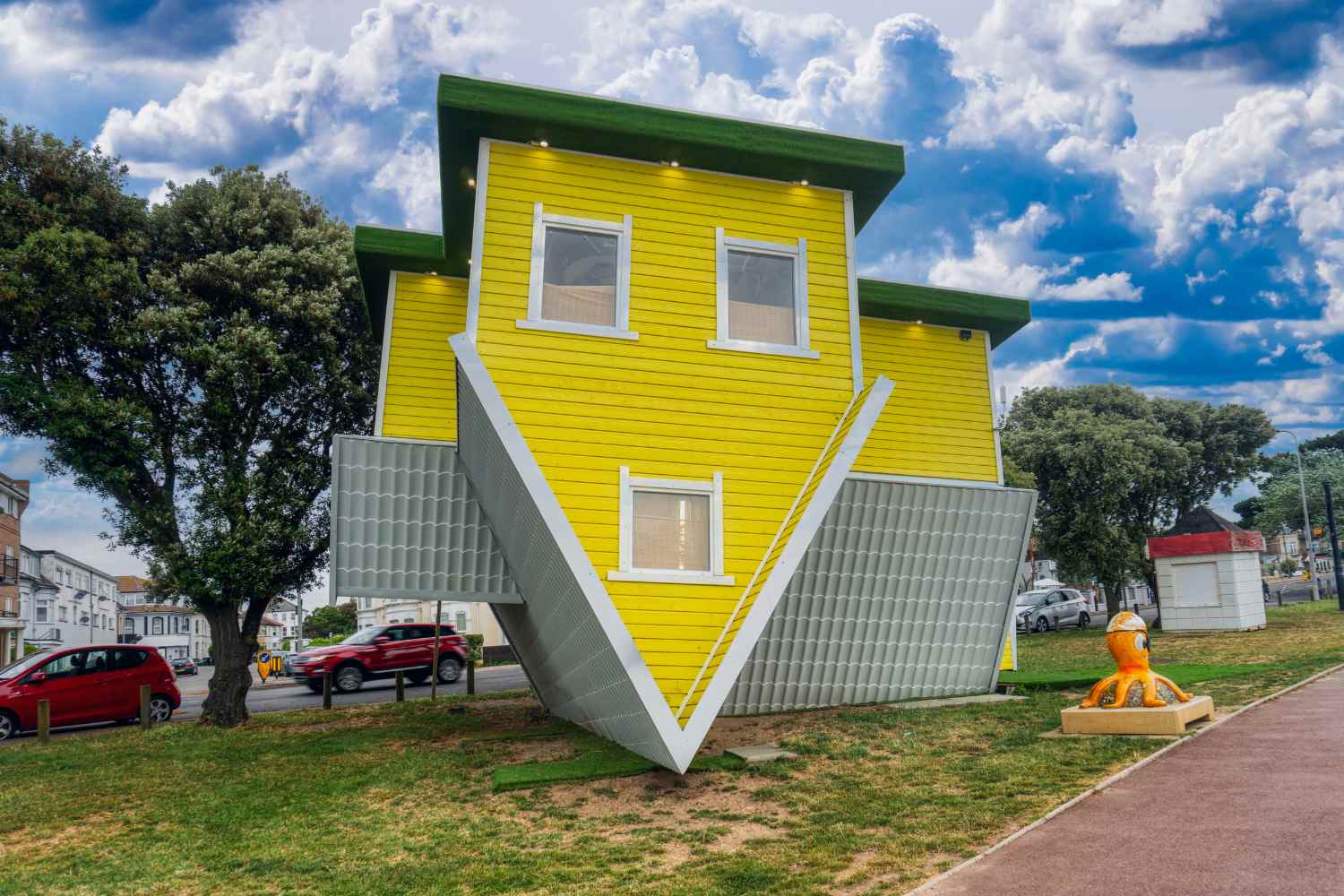
Imagine walking on the streets of a village and finding you in front of a house that challenges every physics law: the roof rests on the ground, the foundations stand up to the sky, and to enter you have to climb up to a window that is located where there should be the floor. It is not a dream or a hallucination: there are really the villages of the houses upside down, and represent one of the most fascinating and surreal architectural phenomena of our time.
When gravity becomes an optional
The inauguration of this strange house was May 12, 2007 in Szymbark, Poland, and the world of alternative architecture has not been the same since then. These constructions are not simple attractions from Luna Park: they are real homes designed with millimeter precision, where each element has been rethought and relocated in a position that challenges our perception of reality.
The first impact is alienating: you find yourself in front of what seems like a mistake of nature, as if a tornado had raised a whole house and then gently reappear it to the ground, but in the wrong way. The feeling of disorientation is immediate and engaging, so much so that many visitors report that they have tried a slight nausea or dizziness in the early stages of the visit.
The house turned upside down
The upside -down house is located in the Kaszuby region (Cassubia or Cascubia), in northern Poland, where many traditions have remained intact, but the phenomenon has quickly spread throughout the continent. Germany hosts “Die Welt Steht Kopf” (the world upside down) in Trassenheide, while other similar creations have sprung up in Austria, England and even overseas, Canada and Colombia.
What makes these buildings really special is not only the external appearance: entering inside, you find yourself in a parallel universe where chandeliers grow from the floor, tables and chairs dangling from the ceiling, and walking becomes a psychedelic experience. The house is not empty inside, but contains a complete furniture, all strictly turned upside down.
More than a simple tourist attraction
Behind the apparent bizarre of these buildings, a deeper message is often hidden. Thanks to an idea of the businessman Daniel Czapiewski, an inverted house was therefore inaugurated, built in 114 days with the aim of attracting tourists and making reflect on the precariousness and instability of the modern world.
The upside -down architecture thus becomes a powerful metaphor: in an era in which certainties seem to falter and traditional reference points are questioned, these houses physically represent our collective disorientation. It is as if the architects had wanted to materialize the feeling of living in a “upside -down” world, where the rules that we were taken for granted no longer are worth.
The art of the impossible
From a technical point of view, building a subsopra house represents a remarkable engineering challenge. In fact, it is not enough to turn a traditional construction upside down: each element must be redesigned to guarantee stability and safety. The foundations, which are normally found underground, must be able to support the weight of the structure from above, while the “roof” that touches the ground must be robust enough to act as a base.
The interiors require even more meticulous work: each furniture, each object, every decorative detail must be firmly fixed to the ceiling, creating the illusion of a world where gravity works on the contrary. The result is an environment that constantly tests our senses and our space perception.
A psychological as well as physical journey
Visiting a Underwide House is not simply a tourist experience: it is a real psychological journey. Our space references are completely subverted, forcing the brain to continually rework visual information. Some visitors report that they have experienced a sort of mental “reset”, as if the experience had helped them to see the world from a completely new perspective.
It is interesting to note how these buildings attract visitors of all ages: children seem to adapt more easily to the upside down world, while adults often experience the experience with a mixture of fun and disorientation that can be liberating.
The success of the houses Underwritten has opened the way to new forms of experimental architecture. Designers and architects from all over the world are exploring increasingly creative ways to challenge the construction conventions, giving life to buildings that seem to come out of a surreal dream.
The next time you see a “normal” house, with the roof above and the foundations at the bottom, maybe you will ask yourself: but are we sure that this is the right way to build?
Don’t you want to lose our news?
Read also:
