
Canned tuna and the mercury question
Canned tuna is among the most consumed foods in Italy and in the world, but it is also one of the most discussed. For some time it has been debated on its environmental impacts, due to intensive fishing, and on contamination by Metilmercurio, a toxic substance for the human body.
Mercury is released in the environment above all by industrial activities such as coal combustion. In the seas it is transformed by some microorganisms into methylmercurio, which accumulates in the food chain, reaching predatory fish such as tuna. The larger or caught specimens in more polluted areas tend to contain more quantities.
Once ingested, the Metilmercurio is distributed in the body, can cross the blood-brain barrier and get to the brain. The documented effects concern nervous system, heart, liver, kidneys and reproductive apparatus. In fetuses and young children the damage can be even more serious: for this reason the exposure must be limited to a minimum.
The most contaminated brand
The new test conducted in Germany highlighted that a particular brand presented the highest levels of methylmercurio. In this case, the usual consumption of one can a week by an adult of 60 kg would have led to exceed the safety threshold established by the EFSA (1.3 μg per kg of body weight per week).
Although the values have never exceeded the legal limits, this brand – together with another problem also problematic – was downgraded in the final evaluation. For usual consumers, and above all for pregnant women or children, exposure could represent a concrete risk.
The test results
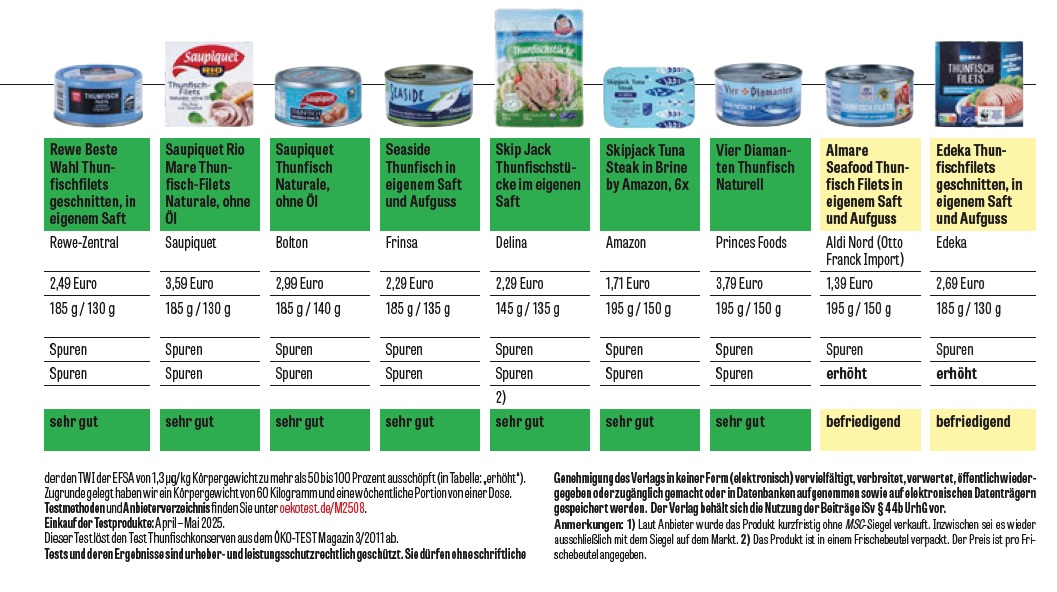
The investigation was conducted by ÖKO-test between April and May 2025 on 29 tuna skipjack tuna products (Katsuwonus Pelamis), that is, the striped tonnetto, the most used species for the boxes. Only natural versions have been taken into consideration, excluding those in oil or with other ingredients, so as to maintain uniform analysis.
The results showed that:
It should be noted that no sample has exceeded the legal limits provided for by the European legislation. However, in some cases it has been dangerously approached to values that could become risky with frequent consumption.
The mercury in the striped tonnetto
The striped tonnetto (Katsuwonus Pelamis), mainly used for the boxes, normally contains less mercury than other species such as yellow fin tuna or red tuna. This is because it is smaller, lives less and is lower in the food chain, therefore it accumulates less contaminating.
But “less” does not mean “without”. The test confirmed that also in this species mercury is always present and in some cases at levels deemed high.
The Italian and European authorities regularly monitor contamination, but the German study shows that even more accurate checks are needed and above all a clearer communication towards consumers. In addition, it is essential to vary the consumption of fish, avoiding always focusing on the same species more subject to accumulation of methylmercurium.
How the test was conducted
The analyzes were carried out in specialized workshops with certified methods internationally:
The results were compared with the tolerable weekly dose (Twi) established by EFSA. The hypothesis of reference was the consumption of a can or sachet by an adult of 60 kg.
ÖKO-TEST used more restrictive criteria than the legal limits: the products that exceeded 50-100% the Twi were judged “high” and therefore penalized in the overall evaluation.
The test showed that mercury is now a fixed presence in canned tuna, even if in most cases the levels are contained. However, the existence of brands with high values shows that habitual consumers, especially the most vulnerable, must be careful.
The advice remains the same: do not abuse the canned tuna, vary as much as possible the species of fish consumed and follow the guidelines of the health authorities.
Don’t you want to lose our news?
