
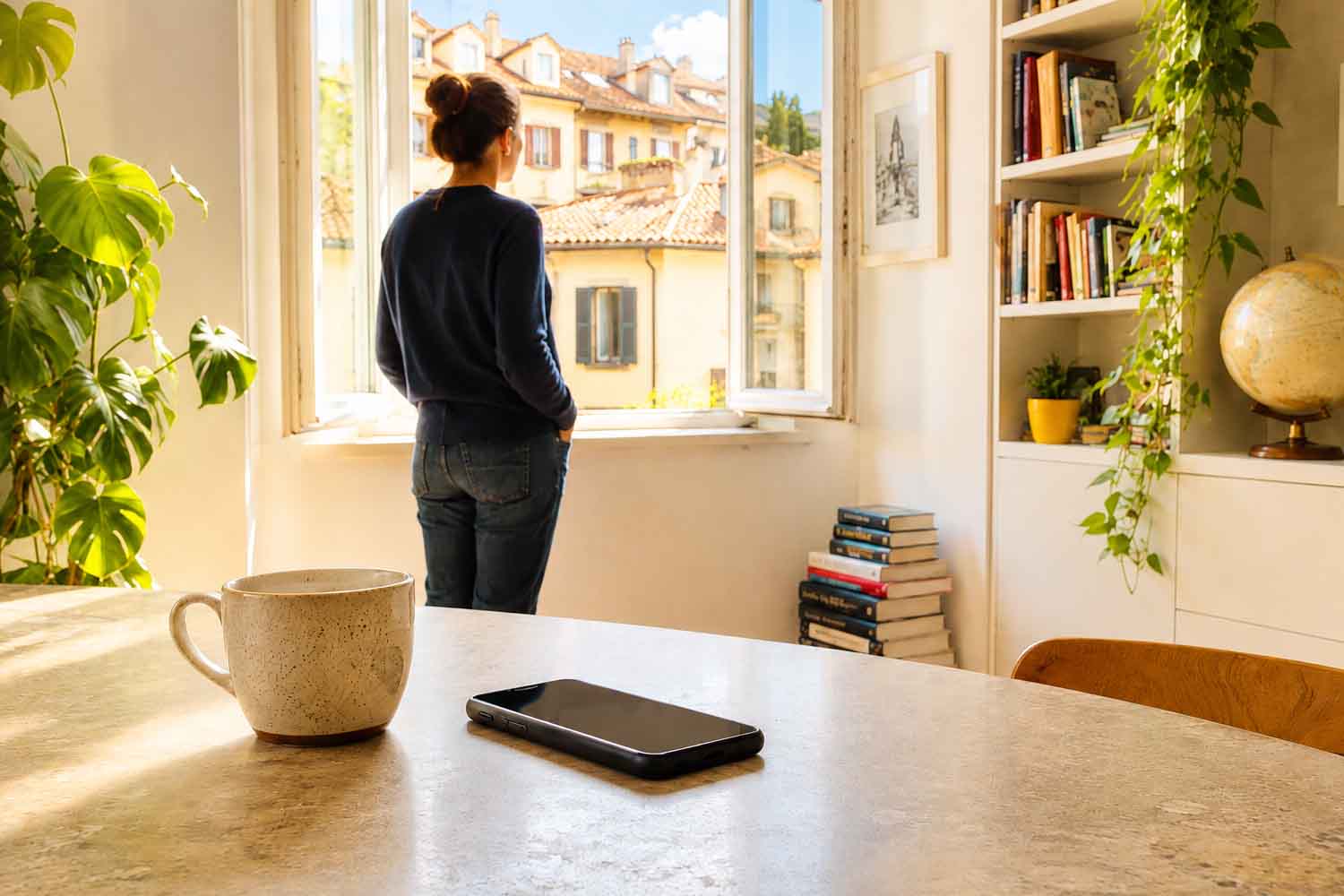
The smartphone does this cowardly thing: it stays there, silent, looking like an innocent object. Then it lights up. A war, a government crisis, the rising heat, the faltering economy, yet another badly cut video, the declaration thrown like a frying pan from the balcony. Maybe you just wanted to check the time, drink a coffee, wait for the pasta water to boil. Instead, after three minutes you’re inside the usual blender: a piece of news, a comment, a reply, a controversy over the reply, someone shouting “shame” under a post, someone explaining the world with the confidence of someone who even gets the recycling bin wrong.
Two days away from the news are enough to feel a precise difference: stress drops. The world remains what it is, unfortunately, with its discreet ability to ruin the mood even before coffee. It changes the way it comes to us. The background noise decreases, the pressure decreases, that desire to immediately check everything decreases, even when yet another update changes nothing about our day, except the way in which we go through it.
And this isn’t just an “I feel better” feeling. When we live exposed to constant alarm signals, the body also participates in the conversation. It does this with shortening breathing, stiffening shoulders, dirty sleep and, among other things, the stress hormone system.
Cortisol, one of the main hormones of the stress response, can increase when the body is exposed to a continuous sequence of stimuli perceived as threatening. And today many of these threats arrive like this: a notification, a headline, a video, a breaking news slipped between the coffee and the shopping list. The body uses it to react, prepare, stay ready. If the signal is continuously repeated, even in the face of dangers that we cannot face directly, the system risks remaining on longer than necessary. The brain reads, the body records. And that light on the dashboard stays there, on, while we pretend nothing happened and continue scrolling.
The noise stays with you
The problem isn’t reading the news. The problem is the loss of the border. Once upon a time, information had times, places, even recognizable noises: the newspaper open on the table, the news on while someone was setting the table, the radio in the car. Now news comes in through every available crack. They come while you’re working, while you’re eating, while you’re trying to sleep, while you’re walking, when you should just leave your brain in neutral for thirty seconds.
The Reuters Institute’s Digital News Report 2026 describes this tiredness well: on average 42% of people often or sometimes avoid news, an increase compared to the previous year. It’s not just disinterest. It is often defense. Many want to stay informed, but they feel that the mental toll has become heavy, especially when information arrives mixed with anger, fear, shouted comments and videos designed to keep us glued to the screen.
Fasting from information serves precisely to measure that price, without the need to transform it into a spiritual challenge. After a few hours you notice how many times you reach for the phone without knowing why. The hand goes there by itself, like when you open the fridge knowing full well that inside there are the same three sad things as before. Only instead of expired yogurt you find yet another headline about something going wrong. And the body reacts. It tends. He’s getting ready. Stay in “let’s see what happens now” mode.
What does cortisol have to do with it
Scientific research does not say that two days without news automatically “lowers cortisol”, but something more interesting: exposure to negative news can influence the way we react to stress.
A study published in PLOS ONE observed what happened after reading negative or neutral news, followed by a stressful task in the laboratory. The negative news alone did not markedly change immediate cortisol; in women, however, they increased the cortisol response to subsequent stress. Translated without making the phenomena: certain news can leave the nervous system more ready to react when another pressure arrives. We don’t just read them. Somehow we carry them with us.
Another study, always on PLOS ONEtested the effect of positive versus neutral news on the stress response. Positive news did not significantly change cortisol levels during the test. Here too the data is useful because it dismantles a very convenient fantasy: it is not enough to insert some “nice” content between two disasters to really compensate for the load. The brain, faced with the threat, takes notes with a much heavier pen.
Then there is the broader chapter of digital detox. A review published in SAGE brought together the available studies on digital breaks and found promising, but also very variable results: it depends on duration, people involved, type of digital use, measurement method. A study on BMC Medicine found that reducing smartphone time for three weeks can improve stress, sleep, well-being and depressive symptoms. Three weeks is not 48 hours, of course. But they point in one direction: when we remove at least part of the digital noise, something in the head breathes better.
The first few hours are the worst
The first hours without news have little that is poetic. They’re more like when you take off a crutch you didn’t think you’d use. You miss the gesture, even before the content. You unlock your phone and stop. Open a browser tab and close it again. It occurs to you to check “just for a moment” what happened, a splendid formula with which we have justified entire afternoons thrown into the gutter of continuous updating.
Then, little by little, a kind of emptiness arrives. At first it seems boring. After a while it looks more like space. Lunch becomes lunch again. The bed becomes a bed again, not a press room in pajamas. The walk ceases to be accompanied by the bulletin of general collapse. Maybe you continue to have thoughts, anxieties, things to do, personal annoyances large and small. But it lacks that additional buzz, that permanent emergency patina that sticks over everything.
The strangest point of fasting on information is realizing that we weren’t looking for a lot of news to understand the world. We were looking for them to fill a hole. So as not to hear the silence. To have something to check. To transform anxiety into gesture: I open, scroll, read, get nervous, close, reopen. A small alarm carousel, with the ticket always in your pocket.
Get better informed, don’t disappear
The 48-hour break makes sense if something changes when you return. Turning everything off for two days and then going back to swallowing news like chips in front of a series means doing yourself a tiny favor and then snatching it up immediately. Better to choose specific windows, perhaps one in the morning and one in the late afternoon, using reliable sources and leaving aside compulsive commentary. The important news arrives anyway. The others often have already lost half their makeup after three hours.
There is also a huge difference between staying informed and staying exposed. Staying informed means looking for context, checking, understanding what is really relevant. Staying exposed means letting everything pass through you: headlines, anger, videos, fear, ironies, token indignation, profiles that live on catastrophes served hot. The first thing can make us more clear-minded citizens. The second transforms us into nervous antennas.
Fasting from information does not resolve stress, it does not cure anxiety, it does not fix the world and it does not replace medical or psychological help when needed. But it can do one very concrete thing: show how much of our daily tension is fueled by a tap left open. Two days is enough to hear the noise when it is missing.
Then the phone turns back on. The world is still there, with its fires, its communiqués, its hourly end-of-time tones. Only for a moment you look at him from half a step back. And half a step, sometimes, is already a room.
You might also be interested in:
