
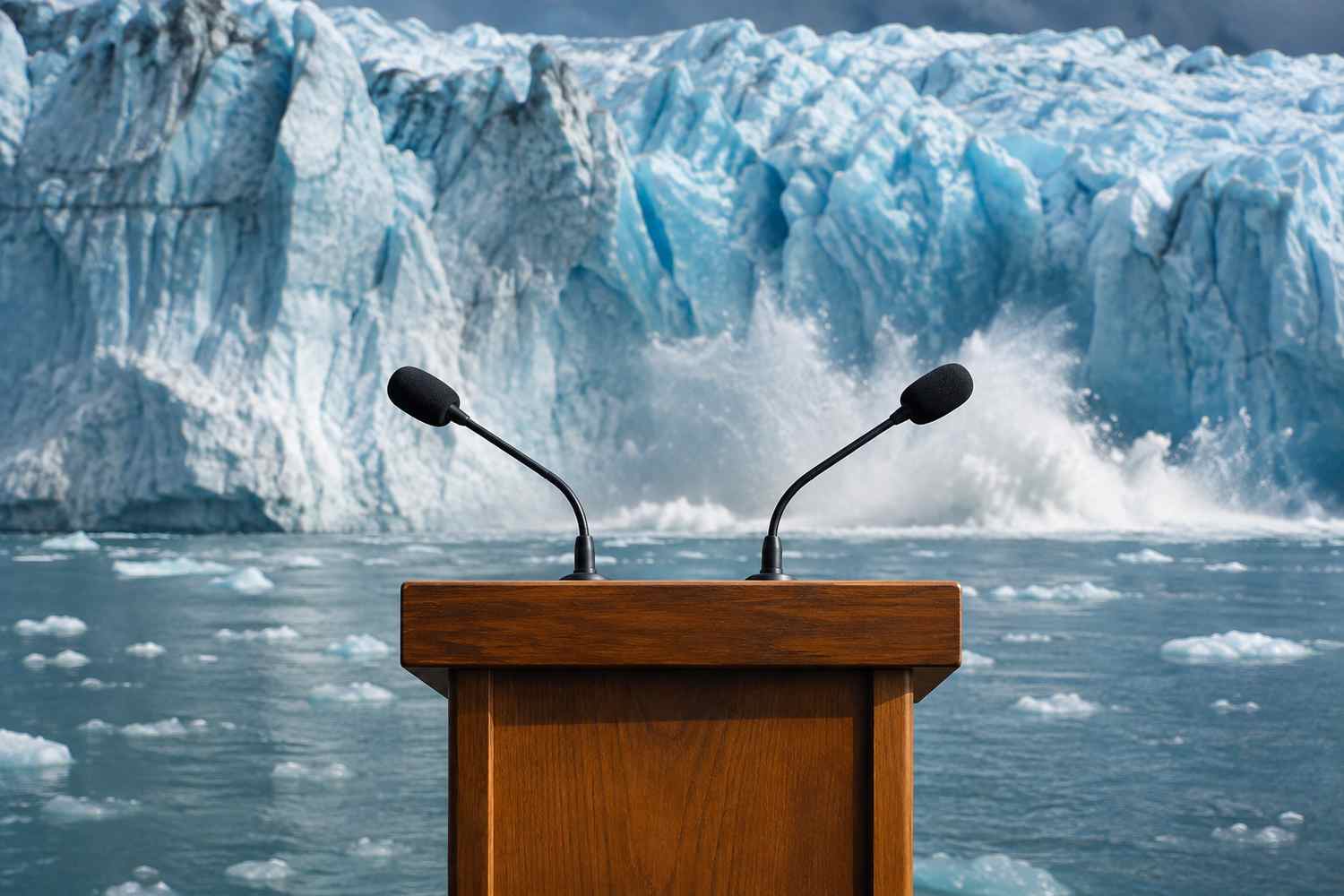
Are glaciers melting or not? Before answering, it seems, it would be useful to know where we stand politically. An Italian research published on PLOS One found that, among the 460 people involved in the study, a more right-wing political orientation corresponds to a greater adherence to conspiracy theories about climate change and a greater propensity to believe false news about it.
The study, signed by Alessandro Santirocchi and six other researchers, with the support of Sapienza University of Rome, tried to understand how much political beliefs and conspiracy thinking are linked to the way we inform ourselves about the climate crisis. On the other hand, we even managed to politicize the temperature. As if recognizing the increase in the concentration of carbon dioxide in the atmosphere automatically entailed joining a party. CO₂, for its part, is not yet registered.
Climate change? A ploy to make us pay more taxes
Between January 31 and April 15, 2025, the researchers submitted a questionnaire to 460 Italian citizens aged between 18 and 65, with an average age of 29 years and a clear female prevalence (370 participants). Everyone was asked to place themselves politically on a scale of 1 to 7, from extreme left to extreme right, and to rate the truthfulness of some statements.
These included the theory that climate change is a fabrication used by governments to raise taxes. A notable evolution of climatology skills, which went from the study of the atmosphere to the compilation of the F24 model. Other claims concerned the alleged manipulation of scientific evidence by scientists and politicians for economic or ideological interests, or the use of the climate issue by developed countries to hinder the economic growth of developing ones.
The participants then evaluated twelve false claims about the climate spread on social networks: the glaciers are not melting, the Earth has actually been cooling since the mid-twentieth century and the work of climate scientists is unreliable. The researchers wanted to know two things: how often participants remembered encountering this information in the previous three months, and how willing they were to believe it.
When conspiracy theories come into play
Moving to the right along the political scale, on average, adherence to conspiracy theories increased, both generic ones and those specifically linked to the climate. And it is precisely the conspiracy beliefs about the climate that stand out in the results. Political orientation alone was not significantly associated with the reported frequency with which participants encountered false climate news. Conspiracy beliefs about the climate, however, yes. And these same beliefs had the strongest link to the credibility attributed to false information.
In short, we can encounter the same news about glaciers and read it in two completely different ways, depending on what we are already predisposed to believe. The authors recall the psychological concept of “motivated reasoning”, i.e. the tendency to evaluate information also according to its compatibility with our beliefs. If news confirms what we think, accepting it can cost us significantly less effort than questioning an entire system of values, friendships, political references and, perhaps, a few hundred comments left on Facebook.
The statistical model developed by the researchers explains 23.3% of the individual variability in the credibility attributed to climate misinformation and 8% of that relating to declared exposure. The sample is not representative of the entire Italian population and the research, concentrated above all on denialist conspiracy theories, identifies associations without establishing which belief arises first.
Surrounded by people who agree with us
And then there are social networks, where we can spend entire days reading people who agree with us, only to mistake that portion of humanity for public opinion. In fact, the authors recall the phenomenon of echo chambersdigital echo chambers. We follow people who share our opinions, we interact with content we like, and algorithms can accommodate our preferences, helping to further narrow the information we encounter. A kind of personalized press review in which, potentially, we can be right from breakfast to bedtime.
The study did not directly analyze the algorithms or the online activities of the participants, but the authors point to these mechanisms as a possible explanation for the relationship between pre-existing beliefs and the information environment. A relationship that could feed in both directions: our beliefs guide the choice of contents and those contents, in turn, can strengthen our beliefs.
The small problem of having to convince someone who believes you are part of the conspiracy
Let’s arm ourselves with graphs, scientific reports, satellite photographs and glacier measurements. They might not be enough. If a person is convinced that climate scientists are complicit in a gigantic international deception, presenting them with yet another scientific study means, in their eyes, showing them a document signed by the alleged accomplices.
For this reason, the researchers suggest exploring strategies that also address mistrust in scientific institutions, through more transparent communication, recognition of uncertainties and dialogue. Correcting the single piece of false news could leave the belief system that made it credible perfectly intact.
When politicians are more polarized than citizens
The one between climate and ideology, of course, is not an entirely Italian story. And apparently it also changes depending on your passport. A study published by the Harvard Kennedy School Misinformation Review analyzed the responses of 8,101 people in eight countries. In the United States and Brazil, about one in four respondents subscribed to the climate conspiracy theory investigated by the researchers. In Germany the percentage fell to 10.7%.
Distrust in scientists and populist attitudes were associated with conspiracy beliefs across national contexts, while the weight of political orientation varied across countries. The climate phenomenon is global, the political fortunes of conspiracy theorists a little less so.
But the matter becomes even more interesting when we move from the opinions of citizens to those of their representatives. Research published on July 14, 2026 on Communications Sustainability compared the responses of 18,281 citizens and 714 politicians from eight democracies: Australia, Belgium, the Czech Republic, Germany, Israel, Luxembourg, the Netherlands and Norway.
Overall, politicians recognized the anthropogenic origin of climate change more than citizens. It’s a shame that, breaking down the answers by political orientation, the distance between right and left was much more marked among political representatives. On the right, politicians were even less convinced of the human origin of global warming than citizens of the same persuasion.
Curious: among the people called upon to develop climate policies, the recognition of the causes of climate change is more polarized than among citizens. The same researchers have in fact found a link between the recognition of the anthropogenic causes of global warming and support for concrete measures, such as incentives for electric cars or the increase in the price of airline tickets.
The climate is not an electoral program
You can be for or against incentives for electric cars, discuss the convenience of photovoltaics, contest European energy policies, support nuclear power or prefer a system powered by renewables. We can discuss who should pay for the ecological transition and how socially fair it is to pass the costs on to families. Politics is also useful for this. And we have plenty of topics to discuss, without needing to invent others. Global warming caused by human activities is instead a physical reality, documented by the IPCC summary report.
Reducing the climate issue to an identity battle even impoverishes the political debate: instead of discussing solutions, we still find ourselves discussing the existence of the problem. With the result of having to start over every time from the foundations of climatology, while we would already have a lot of work to do at the higher levels. Meanwhile, glaciers continue to melt. They have not yet learned to respect the results of elections.
