
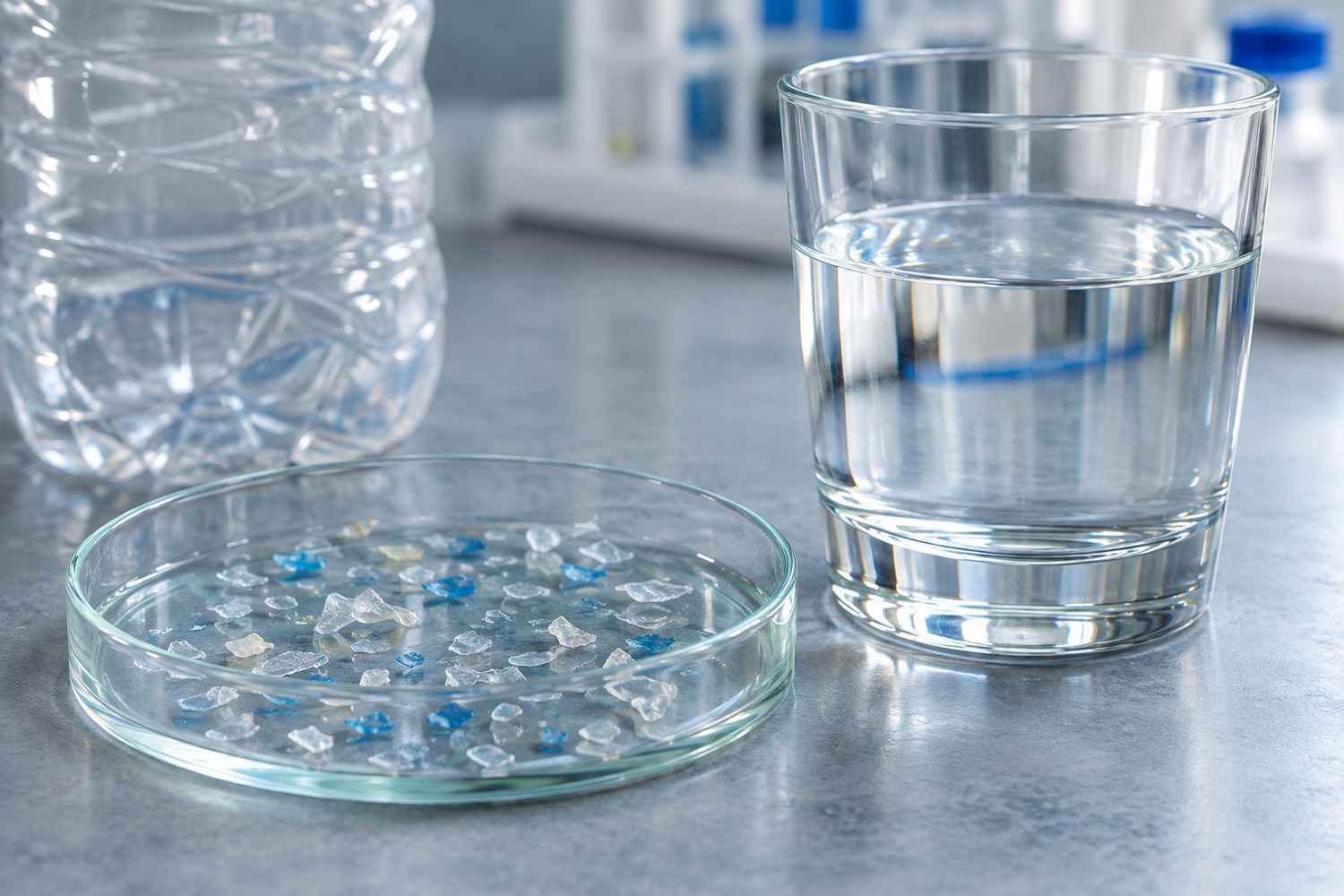
Microplastics only need to come into contact with water to generate substances capable of damaging cells. No particularly high temperatures or industrial chemical processes are needed: the reaction can occur spontaneously on the surface of these tiny fragments. This was discovered by a group of researchers from Columbia University and the University of California at Berkeley, in a study published in Nature.
For decades we have exploited the chemical stability of plastic to preserve food, bottle water, make tools and toys. When the material fragments, however, its way of interacting with the surrounding environment also changes. And water, apparently, actively participates in this process.
The smaller the fragments, the greater the surface area exposed to water
Let’s take a piece of plastic and imagine dividing it into thousands of fragments. The amount of material remains the same, while the overall surface area exposed to water increases enormously. And it is along this surface that the researchers observed the spontaneous production of reactive oxygen species (ROS), including hydroxyl radicals.
The study examined six materials that we know quite well: polyethylene from bags, polypropylene from many food containers, polystyrene from packaging, PVC, PET from bottles and polymethyl methacrylate, better known as plexiglass.
The chemical activity varies depending on the material and is more marked in those that are more hydrophobic, i.e. those that have less affinity with water. To understand the phenomenon, just think of the droplets that collect on some plastic surfaces without distributing themselves uniformly.
On a molecular scale something more complex happens. As researchers from Columbia University explain, contact with these surfaces changes the organization of water in the immediate vicinity of the plastic, creating conditions that favor the transfer of electrons and the formation of radicals.
What happens to cells exposed to microplastics
Our bodies naturally produce reactive oxygen species and have antioxidant systems to keep them under control. When the production of these substances exceeds the capacity of our defenses, a condition called oxidative stress occurs, which can damage cell membranes, proteins and DNA.
To observe the biological consequences of the activity of microplastics, scientists conducted some experiments in the laboratory, also using mouse red blood cells. Under the microscope they observed the fragmentation of some of these cells in contact with polystyrene particles. Other experiments have documented protein aggregation phenomena on the surface of microplastics.
The discovery therefore provides a possible mechanism through which these fragments can damage biological tissues. The study does not demonstrate that the reaction causes specific diseases in humans: it will be necessary to understand how much it affects the concentrations to which we are normally exposed and in the presence of the body’s defenses.
Microplastics continue to interact with the environment
The problem, of course, goes far beyond the contents of our bottles. Let’s think of the synthetic fibers dispersed when washing clothes, of industrial waste, of abandoned packaging that progressively crumbles and ends up in waterways.
Research suggests that even in aquatic environments these particles can become chemically active, with possible consequences for organisms that come into contact with them. According to Teresa Head-Gordon, a chemistry professor at the University of California at Berkeley, understanding the phenomenon could help scientists redesign the composition of plastic materials, reducing their potential toxicity.
How to reduce exposure to microplastics: let’s start from the kitchen
Between the container of dinner leftovers, the bottle of water and the lunch tray to be heated in the office, there are many occasions in which plastic, water and food come into contact during a normal day. Some are easily avoidable. Research published in 2023 had already documented how some plastic containers, subjected to three minutes of heating in the microwave, could release millions of microplastics and billions of nanoplastics per square centimeter of surface.
It is therefore advisable to transfer the food to a ceramic plate or a glass container suitable for the microwave before heating it. To preserve leftovers we can prefer glass or stainless steel containers, above all avoiding pouring boiling foods and liquids directly into the plastic. Even particularly worn cutting boards and utensils can be replaced with durable alternatives.
As for water, it is better to prefer tap water, where it is drinkable, possibly filtered, and stored in glass bottles. Pay attention, however, to the choice of filter: a study on domestic filtration systems found greater effectiveness in removing microplastics in devices equipped with filter membranes compared to those based only on activated carbon and ion exchange resins.
It is useful to check which particle sizes the device can actually retain and respect the filter replacement times. We also avoid leaving plastic bottles in the sun or for hours in the car during the summer.
Reducing domestic exposure is possible, but a large part of the problem is solved upstream, limiting the production and dispersion of plastic into the environment. Also because packaging that crumbles to the point of becoming invisible to our eyes can acquire, precisely during that process, a greater chemically active surface.
