
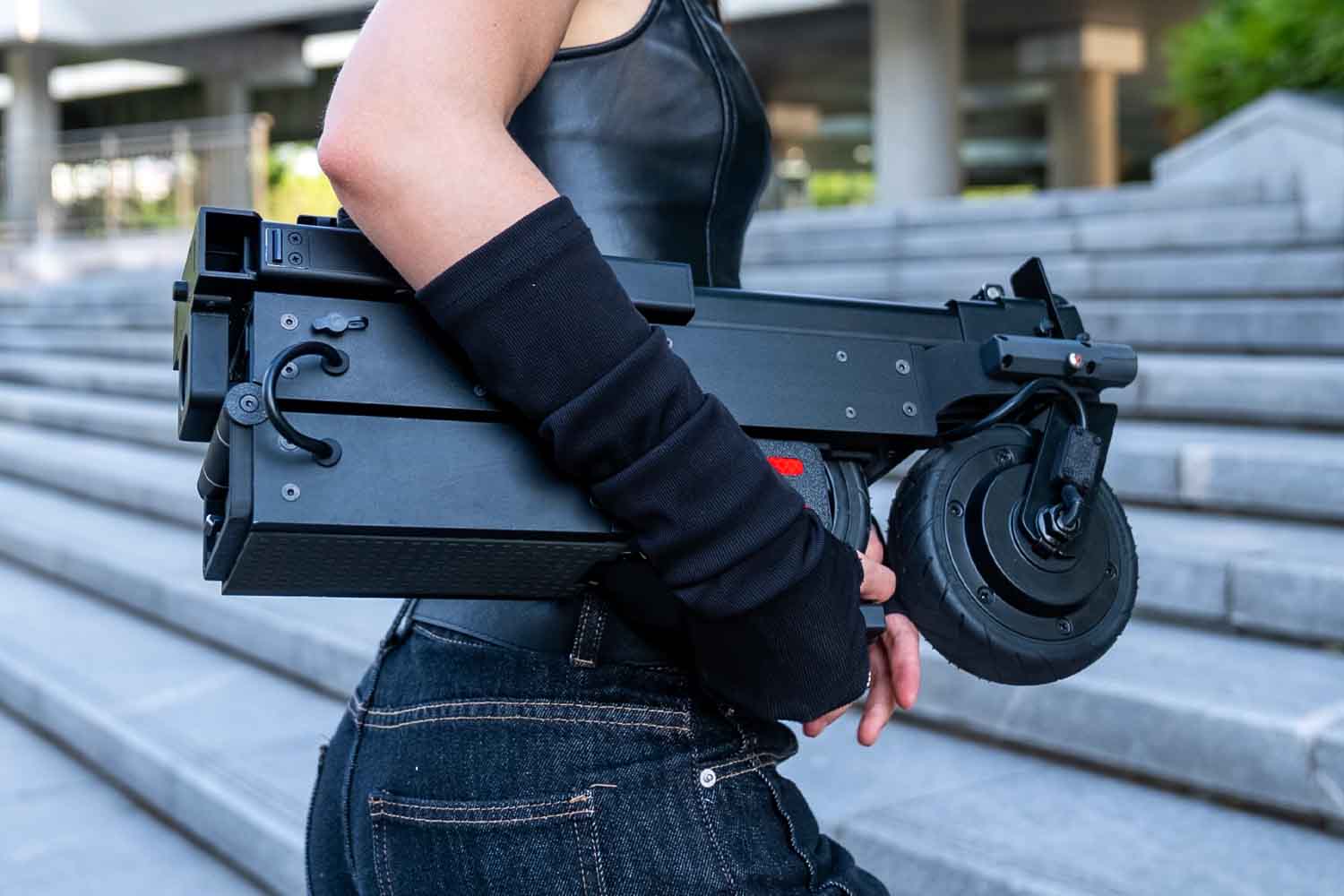
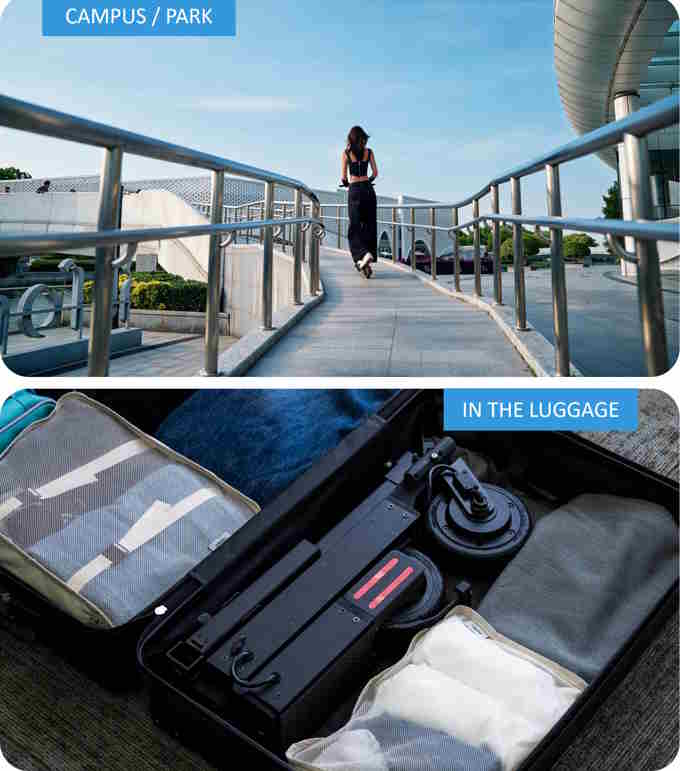
You fold it up, the handlebars disappear along the frame and after a few seconds what looked like an electric scooter becomes an object just 49 centimeters long. Small enough to fit in a dedicated backpack or desk drawer. This is the challenge of the Blizwheel F0.5, a project that has just arrived on Kickstarter: to remove one of its stupidest and most everyday defects from the scooter. When you stop driving it, it’s still a long, heavy affair that you have to park, tie down or lug around.
Blizwheel claims about six seconds to open and nine to close. The Standard version weighs 7.7 kilos; the lightest Air drops to around 7.5 kilos, while the Pro rises to around 9.2 kilos. Lightweight, therefore, at least compared to the numerous urban models that weigh well over 15 kilos. Eight kilos on the shoulders are still eight kilos: the backpack does not acquire anti-gravity properties just because it appears in a promotional video.
@kickstarter
A scooter designed for the last kilometers, with some rather visible compromises
The idea makes sense especially next to public transport. You get off the train, open the scooter, ride the last few kilometers, then carry it inside instead of leaving it tied to a pole. The official campaign FAQ confirms that the F0.5 reduces to 49 centimeters and even specifies a less poetic detail: many normal 17-inch laptop backpacks are around 45 centimeters long, so you need a sufficiently large bag or one designed by the manufacturer.
Performance varies depending on version. The Pro uses two 250 W motors, according to the manufacturer it reaches up to around 20 kilometers of autonomy and can tackle declared slopes of 15%. Those 20 kilometers, however, were measured in very polite conditions: flat and dry asphalt, around 30°C, a 75 kilo driver and a constant speed of 15 km/h. Weight, hills, accelerations and temperature can shorten the real distance, as the company itself recognizes.
What pays the price for miniaturization is above all the wheels. To close within half a meter, the F0.5 uses solid honeycomb tires measuring just 5.5 inches, accompanied by a central polyurethane element that absorbs some of the shock. Blizwheel shows the vehicle dealing with cracks, small unevenness and potholes and claims to have increased the size of the wheels by around 40% compared to the previous generation. Very small wheels remain: on cobblestones or real potholes, the ones that need no introduction in Italian cities, physics retains a certain decision-making autonomy.
In Italy those 5.5 inch wheels stop everything before you even start
Here comes the detail that changes the interpretation of the product a lot. The Italian decree on the technical characteristics of electric scooters establishes a minimum wheel diameter of 203.2 millimetres, i.e. 8 inches. The 5.5 inches claimed for the F0.5 is well below that threshold. With the characteristics presented today in the campaign, therefore, the vehicle would not meet the requirements for circulating as an electric scooter on Italian roads.
And the differences continue. In Italy the regulator must respect the limit of 20 km/h on the road, while Blizwheel indicates a maximum speed of 25 km/h for the European configuration and allows, in private areas, 32 km/h to be unlocked via the app. The Pro version adds another problem: it features two motors, while Italian technical legislation defines the electric scooter as a vehicle equipped with a single electric motor.
This does not make the project useless. It simply means that a future version truly intended for the Italian market would need precise technical changes, starting with the wheels and speed configuration. And in the meantime, the Italian rules have become even more dense: compulsory helmet for everyone, identification mark from May 2026 and compulsory third party insurance from 16 July 2026. The MIT confirmed the entry into force of these last two obligations after the completion of the implementing decrees.
The $199 model seen on Kickstarter is not electric
There is also a small trap to avoid when looking at campaign prices. The F0.5 Lite offered at $199 has no motor and battery: essentially it is a traditional folding scooter. To really get into electric, start from the Standard version, proposed in the campaign at around 349 dollars, while the Pro with dual motor reaches 499 dollars.
And Kickstarter remains Kickstarter. Blizwheel admits in its documentation that the previous generation had endurance issues and severe delivery delays. For the new model it says it has switched to 6061-T6 aluminium, a rectangular structure billed as around 200% stronger and two suppliers for major components, after reliance on a single supplier contributed to previous delays. A small test production of ten units was also completed. All useful. A pilot production of ten pieces, however, is still far from a fleet of scooters that spend years on sidewalks, rain and cobblestones.
The first deliveries are expected towards the end of 2026. The idea behind the F0.5 remains interesting: to build a last mile vehicle that can actually get on trains, subways and buses with us, instead of turning into another object to park. For now, in Italy, it could fit into the backpack much more easily than in the Highway Code.
