
It was already there when many of the cities we live in today did not yet exist. It has gone through centuries of history, resisting fires, storms, lightning and insect attacks. Yet, what nature had failed to put an end to in hundreds of years risks being destroyed by a human gesture as absurd as it is incomprehensible.
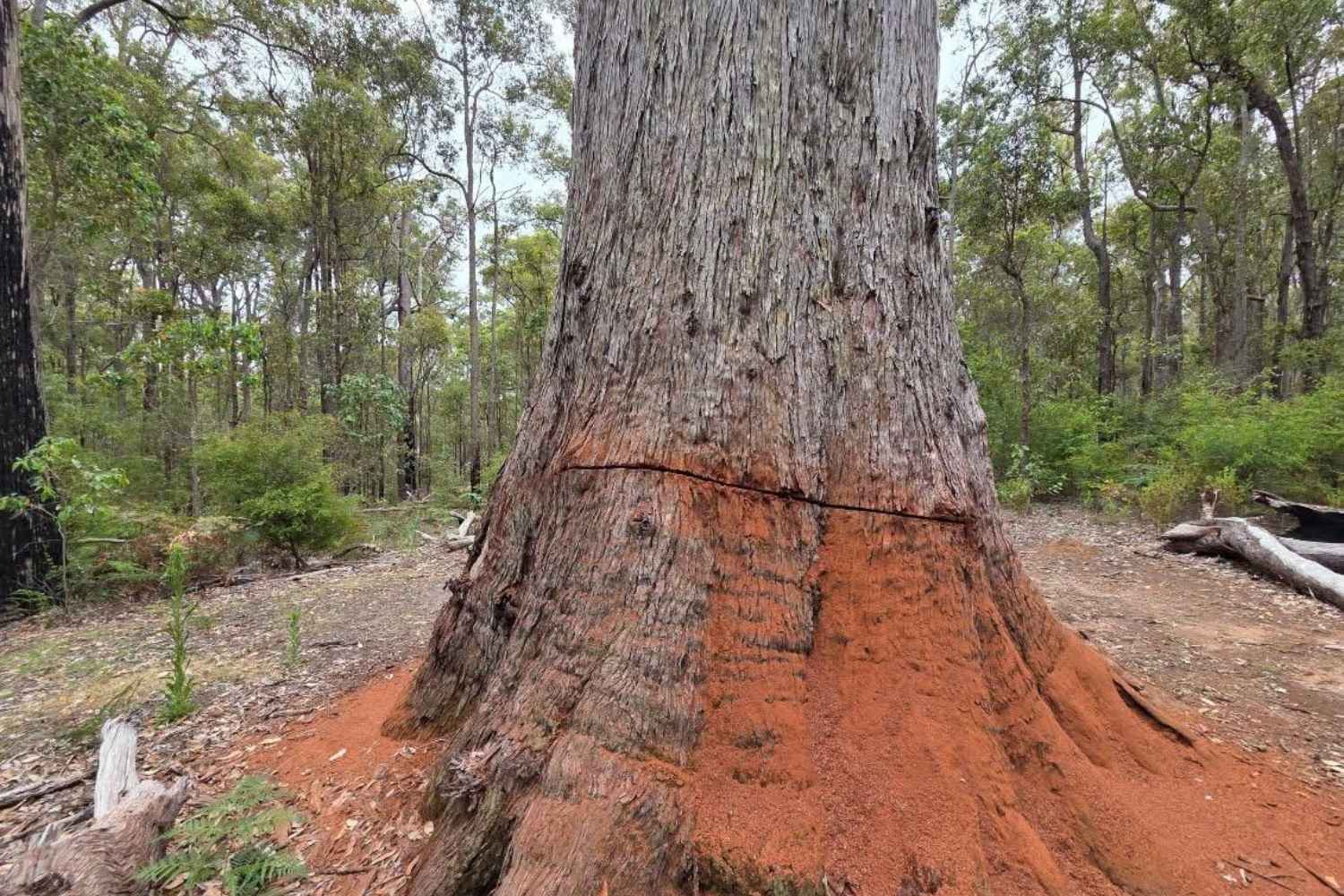
We are in Western Australia, in the Wellington National Park, where someone seriously damaged the King Jarrah, a majestic example of Eucalyptus marginata whose age is estimated between 300 and 500 years.
Approximately 36 meters tall, the tree is one of the most beloved naturalistic symbols of the region. The photographs released by the Australian authorities show the deep wounds on the trunk and the ground covered in sawdust. Images that hurt, especially thinking about how long it took for that tree to become what it is today.
King Jarrah is in danger of being demolished
Minister Matthew Swinbourn / Facebook.
According to what was reconstructed by the police, the vandalism occurred between Saturday 21st and Sunday 22nd November. At the moment, those responsible have not been identified.
The Department of Biodiversity, Conservation and Attractions of Western Australia (DBCA) has closed the area to the public and appointed a specialist to assess the condition of the tree.
What worries experts is not only King Jarrah’s ability to survive wounds, but also its stability. The tree already has a large natural cavity at the base of the trunk and damage caused by vandals may have further compromised its safety.
The fear is that, if it is not possible to make it safe, it will be necessary to demolish it. The technical opinion of the specialists is expected in the next few days. In the meantime, the authorities assure that all possibilities to save him will be evaluated.
A natural heritage that belongs to entire generations
For the inhabitants of the region, King Jarrah is not simply a large tree. Generations of families have grown up visiting it, walking the forest trails and stopping on the observation platform built nearby.
Its grandeur had also made it an internationally known tourist destination.
Peter Murphy, representative of the environmental association Preston Environment Group, expressed his bitterness to the microphones of the Australian broadcaster ABC. The loss of the tree, he explained, would represent enormous damage to the community and its natural heritage.
Western Australia’s Environment Minister, Matthew Swinbourn, also condemned the incident, calling it a shameful, senseless and heartbreaking act.
The stance of the Dardanup administration is no less harsh, recalling that an entire community is suffering the consequences of this act. Anyone found responsible could face a fine of up to 10,000 Australian dollars and a year in prison.
It’s not the first time
Only in 2024, again in Western Australia, another monumental tree, an approximately 800-year-old peppermint specimen, was cut down by mistake by some state government contractors.
Different events, which however remind us how vulnerable a seemingly indestructible natural heritage is.
An ancient tree cannot be replaced simply by planting another. Numerous life forms find refuge in its cavities, bark and branches. Its presence contributes to the biodiversity of an ecosystem that has taken generations to develop.
The last word has not yet been said for King Jarrah. The hope is that this Australian giant will be able to survive this time too.
Sources: ABC News / Department of Biodiversity, Conservation and Attractions
