
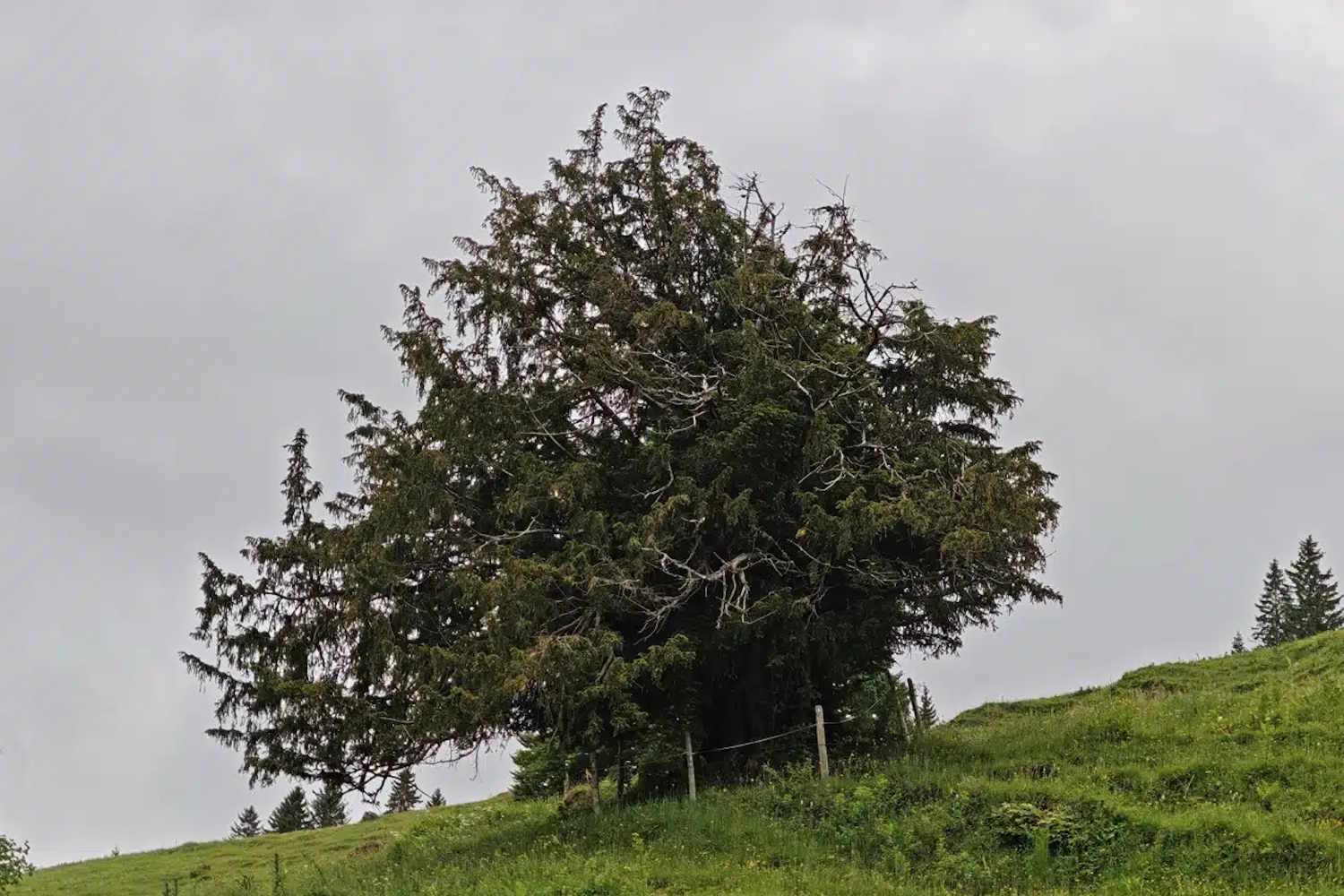
It has seen empires rise and fall, gone through wars, epidemics, glaciations and climate revolutions. Yet it is still there, standing firm on the side of a mountain in the Bavarian Alps, an ancient yew that could be the oldest tree in Germany: according to experts it is over 1,100 years old, an authentic living monument capable of telling, in silence, the history of our continent.
Among the pastures of the upper Allgäu (oberallgäu), in Bavaria, among the small villages of steibis And balderschwang, this extraordinary specimen grows Taxus baccatathe European rate. If the estimates are confirmed, this gnarled giant will conquer the record of the oldest tree in Germany, surpassing the famous thousand-year-old lime tree from Lower Saxony which until now held the record.
Its position, then, makes this discovery even more surprising: the tree grows at around 1,100 meters above sea level, on a slope facing north-west, practically at the upper limit of the natural habitat of the yew in the Alps, which reaches up to around 1,300 metres. It is a difficult environment, where for much of the winter the sun struggles to reach the ground and temperatures remain significantly lower than on the south-facing slopes.
For scholars of the German Dendrological Society this is a true biological prodigy: not only has the badger managed to survive for over a millennium in such severe conditions, but it continues to show signs of excellent health. paradoxically, the progressive increase in temperatures could even favor its growth.
A trunk that tells of eleven centuries of life
Looking at it closely you immediately understand that it is not just any tree. The professor Andreas Roloffone of Europe’s leading experts in tree biology from the Technical University of Dresden, describes its trunk as “a dream monument”, sculpted by time. Deep cracks, bulges, ribs, cavities and portions that seem to belong to different trees coexist in a single living structure. The trunk measures 5.1 meters in circumference, a fact that testifies to the extraordinary longevity of this specimen.
Every cavity, every fold of the bark tells of centuries of adaptation, healed wounds and new rebirths, but how it arrived in this remote place remains a mystery. However, experts believe it is highly unlikely that it was planted by man, while the most plausible explanation is that a bird transported the seed, dropping it on that very slope where, against all odds, it found the conditions to germinate.
The European badger is a very ancient species. it has been present on the continent for about 150 million years, long before the appearance of human beings. For prehistoric populations it was a precious tree, its wood, resistant and elastic, was used to build hunting bows.
The oldest trees in the world
Although the new German record is extraordinary, there are even more long-lived organisms elsewhere on the planet. Among the trees with a single trunk, a bristlecone pine from the White Mountains in California stands out, which is over 5,000 years old.
In Sweden, in the Fulufjället national park, the famous spruce Old tjikko it has a root system that is approximately 9,550 years old, having regenerated several times over the millennia.
Even more impressive is Pando, Utah: not a single tree, but an immense clonal colony of aspens connected by the same root system, whose origins date back as far as 80,000 years ago.
The discovery just made in Germany reminds us of how monumental trees are authentic living archives of biodiversity, custodians of the memory of the landscape and precious indicators of climate change. As climate continues to transform mountain ecosystems, these ancient giants continue to slowly grow, demonstrating extraordinary resilience.
Protecting trees like this means preserving not only a unique natural heritage, but also a part of our common history. Because some living beings, without ever moving an inch, manage to cross the centuries much better than any chronicle.
