
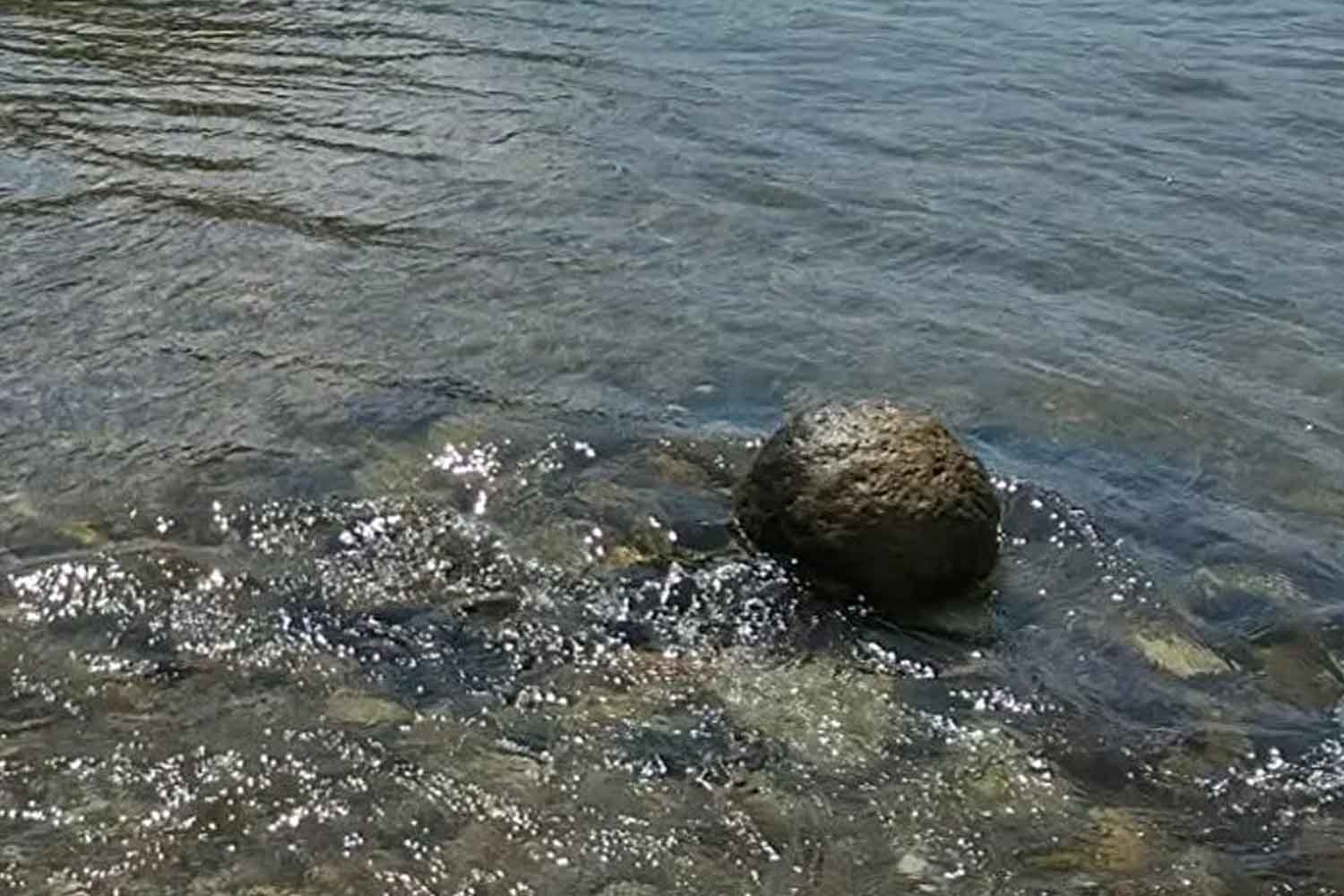
An almost perfect stone sphere remained dry in the bed of the Danubenear Visegrád, about forty kilometers north of Budapest. It could be the projectile of an ancient throwing machine, perhaps used during one of the sieges of the fortress overlooking the river. It could, in fact: archaeologists have yet to examine it. The story already has a very precise shape; identification, for now, decidedly less so.
Meanwhile, the Danube level continued to break its own records in reverse. On the evening of August 2, Budapest station reported 9 centimeters on the hydrometric scale; on the morning of August 3 the value had just risen to 12. The measurement indicates the height compared to the station’s conventional zero, not the overall depth of the river. The previous minimum, recorded in 2018, was 33 centimetres. The data is published by the Hungarian Hydrological Service Hydroinfo.
If it’s a projectile, it could be at least four centuries old
The sphere was reported to the King Matthias Museum in Visegrád, an institute that preserves and studies archaeological finds in the area. According to the director and archaeologist Gergely Buzás, similar stones are not a rarity in the surrounding area: during the sieges of the castle they were thrown by the hundreds and some examples are already preserved in the museum’s deposits.
The examination will have to establish whether the regular shape is truly the result of processing intended for war use. If the hypothesis were confirmed, the find could date back to the 16th century at the latest, when similar ammunition was still used. However, Visegrád already hosted a fortification in Roman times and machines capable of throwing stones had been known long before that.
This is where the time gap that has been circulating in recent hours comes from: from about 400 to 2,000 years. It’s a range of possibilities, not a dating. A sphere found in the mud does not come with the year of manufacture engraved on the bottom, an uncooperative detail on the part of History.
The bed of the Danube is returning wrecks and sandbanks
The Visegrád stone is just one of the objects made visible by the receding water. In July, near Kölked, in the Mohács area, a Second World War wreck also surfaced from the bed of a side branch of the Danube.
Sentinel-2 satellite images published by Copernicus they show the same stretch of the Danube Bend on July 14, 2025 and July 25, 2026. In the second shot the waterway appears much narrower, with large sand banks exposed along the bends. Commercial shipping, ferries and river tourism have already been limited in several sections.
View this post on Instagram
The exposed seabed offers spectacular images and some possible finds. The reason why it is possible to walk on it today, however, has much less appeal.
The Hungarian drought is also fueled by extreme heat
At the end of July HungaroMet, the Hungarian meteorological service, described much of the country as being in conditions of severe agricultural drought, with soils increasingly poor in moisture. In addition to the lack of rainfall, so-called atmospheric drought has been added: very hot and dry air which takes water away from the soil and vegetation, accelerating evaporation.
An analysis of World Weather Attribution examined the 2026 European drought by distinguishing western from eastern conditions. In Eastern Europe, where Hungary falls, warming caused by human activities would have made the soil moisture deficit observed between January and June approximately 11 times more likely. Extreme evaporative conditions would have become about 40 times more likely and 8% more intense.
The analysis covers a large region and periods of several months: those numbers cannot be automatically transferred to the single stretch of the Danube or to the day on which the stone was found. However, they indicate a mechanism that is now difficult to ignore. The little rain weighs heavily; higher temperatures also make the remaining water disappear more quickly.
The sphere will still have to be observed, measured and compared with similar finds. It could tell the story of a medieval siege, a Roman fortification or something much less adventurous. The bed that returned it had already delivered clearer news: the Danube had never sunk so low.
Tuna Nehri’nin çekilmesiyle 2 bin yıllık taş küre ortaya çıktı.
• Uzmanlar, taş kürenin kale kuşatmalarında kullanılan bir gülle olabileceğini belirtti. pic.twitter.com/J6hffFwPZv
— MHA Haber (@mhahaber_) July 31, 2026
