
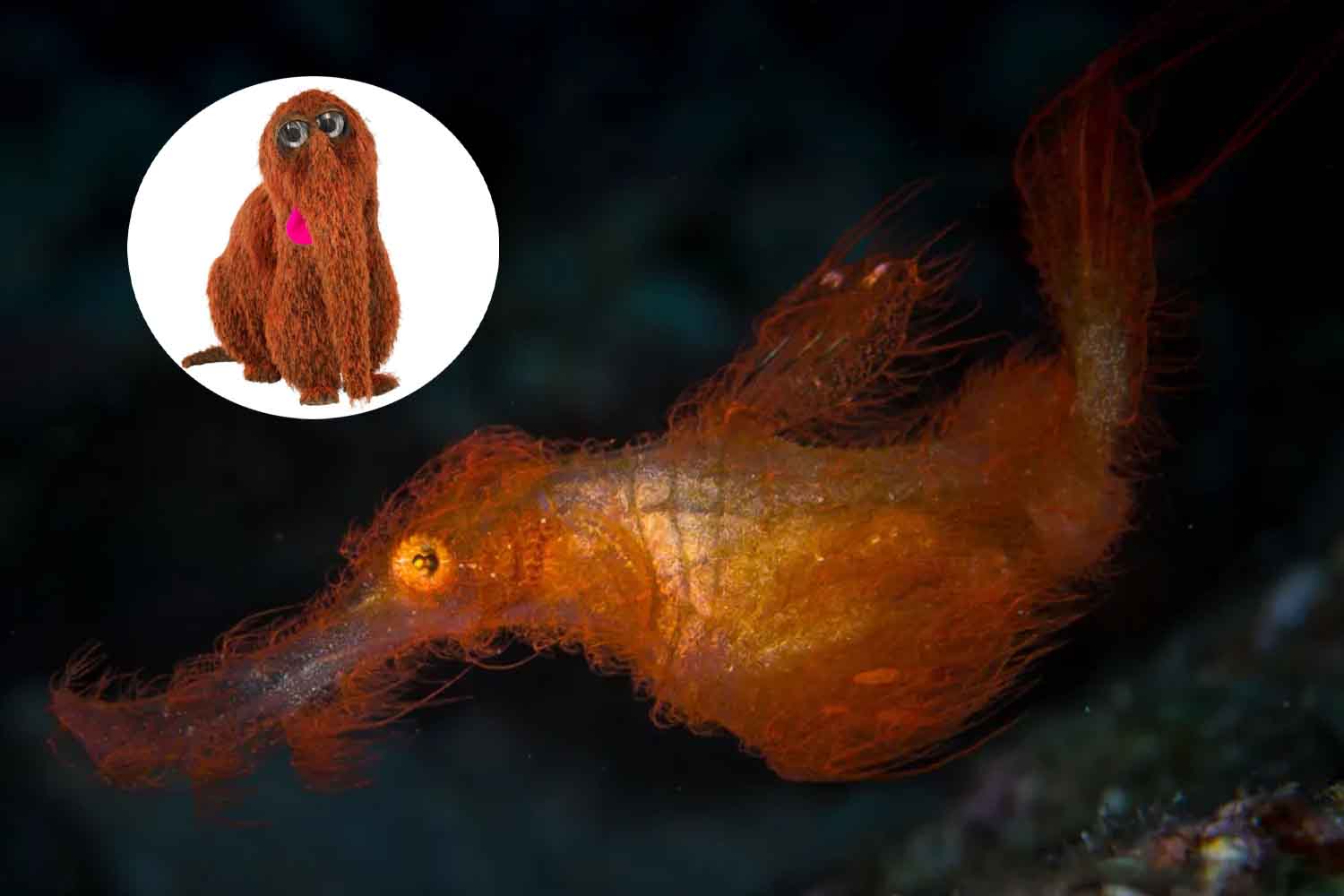
In the sea, certain creatures seem made specifically to make fun of humans. You stand there with tanks, camera, years of study behind you, the serious air of someone who knows how to distinguish a fish from a tuft of algae, and then something that looks like vegetable rubbish moved by the current passes before your eyes. Only that he breathes. And it has a face. And after a while it forces you to admit that perhaps the coral reef still has a lot of desire to mind its own business.
It happened with a tiny ghost fish, a few centimeters long, covered in reddish and orange filaments so thick that it looked like a ball of wool that had ended up underwater. Scientists formally described it as a new species with the name Solenostomus snuffleupagusa direct reference to Mr. Snuffleupagus, the hairy, long-snouted character of Sesame Streeta children’s program well known in the Anglo-Saxon world. For those who are unfamiliar with that puppet: imagine a kind of soft, melancholy and gigantic mammoth. Now reduce it to the size of a matchstick and place it among red algae and coral. We are more or less there. The scientific description was published online on May 10, 2026 on Journal of Fish Biology.
It looked like seaweed
The story starts in the early 2000s, during a dive in Papua New Guinea. Marine biologist David Harasti saw something that, at first glance, might have passed for a piece of red algae carried by the current. Then that fragment moved with too much intent to be just vegetation. Harasti photographed it, returned home and began searching books on ichthyology. No convincing match. The suspicion, the beautiful and uncomfortable one, was already there: he could be faced with a species never documented before.
The problem with animals like this is that being found once means very little. Ghost fish like that Solenostomus they are relatives of seahorses and leaf dragons, and have perfected the art of disappearing into the landscape. Thin body, strange profile, colors copied from the environment, slow, almost vegetal movements. They live like apparitions among corals, algae and seagrasses, so much so that distinguishing them from the seabed requires trained eyes and a good dose of luck.
For years that little fish remained an intermittent presence. Harasti returned to Papua New Guinea several times without being able to find him. In the meantime, reports of divers and underwater photographers appeared between the Great Barrier Reef, Fiji and Tonga, enough to suggest a wider distribution in the southwestern Pacific, on the edge of the so-called Coral Triangle. Some images also ended up on citizen science platforms and enthusiast groups: enough material to spark a more precise hunt, insufficient to give an official name to the creature.
The research was concentrated in relatively shallow waters, between reef walls, coral masses and areas with thick growth of filamentous red algae, more or less between 5 and 30 meters deep. There the hairy ghost fish does its job: it sways slowly, imitates plant debris, lets the human eye pass over it without stopping. At a certain point, however, the researchers managed to collect a female and a male, the material necessary to stop talking about suspicions and start doing real taxonomy.
Hairy to survive
The name makes you smile, the biology much less. The researchers compared Solenostomus snuffleupagus with Solenostomus paegniusa similar species with which it had long been confused. If you look at it quickly, the risk of exchanging them exists. Looking at it carefully, however, the new ghost fish shows solid differences: a more compact body, a stockier appearance, a much more abundant covering of filaments and above all a different skeletal structure.
Micro-CT scans, a technique that allows the internal anatomy to be observed in 3D without destroying the specimen, showed that this species has 36 vertebrae, while related species compared in the study typically have 32-34. Genetic analyzes of mitochondrial DNA have indicated a marked distance from the closest relative, with a divergence estimated at around 18 million years. Translated without being a fake armchair naturalist: this funny little animal, with the look of a marine puppet, has a long and very autonomous evolutionary history behind it.
His “fur” has little to do with tenderness. Those filaments serve to blend in with algae, corals and small reef organisms. The most common color is red-orange, perfect for disappearing among the filamentous algae in which it lives. However, there are rarer chromatic variants: green individuals and also purple forms have been documented, a detail that suggests a certain plasticity in the color, probably linked to the microhabitat frequented. In practice, the fish changes scene and tries to dress accordingly. With much more elegant results than certain human camouflages.
This ability to disappear also explains why the species remained on the margins of official science for so long. The Great Barrier Reef is one of the most observed, photographed and studied marine ecosystems in the world, yet it continues to return nameless animals. Not because no one is watching us. Because the sea, when it wants, knows how to hide things in plain sight.
The miniature predator
The most interesting surprise came from the stomach. During micro-CT analysis, the researchers spotted partially digested remains of a small fish. A tiny detail, sure, but strong enough to change what was thought about the diet of ghost fish. Until now it was believed that these animals fed mainly on small crustaceans, such as mysids, shrimps and zooplankton. Here, however, inside a body just a few centimeters long, there was evidence of predation on another fish.
There is something disproportionate about the scene: a creature that looks like a seaweed puppet, the size of a matchstick, capable of swallowing real prey. It’s the usual unromantic reminder of nature. Cute animals exist above all in our mental categories. In the reef, even an orange wad with a funny face must eat, reproduce, avoid predators, exploit every millimeter of advantage.
Even the reproduction of ghost fish retains a family strangeness. As in seahorses, the topic of egg care follows an unusual path, although here it is the females that have a specialized structure: a sort of incubator pocket formed by fused pelvic fins. Furthermore, in the new species, the females are larger than the males and have slight differences in the shape of the cranial crests. Small things, sure. In biology, however, it is often the little things that separate one species from another.
The name, at that point, was almost inevitable. The long snout, the filaments, the look of an unlikely animal straight out of a children’s programme: snuffleupagus it ended up within the scientific nomenclature with surprising naturalness. The most beautiful part is that this choice holds together two worlds that we often imagine as distant: pop imagination and the patience of taxonomy. On the one hand a television character designed for children, on the other a work made up of anatomical comparisons, DNA, museums, diving, photographs, measurements and decades-long waits.
There is also a very concrete detail not to be missed: without the divers’ observations, the photographs shared online and the contributions of enthusiasts, the reconstruction of the distribution would have been poorer. Citizen science, when tested and integrated with robust methods, can become a real piece of scientific work. Here he helped link Papua New Guinea, north-eastern Australia, Fiji, New Caledonia and Tonga into a more credible map of the species’ presence.
The hairy ghost fish now has a name, a description, a place in the evolutionary tree, and even a little fame as an absurd creature. However, what it was before remains: a tiny animal, hidden among the algae, capable of going unnoticed for years under the eyes of those looking for just such things. The sea still has many ways to remind us that our attention is limited. All it takes is a moving red tuft.
You might also be interested in:
