
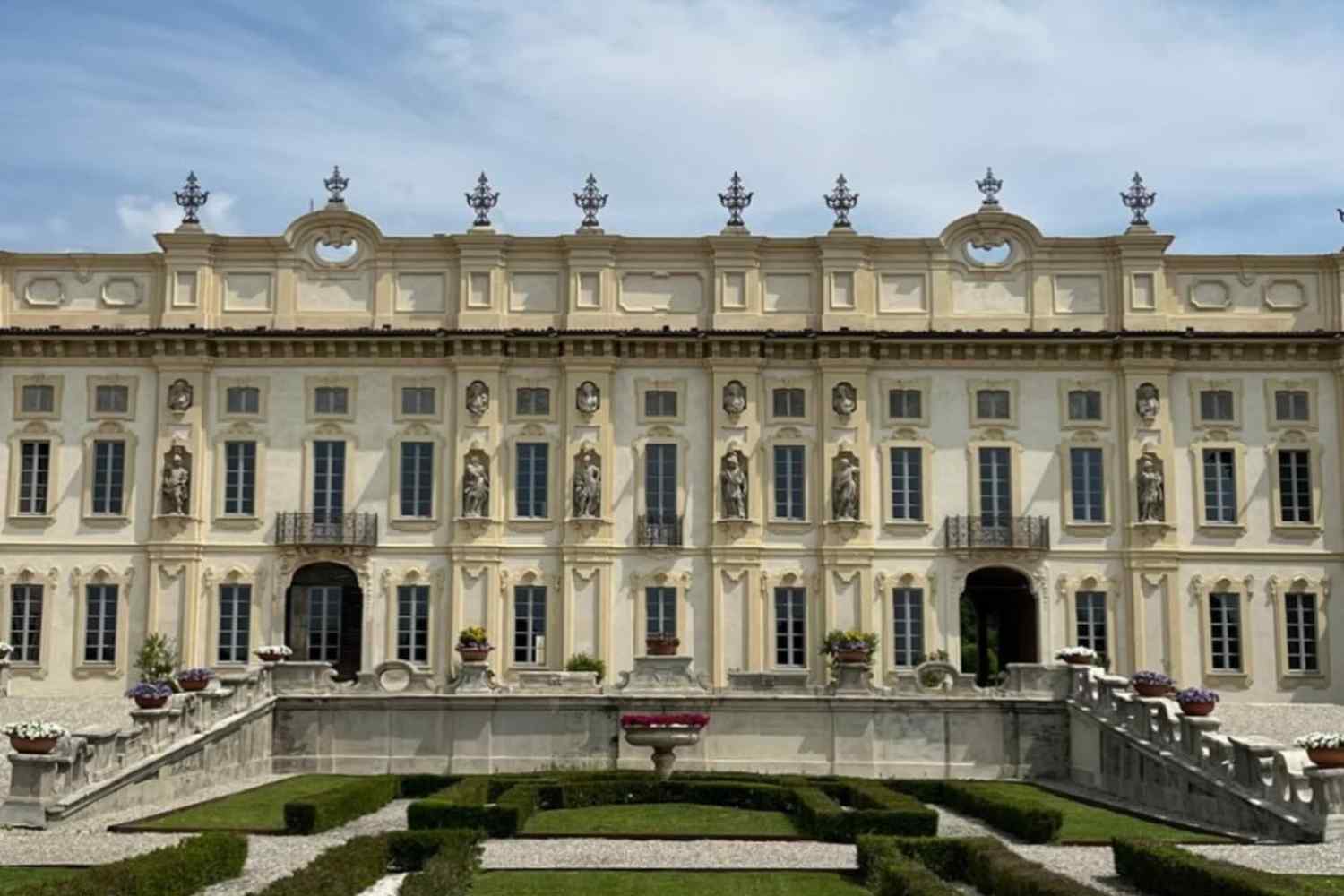
When you think of Versailles, your mind immediately flies to France. But to those who know Villa Arconati, that feeling of baroque grandeur doesn’t require any intercontinental flights — just exit the motorway at Bollate, a northern suburb of Milan.
The villa, built between the 17th and 18th centuries, is often nicknamed the “little Italian Versailles”, and it is not difficult to understand why. Its 365 windows overlook rigorous and scenic French gardens, where geometric hedges, fountains, statues and even an eighteenth-century labyrinth compose a landscape that seems to have come from another era. The interiors are no different: frescoed ceilings, gilded stuccos and candelabras create an atmosphere in which it is almost natural to imagine yourself in period clothing.
A history of collectors and patrons
The origins of the villa date back long before its current splendor. It was Galeazzo Arconati – cousin of Cardinal Federico Borromeo, rector of the Fabbrica del Duomo and passionate art collector – who purchased it in 1610, transforming what was a simple noble house into a residence of great refinement. It was he who introduced theaters and water features into the garden, inspired by the studies of Leonardo da Vinci, and enriched the property with sculptures, classical Roman marbles and even the Codex Atlanticus.
In the following decades each generation of the Arconati left its mark. Giuseppe Antonio Arconati, who inherited the villa in 1718 after frequent trips to Paris and Vienna, was so impressed by the Palace of Versailles that he commissioned a major expansion of the south-west wing, entrusting the frescoes of the parade hall to the famous Galliari brothers. Carlo Goldoni was also among his illustrious guests. With the extinction of the main branch of the Arconati, the property passed to the Busca cousins, who kept it intact until the twentieth century.
The garden: theatres, water features and a rediscovered labyrinth
The garden of Villa Arconati is not a simple green frame: it is a space designed with the same architectural care as the villa itself, and for centuries it has been considered one of the most extraordinary Italian examples of a French garden. He was already famous in the eighteenth century, when the painter and engraver Marco Antonio Dal Re immortalized him in a series of plates that became a fundamental historical document.
Inside, tree-lined avenues, pools of water, sculptures and three vegetal theaters coexist – the Theater of Diana, the Theater of Andromeda and the Theater of Hercules – each with its own symbolic identity and hydraulic mechanisms that activated surprising water features. The majestic Staircase of the Dragons connects the Teatro Grande to the eighteenth-century parterre through a system of waterfalls, while the entire system of fountains is regulated by the Torre delle Acque, a work of hydraulic engineering that Galeazzo Arconati borrowed from Leonardo’s studies.
One of the most fascinating elements is the eighteenth-century labyrinth, lost over time and recently rebuilt starting from Dal Re’s 1743 engravings. The project, carried out by the Fosbury architecture studio with the support of the Augusto Rancilio Foundation, has restored the labyrinth to its original position and with the same historical design. Built in three phases, it is now divided into four axes and five concentric orders, with a path that progressively leads to the center – a symbolic return to one of the oldest elements of the Italian garden tradition.
How to visit it
Villa Arconati in Castellazzo di Bollate is considered one of the best preserved historic homes in the Milanese hinterland. It is open to the public every Sunday from the end of March to mid-December, usually from 11am to 7pm, with a ticket costing around €11 (with reductions available in some cases).
The villa also hosts various types of events: from the Villa Arconati Music Festival to historical re-enactments such as nineteenth-century costume balls, which transform the gardens into perfect settings for those who want to live a truly immersive experience.
