
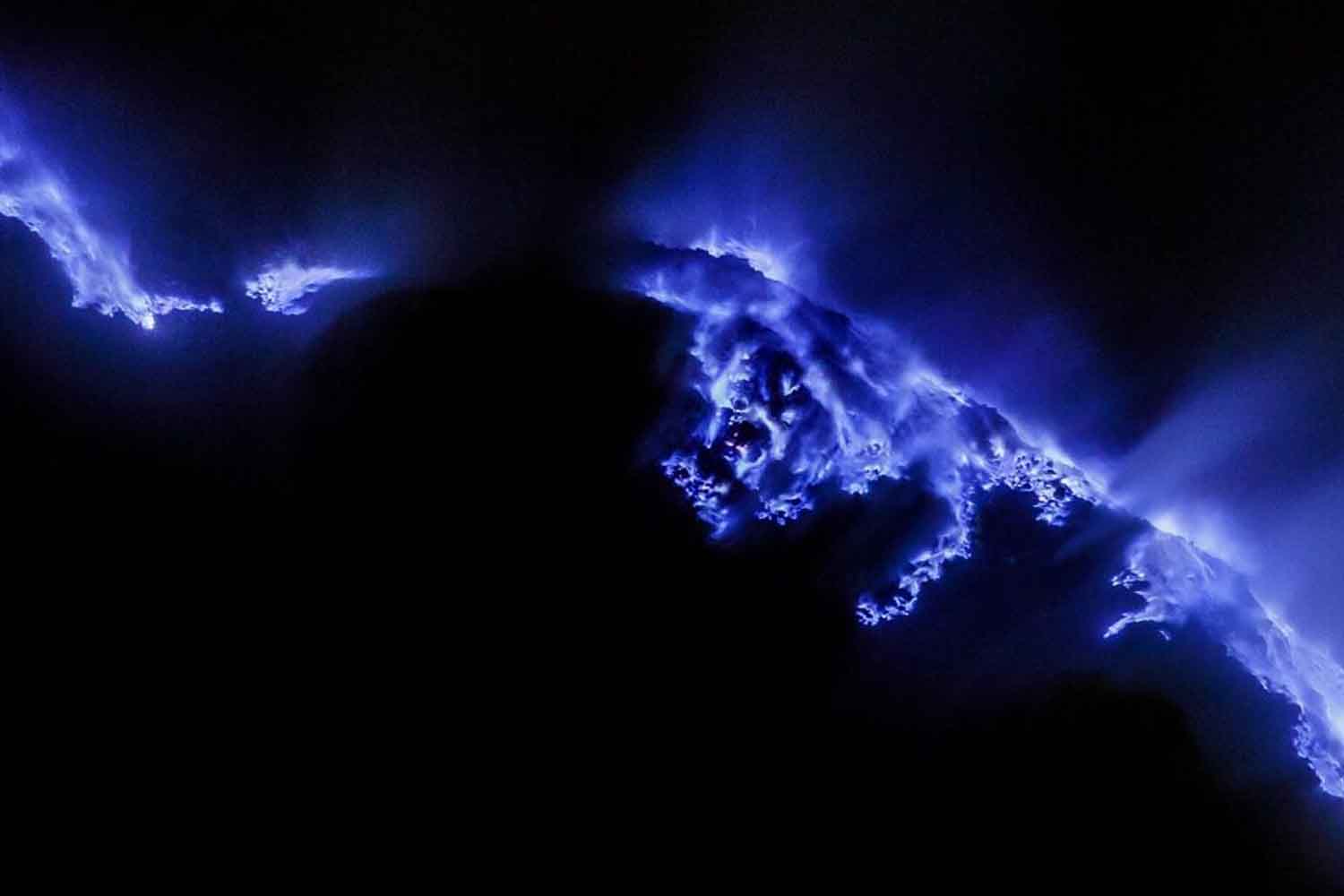
When we talk about volcanoes, the collective imagination immediately thinks of red or orange incandescent flows. Yet, in the heart of Indonesia, there is a place where the night lights up electric blue and the lava, at least apparently, seems to break every known rule of geology. It happens in the Kawah Ijen crater, one of the most surprising natural phenomena in the world, often defined – incorrectly – as “blue lava”.
From a scientific point of view, it is good to clarify it immediately: blue lava does not exist. Lava is molten rock and, depending on the temperature, can appear white, yellow, orange or red. When it cools, it darkens to gray or black. To take on a blue color, a magma flow would have to reach temperatures impossible on the Earth’s surface.
What is observed at Kawah Ijen, therefore, is not molten rock, but a phenomenon of sulfur combustion. The crater hosts one of the largest natural deposits of sulfuric gases on the planet. These gases escape from the subsoil through fractures and fumaroles at very high pressure and with temperatures that can exceed 600 °C. Upon contact with oxygen, sulfur catches fire, generating intense blue flames, visible almost exclusively at night.
There is much more beneath the surface
If it were just a matter of burning gas, the show wouldn’t resemble a lava flow at all. The detail that makes the phenomenon so fascinating is another. Part of the sulphur, as it burns, condenses into liquid form and continues to flow along the sides of the crater, remaining on fire.
The result is a river of molten sulfur that burns blue, with a slow, sinuous motion identical to that of real lava. It is, to all intents and purposes, a river of fire, a glowing mineral that flows through the night with unreal and almost ghostly reflections. In geology this type of event is called a cerulean eruption, a very rare phenomenon on our planet.
In addition to Kawah Ijen, another known example of a cerulean eruption is found in the Danakil Depression, Ethiopia, one of the most geologically extreme areas on Earth.
Those who visit Kawah Ijen during the day are often disappointed: there is no trace of the blue flames. The reason is simple. The sunlight visually cancels the color of the flames, while the crater fills with a dense whitish and acrid smoke, composed of sulfuric vapors and gases.
It is only after sunset that chemistry reveals itself in all its power. In the dark, the flames become clear, vibrant, almost fluorescent, transforming the volcano into a scenario that seems to have come from another planet.
There is also a solid scientific basis that helps understand why Kawah Ijen is such a favorable environment for extreme phenomena such as blue flames. A reference study is “Geochemistry, mineralogy, and chemical modeling of the acid crater lake of Kawah Ijen Volcano, Indonesia” by Delmelle and Bernard, which analyzes in detail the chemistry of the acid crater lake of Kawah Ijen. Research demonstrates how the lake’s waters are among the most acidic in the world, extremely rich in sulphates and fueled by the continuous release of magmatic gases, in particular hydrogen sulphide (H₂S).
Precisely the presence of native sulphur, which forms in more reducing conditions on the bottom of the lake and is then transported to the surface, confirms the existence of a highly active and chemically unstable volcanic system. This geochemical context does not directly explain the visual effect of the so-called blue lava, but it clarifies why an exceptional quantity of sulfur is present in the area, an indispensable element for the combustion which, at night, lights the crater with the famous blue flames.
When the flames die down and the sulfur solidifies, men mine yellow blocks of what is called “devil’s gold” by hand, loading them into heavy baskets and carrying them down steep slopes. It’s the dark side of one of the most incredible sights on Earth. The so-called blue lava is therefore an imprecise term, but the reality behind this name is even more extraordinary: a rare encounter between geology, chemistry and human resistance, capable of leaving anyone speechless.
You might also be interested in:
