
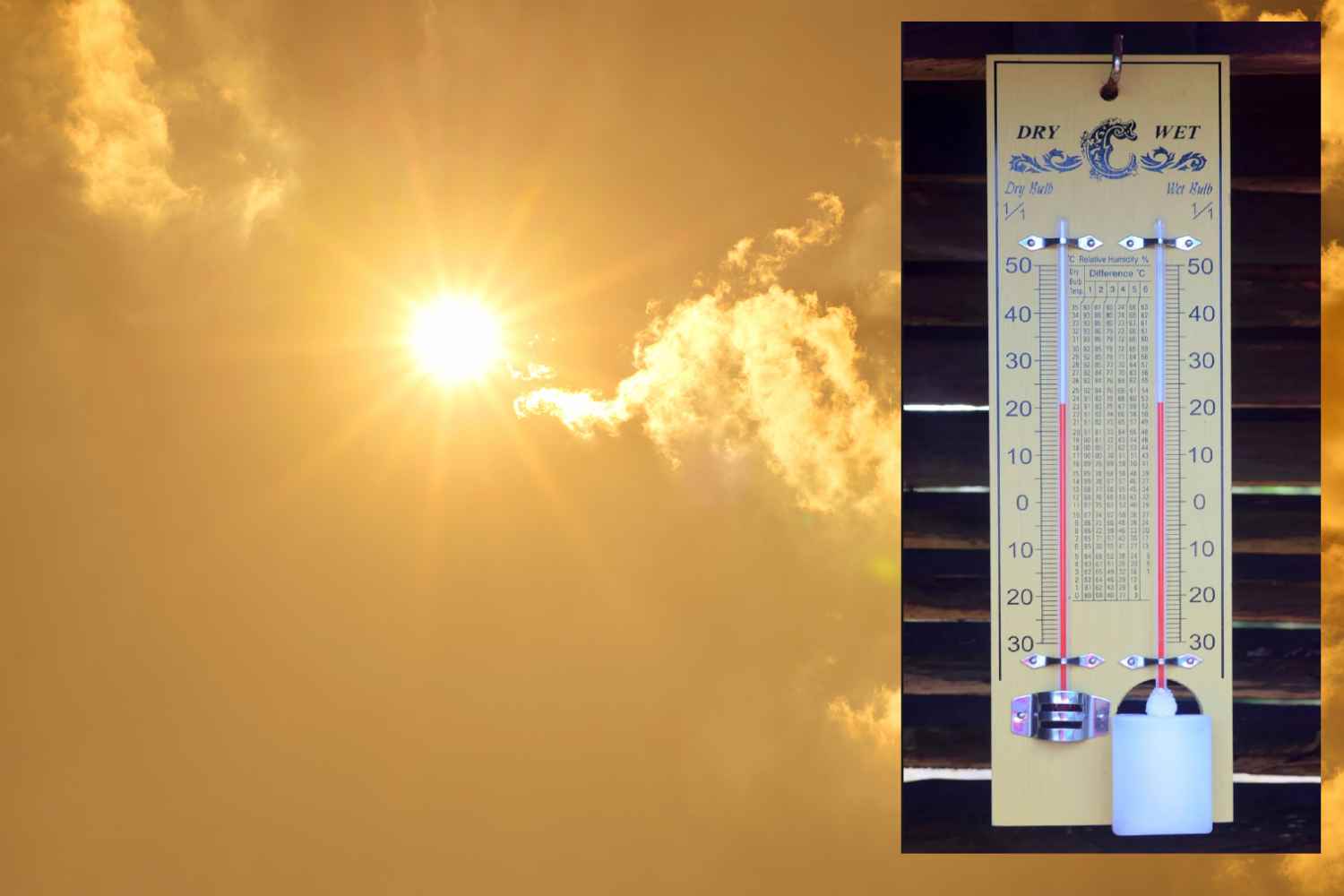
For years we have measured heat by looking at just one figure: air temperature. But a thermometer alone tells only part of the story. Two 40 degree days can have completely different effects on the human body. Humidity makes the difference, and it is precisely from here that one of the most important indicators for understanding climate risk arises: the wet bulb temperature.
@britannica.com
The thermometer that measures body stress
But what is wet bulb temperature? The name derives from the bulb, i.e. the small tank placed at the end of traditional thermometers, the one that contains the temperature-sensitive liquid. To measure this parameter, the bulb is wrapped in gauze kept moist. As the water evaporates, it removes heat from the bulb and lowers its temperature. The drier the air, the greater the evaporation and the cooler the thermometer; if, however, the air is already rich in humidity, evaporation slows down and the temperature detected remains close to that of the air. It is precisely this measurement that indicates how effectively the human body is also able to cool itself through sweat. In modern weather stations the value is now obtained mainly with electronic sensors, but the physical principle on which it is based remains the same.
In summary, the wet bulb temperature combines temperature and humidity to evaluate how much our body is able to disperse heat through sweating. If the air is dry, sweat evaporates easily and cools the skin. However, when the humidity is high, this mechanism stops: the sweat remains on the skin, the body accumulates heat and the internal temperature continues to rise.
This is why 40°C in dry air is not the same as 40°C in a humidity-saturated environment. In the second case, physiological stress increases rapidly, even while remaining in the shade.
The threshold of 35 degrees
According to the United Nations University (UNU-EHS), a wet bulb temperature of 35°C represents the theoretical limit beyond which the human body can no longer cool itself even with water and shelter from the sun. The Interconnected Disaster Risks 2023 report states that exposure for more than six hours can cause very serious consequences even for “a healthy young adult resting in shaded and ventilated conditions”. For the elderly, outdoor workers and frail people the danger comes much earlier.
The study
The most interesting data comes from the PSU HEAT Project at Pennsylvania State University. The researchers tested 24 healthy young adults in climate-controlled chambers, simulating light daily activities such as low-intensity walking or cycling. No participant reached the theoretical limit of 35°C: the conditions in which the body was no longer able to maintain a stable internal temperature occurred between 30 and 31°C in hot-humid environments and even between 25 and 28°C in very hot and dry ones. The authors conclude that “all observed critical thresholds were significantly lower than the theoretical 35°C” and that there is probably no single value valid for all climates on the planet.
The climate also changes risk
Global warming makes these conditions increasingly less exceptional. Extreme heat already causes around 500 thousand excess deaths every year in the world according to the UNU-EHS, while the increase in greenhouse gas emissions increases the probability that temperature and humidity will simultaneously reach critical levels.
The most exposed areas are South Asia and the Middle East. Jacobabad, Pakistan, considered one of the hottest cities on the planet, has already experienced conditions close to the critical threshold several times. If global warming continues, these episodes could become recurrent in several regions within a few decades.
Adapting is not enough
Air conditioners, fans, reflective roofs, trees and new urban planning strategies can reduce the risk, but they do not eliminate the problem. The wet bulb temperature is an indicator that measures the margin within which the human body can still adapt. Beyond that limit, not only does the way we perceive the heat change: the very possibility of living and working in some areas changes. For this reason, reducing emissions does not just mean containing a number, but preventing the climate from exceeding the threshold beyond which adaptation becomes increasingly difficult.
Sources: PSU HEAT Project / UNU-EHS
