
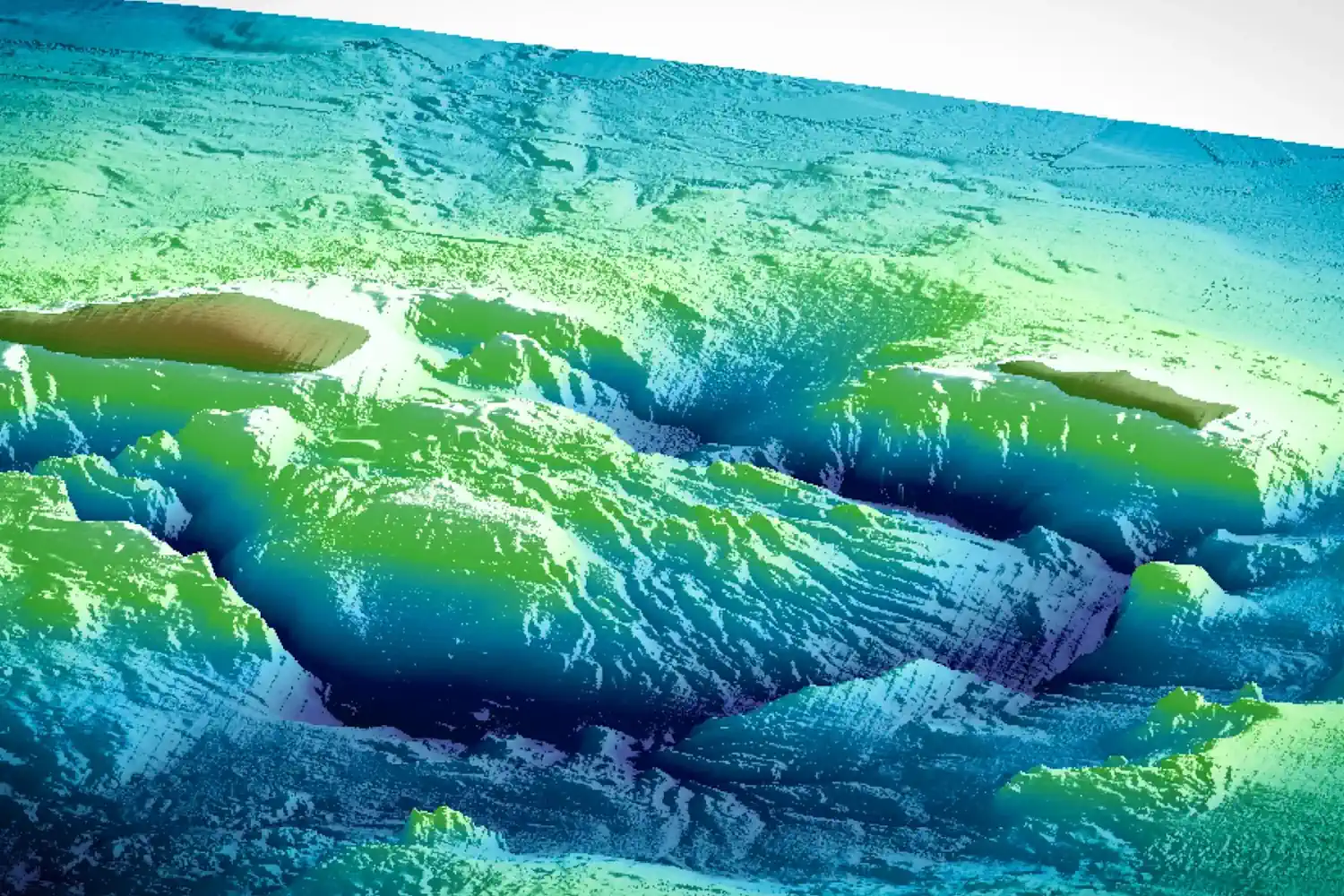
Seven thousand years may seem long enough to archive a catastrophe. In geology, however, they are little more than a long breath. Beneath the South Japan Sea, the Kikai caldera is showing something that researchers have been waiting to observe with this clarity for some time: the magma system linked to one of the largest eruptions of the Holocene is recharging. And this time the interesting point is not the catchy title. It’s the quality of the data.
The new research, published on Communications Earth & Environment by a team led by Kobe University, describes a large magma reservoir still active beneath the Kikai underwater caldera, with signals consistent with a re-injection of fresh magma into the same system that fueled the giant eruption about 7,300 years ago.
Kikai is located south of Kyushu Island and is a largely submerged caldera. This condition, which on paper would seem to complicate everything, instead offered the researchers an important operational advantage: working on a large scale in an area less disturbed by infrastructures and settlements. To reconstruct the deep architecture of the volcanic system, the team used a marine seismic refraction campaign, generating controlled waves and recording them with instruments placed on the ocean floor.
Those measurements revealed a low-velocity anomaly directly beneath the caldera. In simple words, an area where seismic waves slow down because the material at depth is partially molten. According to the study, this large magma reservoir lies at a depth of between 2.5 and 6 kilometers and extends at least as wide as the width of the inner caldera.
The next piece of data is perhaps the one that helps most to bring order. This reservoir would not be filled by liquid magma uniformly: the estimated melting fraction is relatively low, around 3-6%, with an assumed maximum ceiling close to 10%. It means that the system is active, yes, but not in the cinematic sense of the term. Rather, it is a vast, slow, evolving magmatic structure that accumulates material and heat over geological time.
The lava dome in the center of the caldera
In the center of the Kikai caldera a lava dome was formed after the great prehistoric eruption. The geochemical studies already available had shown that this structure, which has grown over the last millennia, has a different composition from the magma emitted during the event 7,300 years ago. And this is precisely where the new results gain strength: the chemistry and seismic data point in the same direction. The magma present today under the dome does not appear to be a cooled residue of the old eruption, but the product of a new feeding from below.
The study also quantifies the phenomenon. Over the last 3,900 years, at least 32 cubic kilometers of new magma would have been injected into the system, with an average rate estimated to exceed 8.2 cubic kilometers every thousand years. They are numbers that move the discussion from the generic to the measurable. The caldera is not simply “still alive” in an abstract sense: it is receiving new material in a volume that researchers can estimate.
This process is called melt re-injection, i.e. re-injection of molten magma into a large surface reservoir. And it is the true heart of the work published by Kobe: understanding how a system capable of a super-eruption rebuilds itself after collapse, how it reorganizes itself and in what forms it can return to accumulate magma under the caldera.
The Kikai supervolcano changes the way we read long volcanic silences
The part that is easiest to deform is also the part that must be held most still. This study doesn’t say Kikai is about to erupt. It does not signal an immediate alarm, it does not describe a system on the verge of exploding and it does not authorize catastrophic readings. What he says is different, and from a scientific point of view perhaps it matters more: even after a gigantic eruption, a caldera of this type can slowly fill again, using the same crustal space as a long-term reservoir.
The work also has a reach beyond Japan. The authors explicitly refer to comparisons with large systems such as Yellowstone in the United States and Toba in Indonesia, because comparable surface magmatic structures have been hypothesized or observed there too. If the dynamics seen at Kikai truly represent recurring behavior, then the long intervals of apparent quiet do not coincide at all with a shut down system. They coincide, more realistically, with a slow phase of recharge, partial cooling, rearrangement and possible accumulation.
Another useful piece comes from a 2024 JAMSTEC research on underwater cores from the same caldera. That work also indicated that, after a previous large eruption of about 95,000 years ago, the system had started to accumulate magma again after a few tens of thousands of years, then keeping it at depth for very long times before the next event. It is confirmation that supervolcanoes think on time scales that have nothing to do with the ordinary human horizon.
This is, after all, the most interesting point that comes from Kikai. The Japanese supervolcano isn’t offering an end-of-the-world scene. He’s offering something more sober and more important: a real-life model of how a giant reforms itself over time. Under the seabed, away from the eyes and the rhythms with which we read the present, the magma continues to rise. Floor. And in the meantime it forces geophysics to look at silences with less confidence.
You might also be interested in:
