
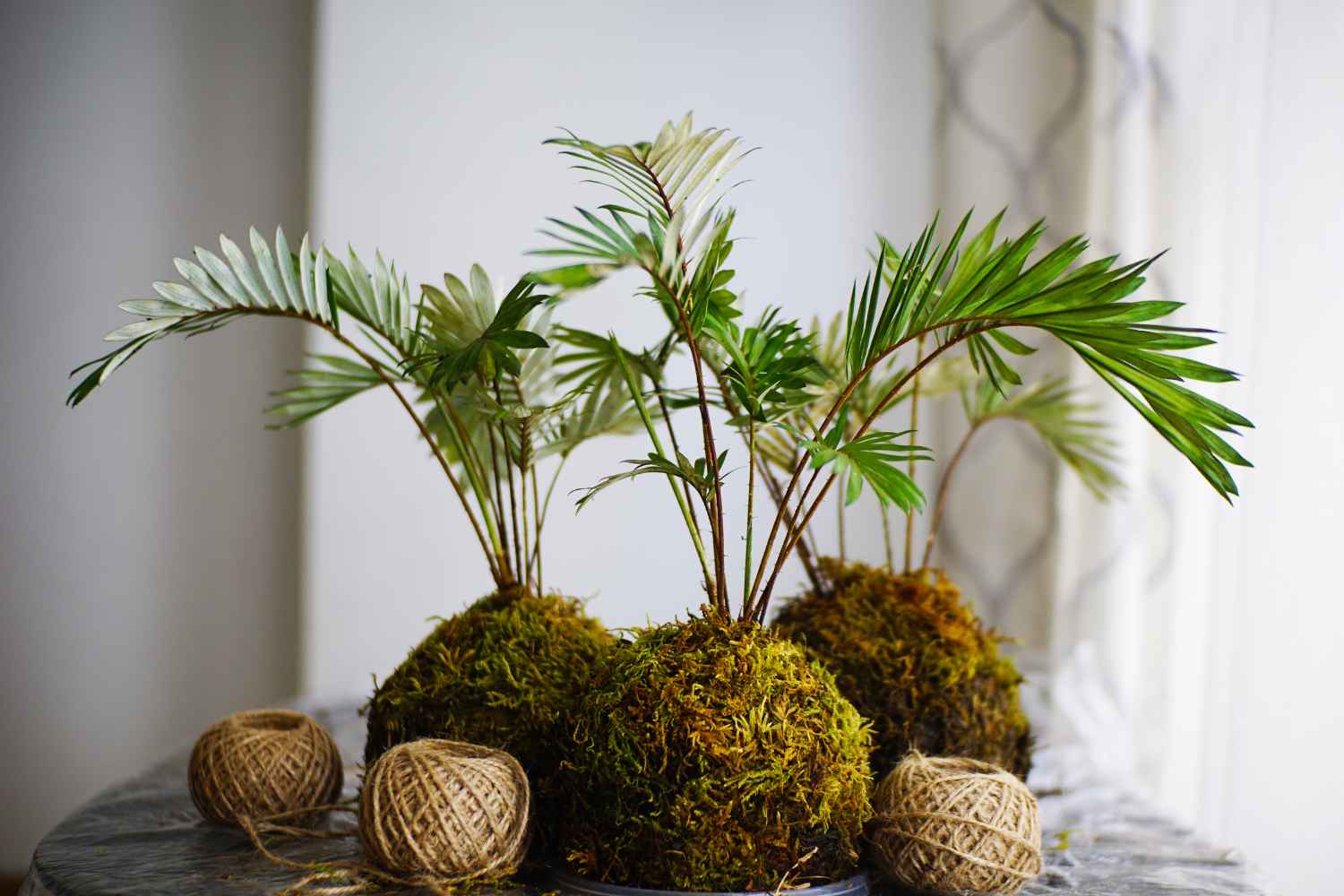
Imagine being able to transform your home into a suspended garden, where plants float in the air as small green islands. This dream can become reality thanks to Kakedama, an ancient Japanese technique that is conquering gardening enthusiasts all over the world.
An art born from necessity
The term Kakedama literally means “musk ball” and perfectly describes this fascinating form of cultivation. Its origins are lost in the Japanese tradition, but a legend tells of a farmer who, too poor to buy a vase, decided to wrap the roots of his plant in a mud and musk mixture. With his great surprise, the plant not only survived, but prosperous luxuriantly.
This technique represents an artistic evolution of bonsai, but while the latter remains anchored to the pot, the Kakedama completely frees the plant, creating a sculptural composition that can be resting on decorative surfaces or, even more suggestively, suspended in the air.
Floating plants
When a Kakedama is hung on the ceiling with a thin nylon thread, the effect is truly spectacular. A Floating Garden is created that transforms any environment into a Zen space, where nature seems to challenge gravity. The beauty of this technique lies in its simplicity: no bulky vessels are needed, sauces or complex drainage systems.
How to choose the right plants
Not all plants are also suitable for this technique. For beginners, it is advisable to start with resistant and adaptable species. The fatty plants and succulents are often the first choice, even if you have to consider that they prefer less humid environments than what the musk naturally offers.
The Ficus Ginseng represents an excellent option for those who approach the Kekedama for the first time, thanks to its extraordinary resistance. The ferns, with their delicate fronds, create a particularly suggestive effect when suspended, while fittonia and pilea, with their small size, adapt perfectly to this form of cultivation.
How to do

Creating a Kakedama is an almost meditative experience that requires few materials but a lot of attention. The heart of the technique lies in the preparation of the substrate, a special mix that combines Akadama (a Japanese clay), Ketotsuchi (a peat used for bonsai) and common land in equal parts. This mixture is moistened and modeled in a compact sphere, of the right size to accommodate the radical apparatus of the chosen plant.
Once the plant has been extracted from its original pot and gently clean the roots, these are inserted in the sphere of soil. The next step is the most artistic: completely wrap the sphere with moss, fixing it with natural string so that it becomes one with the substrate.
Before placing the Kakedama, it is essential to immerse it completely in the water, leaving it to soak until moss and soil are perfectly hydrated. Only then will your creation be ready to be exposed.
How to take care of a Kakedama
Taking care of a Kakedama requires a different approach than traditional pot plants. Exposure to light must be calibrated according to the specific needs of the plant: ferns can tolerate environments with little light, while other species need more illuminated positions.
Irrigation becomes a particular connection moment with the plant. The most effective method consists in periodically immersing the Kokedama in a basin of water at room temperature, preferably rainy, for about five minutes. After the immersion, it is important to gently squeeze the excess of water before repositioning it.
Alternatively, you can use a nebulizer to keep the humidity constant, remembering that the musk must remain humid but never excessively wet.
Kakedama is not only a cultivation technique, but a real lifestyle that invites to slow down and observe nature from a different perspective. Each creation is unique and tells a story, transforming the house into a living museum where art meets botany.
In an increasingly frenetic world, this ancient Japanese practice reminds us that beauty often arises from simplicity and that even without a vase, life always finds a way to express itself in all its magnificence.
