
The images we use to talk about plastic pollution almost always follow a rather lazy script. Bottles floating in the sea, bags caught in branches, river banks transformed into landfills, fields that absorb waste with the desperate patience of things that remain there for years. Then scientific research arrives, moves the camera a few meters, changes the angle and ruins the illusion.
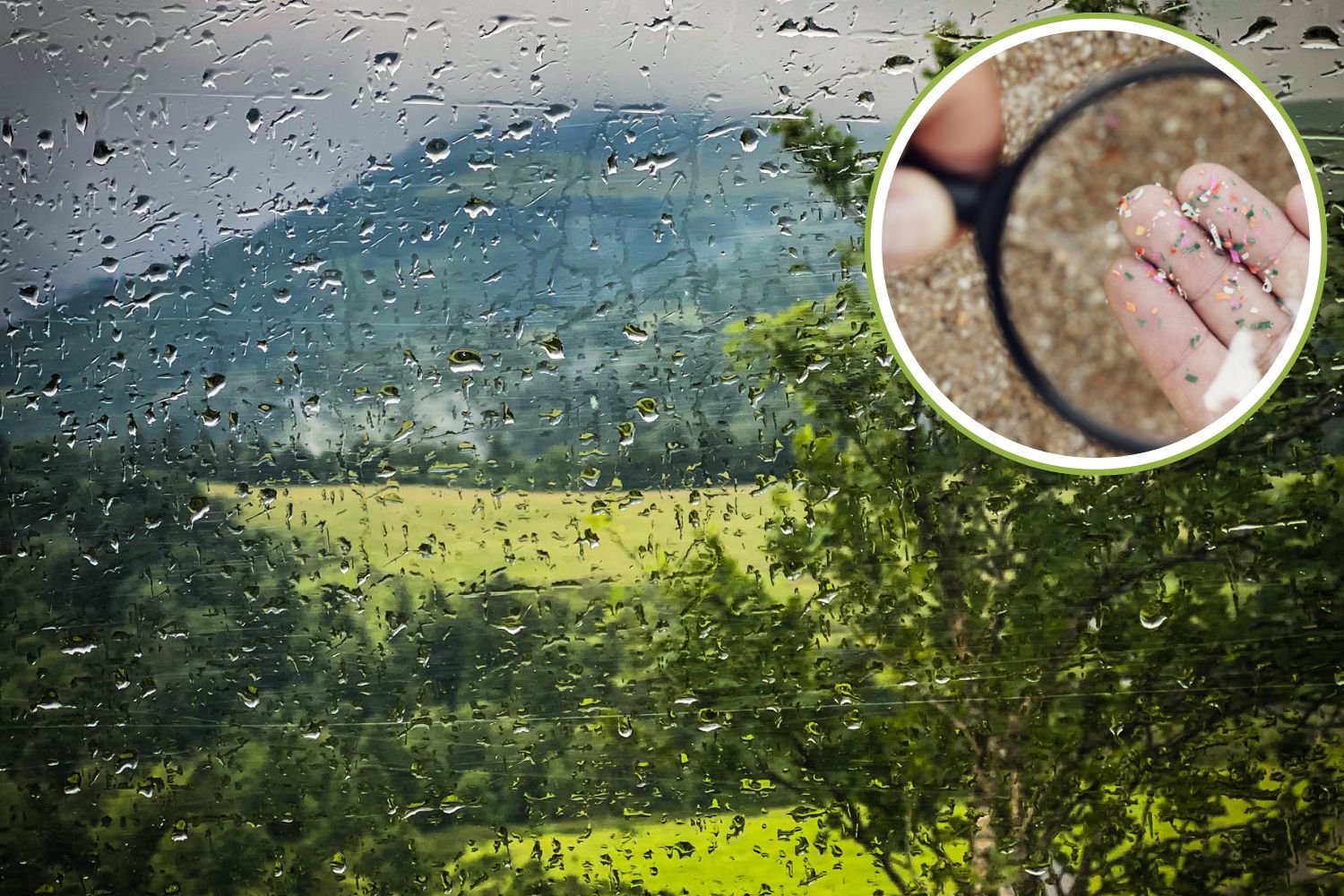
Microplastics in forests don’t just come from the ground. They arrive from above, move in the atmosphere, rest on the foliage and slowly descend towards the ground until they become part of ecosystems that we continue to imagine as places separated from the chaos that surrounds them. The study signed by Collin J. Weber and Moritz Bigalke, published on Communications Earth & Environmentshows precisely this: forest soils accumulate microplastics mainly through atmospheric deposition.
Microplastics in forests follow an almost invisible trajectory
For years we have described plastic as an invasion that was advancing along the most visible paths. The abandoned waste, the torrent that drags, the human gesture easy to point at with the finger and even easier to use as a moral alibi. This research adds a much more subtle, and therefore more disturbing, trajectory. An important part of the pollution reaches the forests through the atmosphere, transported by the wind even over long distances, until it is deposited on the treetops. Weber explains that the particles present in the air initially stop on the leaves in the upper part of the forest, in what scholars call the comb-out effect, and then are transferred to the ground by rain or the autumnal fall of leaves in deciduous forests.
At that point, the leaves stop being just a plant surface. They become a temporary landing strip for tiny synthetic fragments. The rain does the rest, with the impersonal efficiency of things that work too well. Autumn closes the circle: the leaves detach, fall, dragging with them the plastic intercepted during the previous months and delivering it to the ground. That movement that we are used to reading as an image of passage, cycle, transformation, carries with it a much less poetic burden. The forest intercepts, holds, accompanies downwards.
From there the most uncomfortable part of the story begins. Once they reach the ground, microplastics do not remain still like dust on the edge of a piece of furniture. They immediately enter the cycles of the forest. The dead leaves decompose, the litter is transformed, the soil organisms work tirelessly, and within this continuous metabolism the plastic fragments are retained and then pushed progressively deeper. The authors of the study detected a short-term enrichment in the decomposing litter horizons and then an accumulation in the lower mineral layers, precisely due to litter turnover processes. In other words, plastic quickly stops looking like a foreign body resting on the surface and begins to behave like an embedded presence in the soil.
Here the tone changes. The forest land has a very dense, industrious life, almost ferocious in its continuity. Bacteria, fungi, microfauna, nutrient exchanges, water that filters, matter that decomposes and becomes useful for something else. When plastic enters this system permanently, the problem ceases to have the reassuring face of a recognizable object. It becomes a question of altered balances, of processes that can slow down, deviate, lose efficiency. Weber says it with a sobriety that weighs more than many alarmist formulas: forests are already threatened by climate change and the results suggest that microplastics may represent an additional threat to these ecosystems.
Forest soils retain decades of accumulation
To understand how this accumulation works, the researchers worked in several forest sites in central Germany, analyzing organic and mineral soil and also measuring deposition through throughfall, i.e. the water that passes through the canopy and reaches the ground. The heart of the work lies in aligning this data and trying to reconstruct the origin of the particles. The result is clear: the characteristics of the microplastics detected in the soil and in deposition through the foliage are similar, and this indicates that the main entry route is the atmosphere, together with falling leaves. The other sources have less weight.
The really difficult step, however, comes when researchers try to give temporal depth to the phenomenon. By calculating the stocks present in forest soils and deposition flows, the study estimates the contribution of atmospheric input to the accumulation of microplastics in forests up to 1950. This scale completely changes the perception of the problem. It means that today’s soils may harbor decades of slow, steady, seemingly imperceptible deposition. Particle after particle, season after season, the forests recorded synthetic rain that continued to fall while everyone looked away.
And it is precisely here that microplastics in forests stop seeming like a technical detail for professionals. Forests become a kind of atmospheric archive. A silent, very severe register, which preserves proof of how much widespread pollution continues to fall from the air. In fact, Weber concludes that forests are good indicators of air pollution from microplastics and that high concentrations in forest soils indicate a high widespread contribution of airborne particles, different from a direct contribution such as that linked to fertilizers in agricultural soils.
This is the part that really broadens the problem. Plastic pollution loses the reassuring boundaries we have sewn on it. It comes out of the industrial suburbs, the urban edges, the river banks, the greenhouses, the fields. It appears in places that we continue to imagine as a safe elsewhere, almost a scene outside the noise of the system that produces plastic without respite. Instead, the forest intercepts that noise even when it seems immersed in silence. It’s a bit like when in certain dystopian films the refuge in the mountains seems like the perfect escape route and then a particle, a cloud, a tiny detail is enough to understand that the world has already entered there too. Plastic follows precisely this logic: discreet, capillary, tenacious.
The forest loses the aura of an uncontaminated refuge
The big picture makes this discovery even more weighty. Forest ecosystems are already dealing with rising temperatures, prolonged droughts, increasingly marked meteorological imbalances and ecological pressures that pile up on each other. To this scenario is now added a widespread deposit of plastic particles which could interfere with the health of the soil, with water flows and with the life of the organisms that inhabit the underground layers. The forest, which in our imagination often remains synonymous with respite, shade, breathing space, thus fully enters the global geography of plastic.
Then there is an aspect that affects people much more closely. If microplastics can travel in the air and even reach forests considered remote or at least far from direct sources of contamination, then the issue of human exposure through the atmosphere becomes even more concrete. Weber also explicitly recalls this point: the confirmation of the global transport of microplastics in the air makes it inevitable to question what is also moving in the air we breathe. The research does not close the discussion on long-term health effects, but it shifts the question into a space where it becomes difficult to pretend nothing happened.
In the end, there remains a truth of those that arrive without the need for special effects. Microplastic pollution does not stand still. It moves in water, in air, in soil, in organisms. Change shape, change trajectory, change scenery. And meanwhile the forests, which continue to seem like a sheltered elsewhere, collect this continuous fall with the silent discipline of living things. Leaf after leaf, rain after rain, year after year. The study was published on Communications Earth & Environment.
You might also be interested in:
