
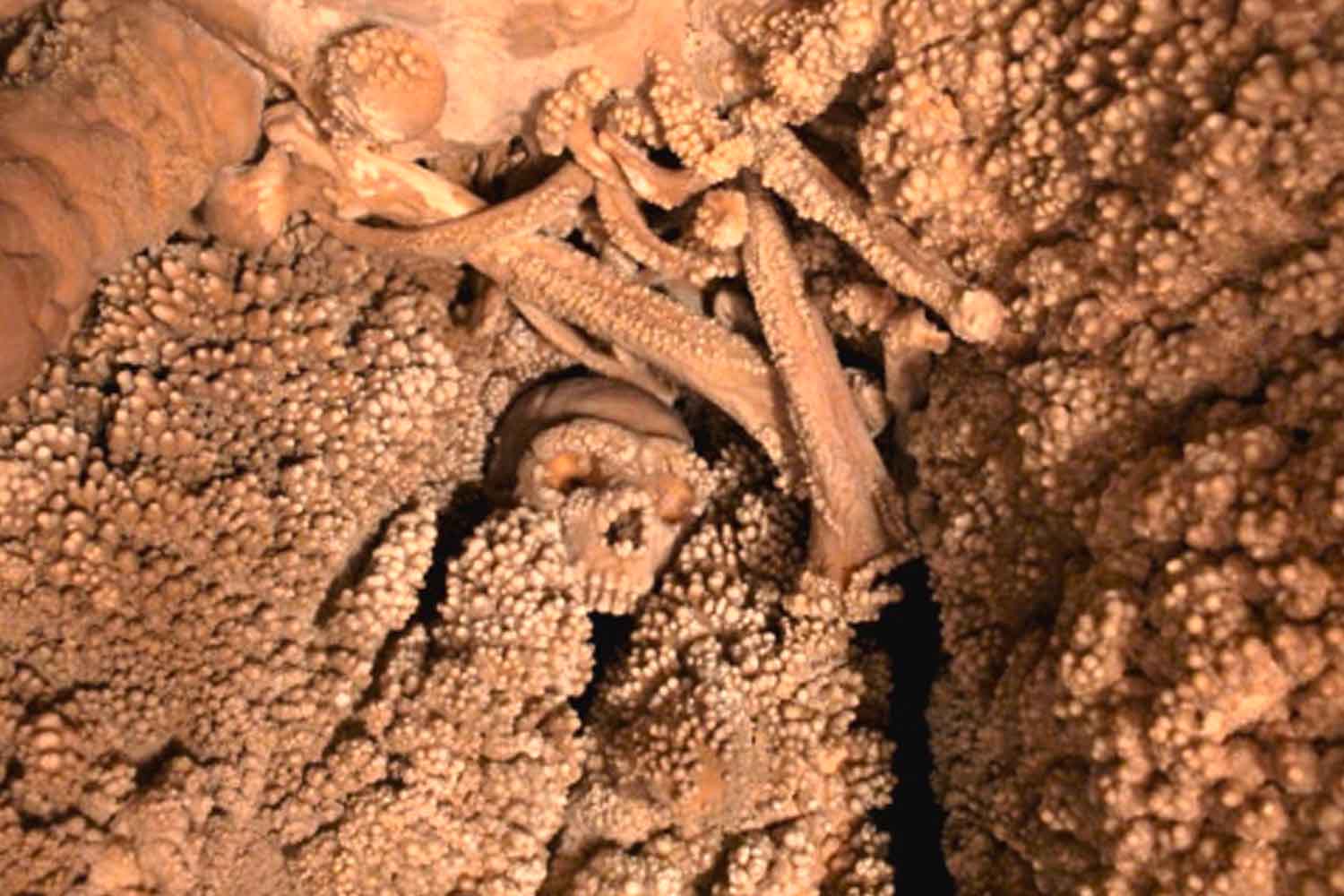
In a remote cavity in Southern Italy, closed and remained intact for 130,000 yearsscientists in 1993 brought to light a fossil capable of radically changing what we thought we knew about Neanderthal noseone of their most enigmatic peculiarities. For decades, the wide nostrils and the massive structure of the face have been attributed a protective function: a genetic adaptation to the glacial winters, necessary to warm and humidify the freezing air of prehistoric Europe.
The discovery kept in the Lamalunga Cavenear Altamura, calls everything into question. Here still lies trappedMan from Altamuraan extraordinarily well-preserved skeleton, literally wrapped in a thick calcite shell. This mineral “armor” has sealed anatomical details like no other for millennia Neanderthal skull had never been returned: especially the inside of the nasal cavity, which until now had always been fragmented or compromised.
The digital reconstruction of the Altamura skull
When the fossil was identified in 1993, leaving it in the cave was an obvious choice: removing it meant risking destruction. Three decades later, that caution has turned into a once-in-a-lifetime scientific opportunity. A team led by Costantino BuziUniversity of Perugia, introduced optical micro-probes inside the skull, filming bony elements such as the ethmoid, the vomer and the inferior turbinates: structures that, in other Neanderthals, were missing or useless.
From the images, then reproduced in Very high definition 3D modelsit turns out that Neanderthals’ famous “cold nose” may never have existed in the way imagined for years. Two characteristics considered autapomorphies — that is, exclusive traits of the species — result absent in the nasal cavity of the Altamura Man. According to several paleoanthropologists, including Todd Rae from the University of Sussex, this discovery undermines the idea that Neanderthals had a respiratory system specifically designed to counteract freezing temperatures.
In short, the shape of the nose would not be a simple effect of the glacial environment but the result of a more complex combination of biological factors. Scholars speculate that much stems from the their massive bodycapable of consuming more oxygen: a metabolic requirement capable of influencing the morphology of the face more than any extreme climate.
A revolution of method
The real turning point, in addition to the results, concerns the method. The study on the Altamura Man did not touch a single fragment of the skull: the entire investigation was conducted through virtual paleoanthropologya growing discipline that combines forensic science, high-resolution imaging and digital modeling.
The work fits into the THOR Projectwhich develops technologies to study fossils embedded in karst caves without affecting the context. Similar techniques had already made it possible to analyze the rest of the skeleton between 2023 and 2024, but it is the reconstruction of the nasal cavity that represents the most innovative step.
If this approach becomes the standard — and everything indicates that it will — we could be faced with a general revision of evolutionary models. Many fossils, considered “known”, could tell a different story once observed with more accurate and less invasive digital tools.
The discovery of the Altamura Man not only reshapes the face of the Neanderthals, but resizes the very idea of adaptation, often narrated as a linear correspondence between environment and anatomy. Their nose, a symbol of an evolutionary model that seemed obvious, could instead reflect physiological, metabolic and perhaps even genetic needs not linked to the glacial climate.
A single skull that has remained sealed for 130,000 years thus manages to undermine one of the most resistant myths of paleoanthropology. And if evolution is more nuanced, and much less schematic than we imagine, we owe it to a fossil that continues to speak without ever having been touched.
