
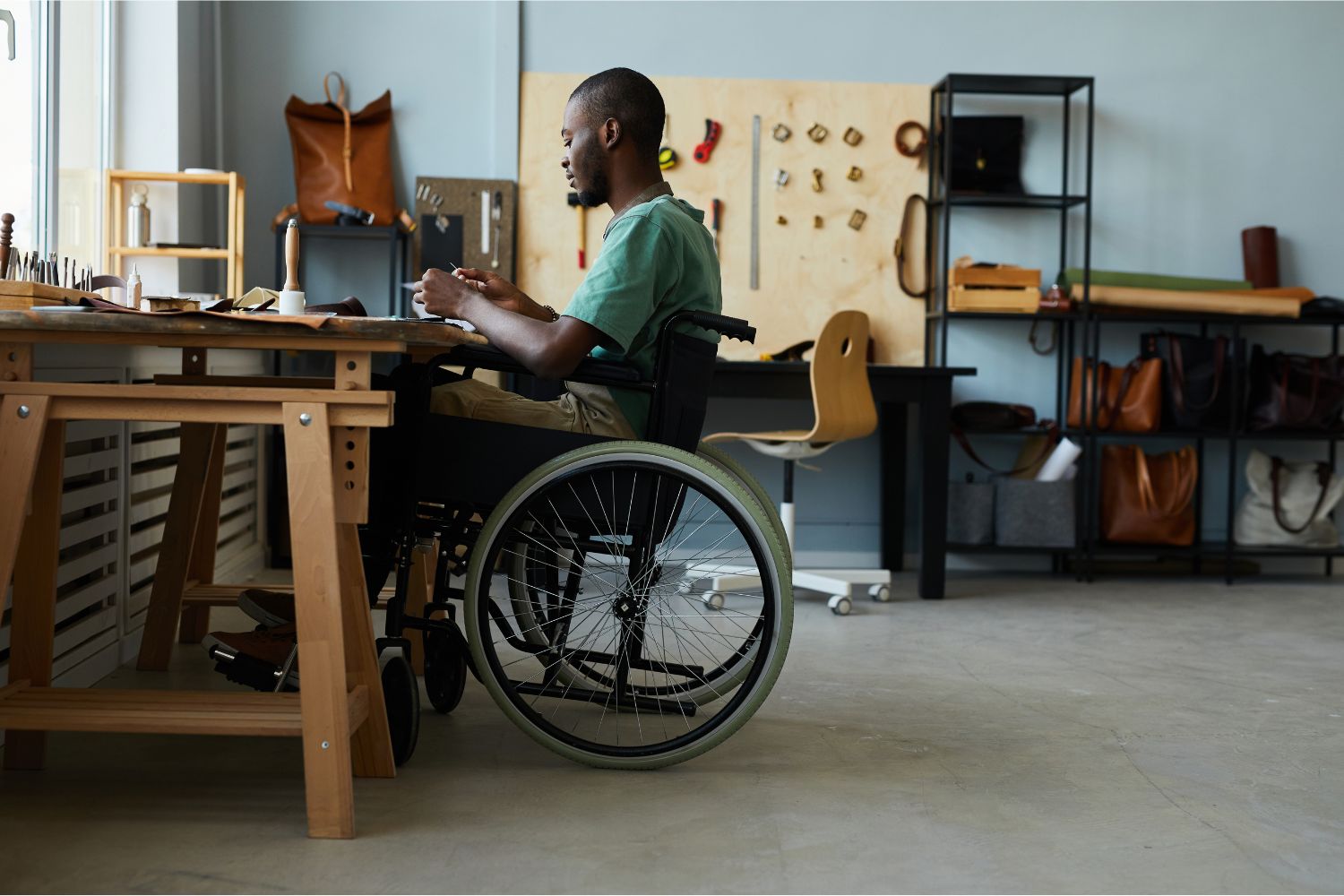
There is disability and disability, of course, but there is also a whole world behind it made up of great efforts and small satisfactions, of questions falling on deaf ears and doors closed in our faces, of a minimum amount of trust to ask for in order to live with dignity. There is disability and disability, of course, but also a whole series of nuances that are always worth seeing, because only with those do you have the opportunity to give a name to things, to all things, and not to lose sight of a person. The person.
Because this is precisely the point: we constantly lose sight of people with disabilities, convinced that we, the able-bodied and dull, are incapable of managing anything, incapable of overcoming an obstacle or taking responsibility. And this is how pottery and cutting and sewing courses are pouring in, regional courses lasting 12 hours a week in which to keep them for a while, without ever teaching them a skill, without ever teaching them the right value of a job. And of a salary, too, that can give them hope of a future, of a Afterof a When the people who now take care of them will no longer be there.
We are groping in the void, with compassion and pity in the background, and we forget what people living with a disability really need. Social inclusion is the real challenge. And it’s not made of cuts and sews.
View this post on Instagram
International Day of Persons with Disabilities
Today, December 3, we celebrate the 33rd edition of the International Day of Persons with Disabilities. This year’s theme is “Promoting inclusive societies for people with disabilities to promote social progress”, building on what emerged during the recently concluded Second World Conference on Social Development in Doha, when the “persistent obstacles” that disabled people still struggle with: increased risks of poverty, limited access to decent work and lower wages, gaps in social protection, barriers to autonomy, dignity and decision-making within care and support systems, and unequal access to assistive technologies and accessible environments.
People with disabilities at work in Italy
According to data, in Italy, only 33.5% of people between 15 and 64 years old with serious limitations have a job. A recent OECD report confirms that, even when access is achieved, job positions do not always correspond to the skills and qualification levels acquired.
The academic framework has the same critical issues: despite having around 36,000 students with disabilities enrolled in Italian universities, less than 500 enroll in post-graduate research courses, a proportion that shows how much work is still needed to guarantee equal opportunities in professional growth and entry into the world of research.
Furthermore, not all public administrations have fully covered the positions reserved by law 68/1999, leaving professional rights and potential partially unfulfilled.
The numbers, therefore, still bear witness to the difficulties in accessing the world of work for many citizens with disabilities.
Nevertheless…
Yet perhaps only in recent years has something moved. Thanks to the push of associations, researchers and workers themselves, the awareness is growing that inclusion is not a favor, but an investment.
In Italy, a great example of this is Nico Acampora, who – with his PizzAut – gives work and dignity to autistic children.
View this post on Instagram
Companies that have chosen to adopt robust accessibility policies and reasonable accommodations are seeing higher rates of productivity, while universities that have expanded specialized tutoring and assistive technology services are starting to see increased access to more advanced pathways.
In short, there are successes and, even if they are not uniform nor sufficient, they demonstrate that when barriers are broken down, the result is not the virtuous exception: it is normality that simply manifests itself.
At the same time, the limitations still present make it clear that sporadic interventions are not enough. We need stable structures, rigorous controls on the application of rules, career paths that don’t stop at the front door and a cultural change that recognizes competence before condition.
As long as the full participation of people with disabilities continues to depend on the goodwill of a single office or a single manager, Italy will remain behind. The challenge, therefore, is not to imagine a more equal future: it is to build it decisively, without being satisfied with small steps when it is clear that leaps forward are needed.
