

Contamination from Pfas (substances per- and polypluoroalchilic) Today it represents one of the most insidious and persistent environmental threats, which has serious repercussions on human health and ecosystems. These “eternal pollutants”, used in a wide range of industrial and consumer products, are extremely resistant to degradation, and often end up accumulating in the aquifers and, consequently, in the drinking water we drink every day, as has also shown the latest Greenpeace investigation.
But now, one New all -Italian technologyoffers a possible turning point: an innovative graphene oxide filter, capable of effectively removing even the most difficult contaminants.
Pfas: because they are so dangerous and difficult to eliminate
The PFAS are found in many commonly used products: non -stick coatings, waterproof fabrics, fire foams, food packaging, cosmetics. Their chemical structure makes them extremely stable and persistent in the environment.
Several scientific studies have associated prolonged exposure to PFAS with serious health problems, including hormonal dysfunctions, immune system disorders, reduction of fertility and increased risk of some types of cancer. Eliminating these substances from the water we drink every day should therefore become an absolute priority all over the world and fortunately scientists are working on possible solutions.
The new CNR technology
The National Research Council (CNR), in collaboration with the Medica Spa company, has developed one New generation of drinking water filters which are used by the integration of composite membranes of graphene oxide (Go) and Polisulfone on the basis of cave capillary fibers.
Published on Nature Water, the discovery demonstrates how these filters are able to retain emerging contaminating with great effectiveness, including PFAS, as well as other dangerous substances such as shit antibiotics and lead.
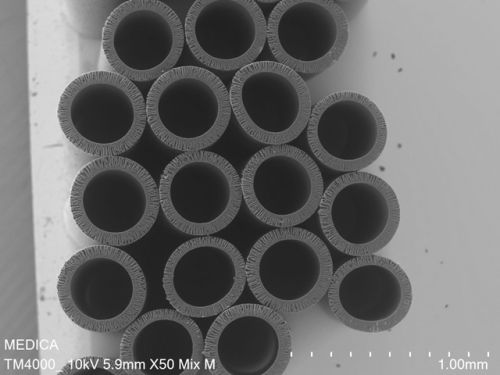
The performance of this technology are comparable – if not higher – to the best systems currently on the market, with the advantage of being more sustainable and easily integrated in existing industrial processes.
In addition to the PFAS, there are hundreds of chemical compounds, emerging contaminants, which end every day in our waterways: drugs, pesticides, microplastics, sunscreen, flame delaying filters. Often these are not yet regulated substances, but which can have harmful effects even at very low concentrations. The new technology developed thanks to the European Graphil project has shown that it can also remove these compounds thanks to the high graphene adsorption capacity and the selective structure of the Polisulfone membranes.
The new filter is not only effective, but also ready for large -scale production. Use minimal quantities of oxide graphene, it is compatible with the already existing industrial lines and guarantees low costs.
CNR technology shows that innovation can (and must) be at the service of sustainability. As he said Vincenzo Palermo, one of the authors of the work and director of the Institute for the organic synthesis and photo capacity of the CNR of Bologna (CNR-Isaf):
It is an effective example of how fundamental research, if oriented towards industrial needs and supported by targeted public funding, can lead to concrete technological results. We have developed a technology that combines security and sustainability, thanks to which Medica Spa will be able to produce thousands of filters per year.
