
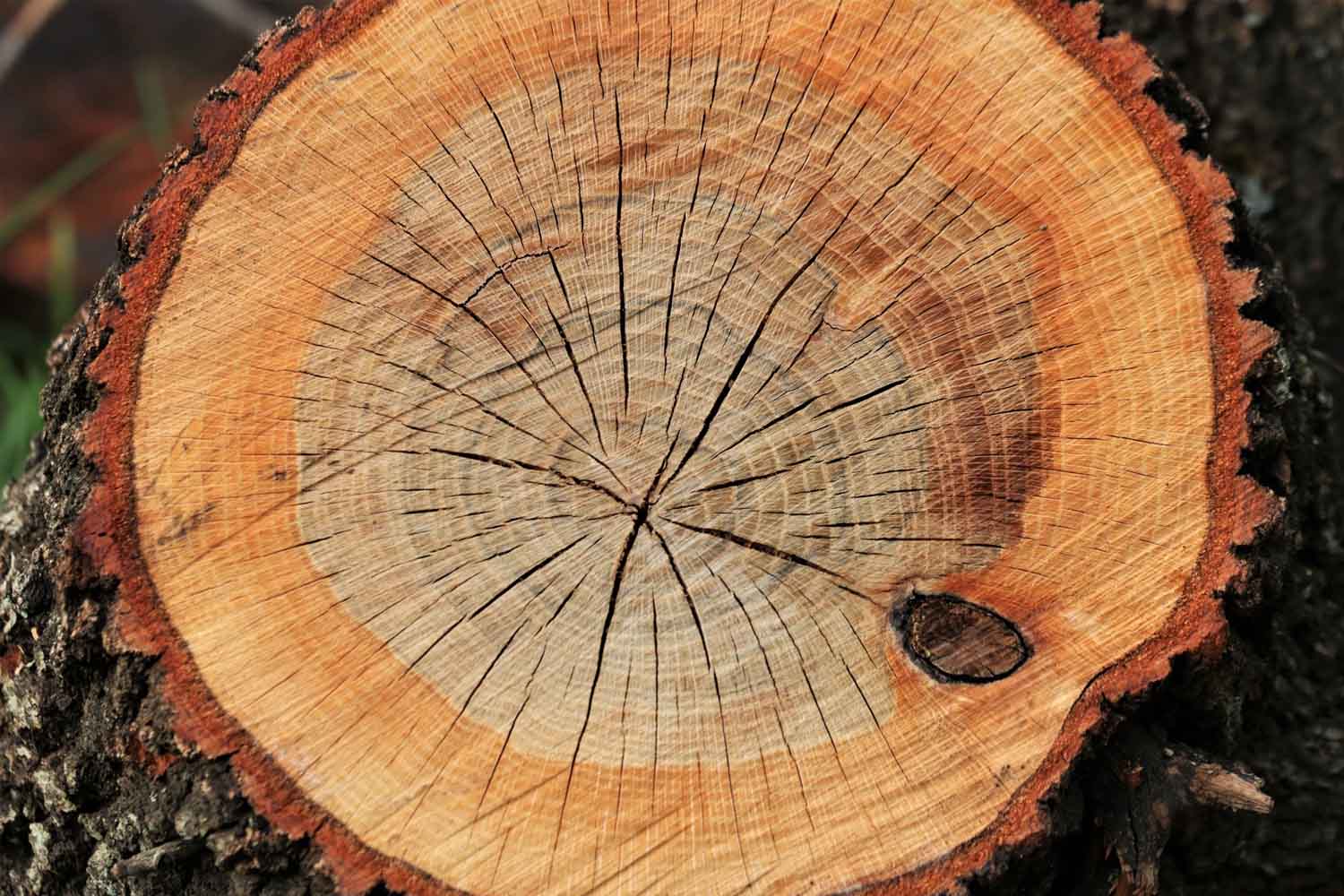
Tree rings are not simply concentric circles imprinted in wood. On the contrary, they represent a true natural chronicle capable of telling stories of climate, environment, diseases, extreme events and even human activities, much beyond the simple determination of the age of a plant.
When looking at a section of trunk, what is evident is the alternation of lighter and darker bands. This pattern is not random. Growth rings form because trees grow differently depending on the seasons. During spring and summer, when light is plentiful and water is available, growth is rapid and produces larger, lighter rings. In the winter months, however, the metabolism slows down and the wood compacts, giving rise to thinner and darker rings.
This seasonal alternation allows not only to count the years of life of a tree, but also to identify with surprising precision the period of the year in which it was felled, observing whether the last ring is complete or interrupted. A precious detail for scholars, archaeologists and landscape historians.
What tree rings reveal about climate, disease and environmental stress
The rings are not all the same because the growing conditions change from year to year. Favorable periods, with mild temperatures and regular rainfall, leave traces in the form of wide rings, while years of drought, intense cold or nutrient deficiency produce narrow and irregular rings.
This sequence of wide, thin rings works like a natural barcode. Trees growing in the same geographic area, being exposed to a similar climate, show almost identical growth patterns. By comparing these patterns, it is possible to reconstruct past climate variations, identify years of environmental stress and recognize the presence of diseases, parasites or physical damage, such as fires or late frosts.
In some cases, the rings can even witness exceptional events, such as volcanic eruptions or periods of global cooling, that slowed tree growth on a large scale.
From tree rings to wood dating
By analyzing wood samples of different ages but with overlapping periods, scholars are able to construct extremely reliable chronological sequences. This method allows you to date wooden beams, buildings, finds and artifacts, even if they were made centuries or millennia ago, providing a maximum possible age for historical and archaeological structures.
In England, thanks to the combined study of oaks and pines, a continuous chronology dating back almost 7,000 years has been reconstructed. On a European scale, the same technique has made it possible to extend this natural archive up to approximately 12,000 years, offering one of the longest and most reliable testimonies of the climate of our continent.
Tree rings, therefore, are not just a botanical curiosity, but a scientific source of extraordinary value: a diary engraved in wood, capable of recounting the Earth’s past with a precision that few other natural archives can boast.
You might also be interested in:
