
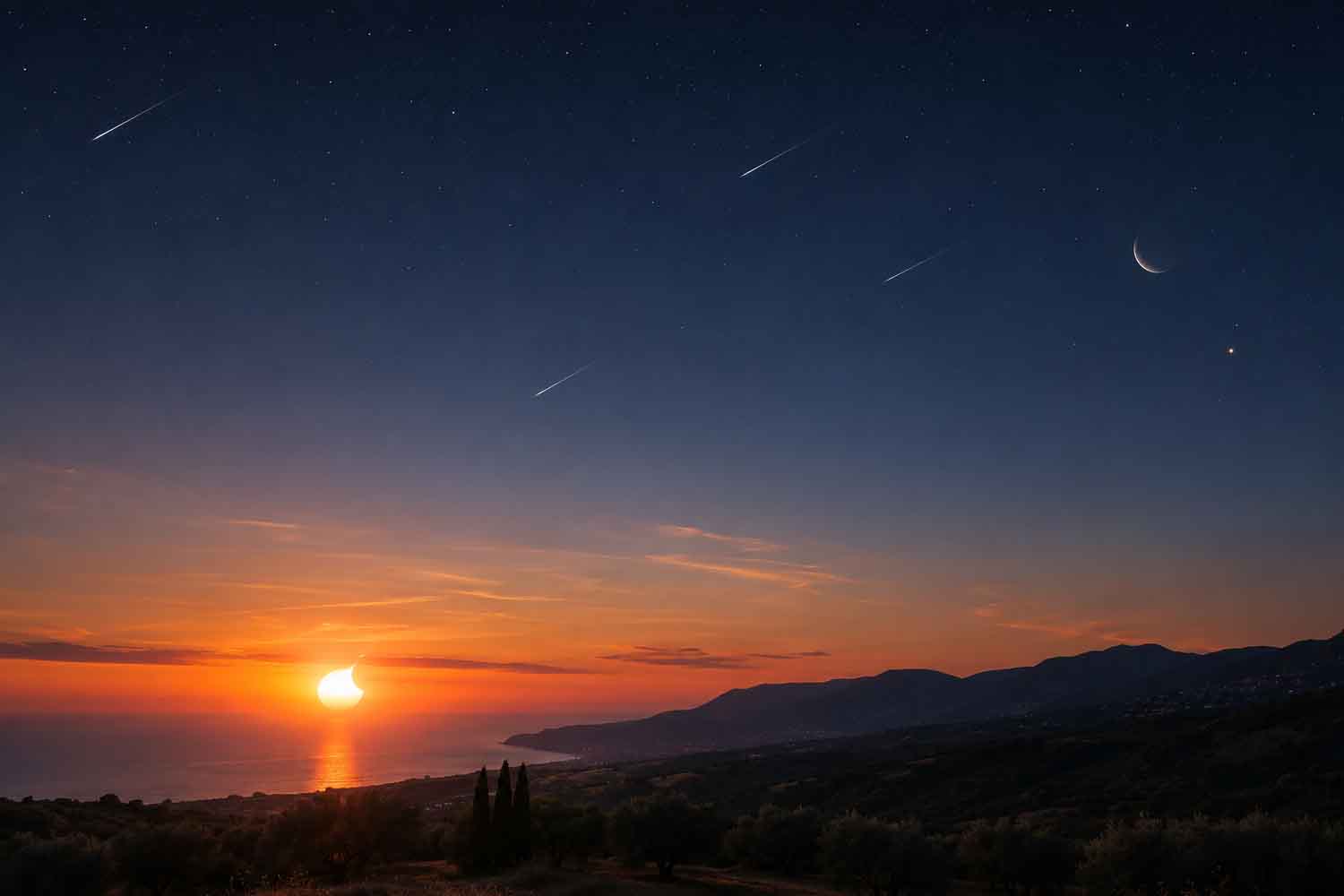
The August 12, 2026 the Sun will begin to disappear behind the Moon while it will already be low on the western horizon. A few hours later, after sunset, the same sky will remain without moonlight during the maximum of the Perseids. First you will need certified glasses, then a blanket and a lot of darkness: the astronomical events of August 2026 they organized a decent relay.
The month begins already on the night between August 3rd and 4th with the Moon and Saturn, continues on the 9th with Mars and concentrates the busiest passage between the 12th and 13th. The partial lunar eclipse of August 28th will close, visible before dawn with our satellite now close to sunset. Dates and times are those indicated by the Italian Amateur Astronomers Union; the precise position of the stars and visibility may change slightly depending on location.
August 3-4: The Moon meets Saturn
From the late evening of August 3, the waning Moon will rise together with Saturn towards the East, in the constellation of Pisces. The most suggestive approach will be visible in the central hours of the night, around 2 of August 4th. Naturally, this is an apparent proximity: the two bodies remain separated by distances that a photograph from the balcony kindly tends to ignore.
The duet will be recognizable even to the naked eye. A small telescope will instead allow you to observe Saturn’s rings, provided you can keep the instrument still at that time and have a fairly clear eastern horizon. The planet is still low in the early hours of the night and will progressively rise in the sky.
August 9: a crescent Moon next to Mars
Before the dawn of August 9tharound 3, a thin waning crescent Moon will rise in the East accompanied by Mars. The two stars will appear between the constellations of Taurus and Gemini. The reddish color of the planet will help distinguish it from nearby stars, while binoculars will be able to better show the reliefs along the illuminated part of the Moon.
You will need to look for a place with a clear view towards the East: both objects will still be quite low. The phenomenon will be visible to the naked eye and will not require any special equipment, apart from an alarm clock that is not inclined to negotiation.
August 12: The solar eclipse will arrive at sunset
Around 7.30pm on August 12th the Moon will begin to cover the Sun. In Italy the eclipse will only be partial; the band of totality will instead cross Greenland, Iceland, part of Russia, Spain and a small stretch of Portugal. The Italian phenomenon will be more evident in the northern and western regions, while the darkened portion will decrease moving towards the South.
In Ventimiglia, one of the most favored Italian locations, the Moon will almost cover the 95% of the apparent diameter of the Sun around 8.23pm. At that time the Sun will be just 1.6 degrees above the horizon. Trees, buildings, mountains and even a seemingly harmless mist can then erase the scene. You will need a point facing West with a very low horizon: a beach exposed to the sunset will be among the best solutions.
During all phases visible from Italy it will be necessary to use glasses or solar visors compliant with ISO 12312-2. Sunglasses, even very dark ones, do not protect your eyes; the same goes for smoked glass, improvised films and filters mounted in the wrong place on binoculars or telescopes. The eclipse can also be observed by indirectly projecting the image of the Sun through a small hole.
August 12-13: The Perseids will find a moonless sky
The evening of the eclipse will coincide with the New Moonscheduled for August 12 at 7.37pm. The maximum of the Perseids will also arrive on the night between the 12th and the 13th, the meteors produced by the fragments left along the orbit by comet 109P/Swift-Tuttle. Without moonlight, the sky of 2026 will offer particularly favorable conditions even for identifying the faintest contrails.
The theoretical rate may approach 100 meteors per hourbut that number describes ideal conditions: completely dark sky, very high radiant, and clear view. From an enlightened city the bill will inevitably be smaller. It is best to move away from residential areas, wait at least twenty minutes for your eyes to get used to the darkness and look towards the North-East in the early hours, then moving your gaze higher during the night.
Binoculars and telescopes can stay at home: they narrow the field of vision too much. To observe the Perseids you need your eyes, a comfortable position and a little patience. The so-called shooting stars don’t come to order, not even on their best night.
August 28: Earth’s shadow will cover almost the entire Moon
In the last hours of the night between the 27th and August 28th the Full Moon will enter the Earth’s shadow. The penumbral phase will begin around 3:24, while the dark edge of the actual shadow will become visible from Approximately 4:34. The maximum is expected shortly after 6:12 a.m., when nearly 93% of the moon’s diameter will be immersed in shadow.
From Italy the Moon will appear very low towards the West and, in several locations, it will set before the conclusion of the phenomenon. The eclipse will therefore be observable, albeit not entirely from every point of the country. Once again, a clear horizon will be needed; glasses and filters, this time, can safely remain in the drawer.
August will ask you to look first towards the West, then towards the North-East, then back towards the West before dawn. Heaven has prepared the program; for punctuality, unfortunately, it’s still up to us.
