
For years, Sudan has been torn apart by a war between two armies: the regular one and the Rapid Support Forces, which spread death everywhere. They violate, kill, exterminate entire families. Anyone who tries to escape risks dying of hunger or thirst in the desert. But did you know all this?
Did you know that one of the most ferocious and devastating wars ever seen is underway in this part of North-East Africa? It has been at least two years since a brutal clash between the regular Sudanese army (SAF) and the Rapid Support Forces (RSF) brought the country to its knees, with almost 12 million people forced to flee their homes and around 30 million – half the population – depending on humanitarian aid to survive. Among these, 15 million children. Women and girls are experiencing horrific levels of sexual violence. Health care is under frequent attack, even as a cholera epidemic spreads across the country.
Since October 26, the city of El Fasher, in northern Darfur, has become the new “epicenter of horror”: hundreds of thousands of civilians besieged, deprived of food and water, victims of ethnic massacres and indiscriminate attacks targeting women and minors.
What is happening in Sudan
El Fasher, a city in northern Darfur, has now been under a devastating siege for over 500 days. With conflict raging, house-to-house raids, summary executions and escape routes blocked, the situation has become untenable. Civilians, including hundreds of children, are forced to survive in conditions of extreme hunger and poverty, with hospitals destroyed and health services collapsed. Violence is the order of the day, and those who try to escape risk their lives: armed men block the escape routes, robbing and killing those who try to save themselves.
The tragedy has affected thousands of families. According to Save the Children, around 260 thousand people, including 130 thousand children, are trapped in the city, unable to escape or receive adequate aid. Despite urgent calls for humanitarian assistance from international agencies, the situation continues to worsen, with vital aid unable to be delivered across borders.
Hunger is claiming daily victims. Children die from malnutrition, while families are forced to feed themselves umbazan animal feed.
The violence suffered: women and children are attacked, robbed and often killed. The stories of those who managed to escape are heartbreaking: a mother tells how, together with her children, she walked for days without food and water, facing the assault of armed men who stole everything from her clothes to her phone.
As always, women and children are the most vulnerable victims. Sexual violence and abuse are on the rise, while millions of children suffer from hunger and a lack of healthcare. The situation is unsustainable, and every day that passes without decisive intervention leads to new suffering. Gaza is not the only one: the world cannot afford to ignore this humanitarian tragedy which is also affecting Sudan.
Satellite images
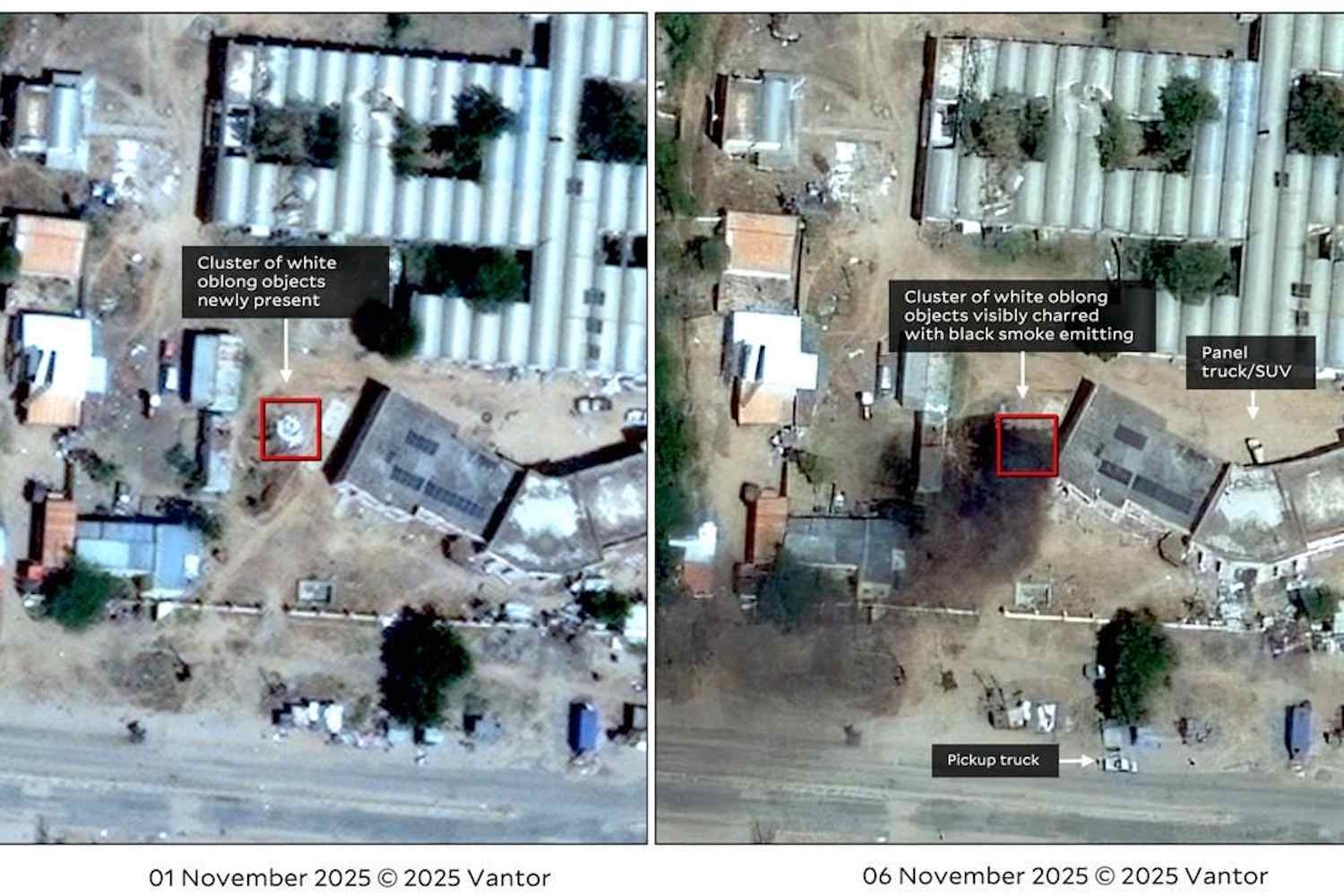
The Humanitarian Research Laboratory at the Yale School of Public Health analyzed images of el-Fasher taken by Vantor, a Colorado-based imaging company. These images appear to show mass graves dug and subsequently covered at two sites in the city, one at a mosque just north of the Saudi hospital where around 460 people were reportedly killed and another in a former children’s hospital that the RSF had used as a prison, the researchers said.
And not only that, other images show how the Rapid Support Force has closed one of the only five remaining outlets in the city of El Fasher and how there may be ongoing possible body disposal activities in and around El Fasher:
ATROCITY ALERT

RSF has closed 1 of only 5 exits out of El-Fasher. @HRL_YaleSPH identifies ongoing possible body disposal activities in and around El Fasher#KeepEyesOnSudan
@Vantortechhttps://t.co/1HApllgfVx pic.twitter.com/fXKAl54qCl
— Humanitarian Research Lab (HRL) at YSPH (@HRL_YaleSPH) November 7, 2025
The closure of an escape route, in a besieged city like El Fasher, represents a tragic and deliberate action: it is not just a logistical blockade, but a further instrument of pressure and control against the civilian population. When an armed force not only occupies, but prevents exit, access to aid and manages – or attempts to hide – its actions by disposing of corpses, the level of the humanitarian crisis surpasses any emergency measure.
Here too, as in Gaza, it is urgent for the international community not only to keep its eyes open, but to intervene concretely: monitoring, disarmament, safe humanitarian access and protection of civilians should be absolute priorities. How many times have we heard this in recent months? We are exhausted by these horrors.
Read also:
