
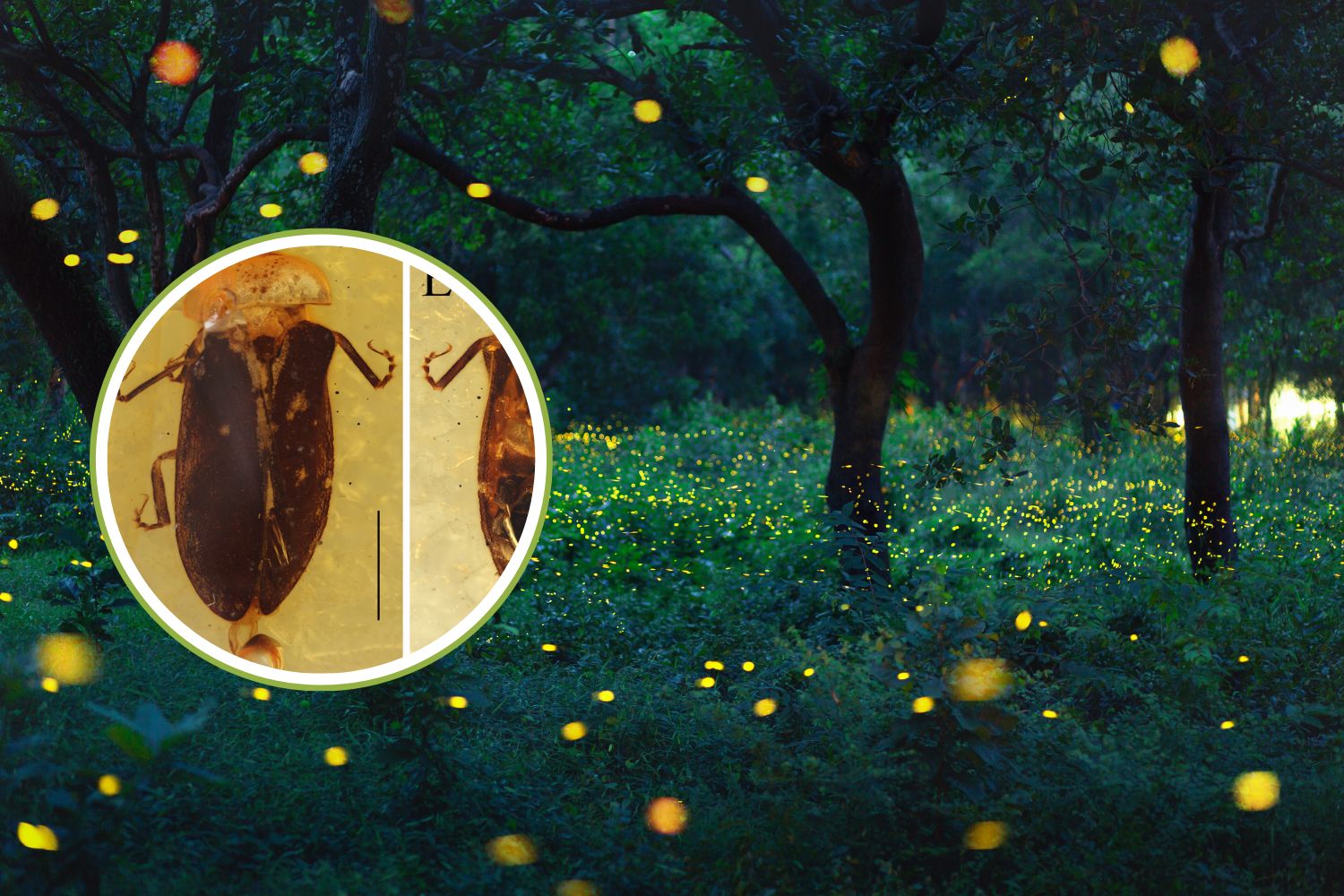
A tiny, almost domestic detail has been trapped in the hardened resin of an ancient forest: an insect capable of shedding light. A fossil firefly preserved in Burmese amber, coming from the area now known as Myanmar, has allowed researchers to push the history of the glow we associate with summer evenings far back. We are talking about the Middle Cretaceous, approximately 98-99 million years agowhen there were still dinosaurs on Earth and in tropical forests insects had already begun to use the dark as a kind of language.
The new fossil has been named Burmese cretoluciola and was described in a study published in Proceedings of the Royal Society B: Biological Sciences. The most interesting fact lies in its anatomy: the specimen has large eyes, thread-like antennas, six abdominal ventrites and, in males, a bipartite light organthat is, divided into two parts, right in the abdomen area. A small detail only in appearance, because an enormous part of the evolutionary history of fireflies is concentrated in that piece of body.
A very ancient light
Fireflies belong to the dei family Lampyridaesoft-bodied beetles that include over 2,000 described species worldwide. They are the richest terrestrial group among organisms capable of producing bioluminescence, that cold light generated by an internal chemical reaction, without the need for light bulbs, sockets, batteries and other small dramas of modernity. In known larvae, light has above all a warning function: it signals to predators that that morsel could be a bad idea. In adults, in many evolutionary lines, the glow has also become a sexual signal, a call in the dark.
The courtship of fireflies works like a luminous grammar. Males produce sequences of flashes, often repeated and recognizable, while females respond with shorter signals, in some cases with a single pulse. Each species has its own rhythm, its own distance, its own way of being found. Seen from the outside it looks like poetry. Seen closely it is evolution, selection, survival, choice of partner. An on and off conversation in the tall grass.
This is where the fossil fits in. The history of bioluminescence in fireflies has long remained difficult to reconstruct, because useful fossils are few and often incomplete. An insect preserved so well in amber changes the weight of the hypotheses. It offers material proof, with a body, an abdomen, a luminous organ still legible after almost one hundred million years.
Inside the amber
To understand where to place Burmese cretoluciolathe authors compared the fossil to living fireflies using a very broad analysis: beyond 400 morphological characteristics and genetic data from current specimens. The result placed him in the Luciolinaeone of the most important subfamilies of the Lampyridae, known for the use of the abdomen in the production of light signals.
This passage is important because the specimen represents the first Cretaceous fossil solidly attributed to the Luciolinae. In practice, it indicates that the branch of modern fireflies was already present at least 99 million years ago. Their luminous apparatus, therefore, was already well developed when dinosaurs still occupied terrestrial ecosystems.
The scene, if you imagine it, has something alienating. In the forests of the Cretaceous, among plants, resin, humidity and animals that have now disappeared, these small beetles probably already flashed with a system on-off very similar to that of current fireflies. That light could have been used for courtship, to recognize each other, perhaps even to discourage predators. A tiny biological technology, stable for tens of millions of years, which came down to us without asking permission.
The forest was brighter
The discovery also opens up another interesting crack. The classification of two other fossil genera, Flammarionella And Protoluciolaalready connected in the past to the Luciolinae, is called into question. It means that the picture of Cretaceous fireflies could be more varied than expected, with forests inhabited by a richer luminous fauna than previously imagined.
The authors suggest that the first fireflies were probably nocturnal and already capable of combining different strategies: being seen by the right partner, keeping away those who wanted to eat them, orienting themselves in an environment where darkness was a real condition, without street lamps, car headlights, signs and balconies lit. Their light, so fragile in our eyes today, already had a precise job to do.
