
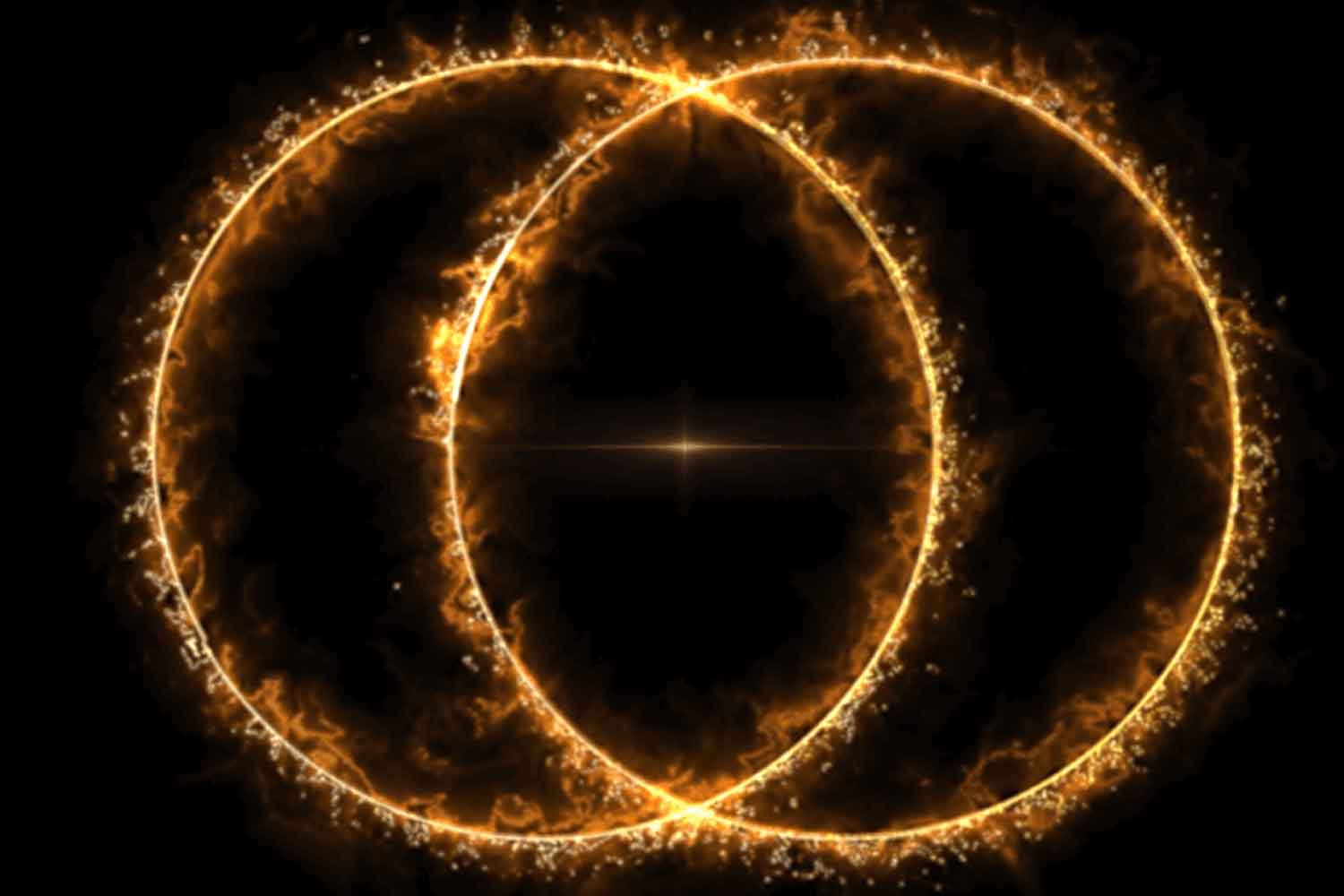
In the silence of deep space, about seven billion light years from Eartha group of astronomers has identified something never seen before: a gigantic double ring structurea sort of “cosmic smoke circle” that seems to come straight out of a science fiction film, but is absolutely real. His name is RAD J131346.9+500320 and, for the scientific community, is the most powerful “Odd Radio Circle” (ORC) ever discovered until today.
Unlike the already known ORCs – circular and dim structures that are seen only in radio frequencies – this new object, but presents two intersecting ringslike a Venn diagram cosmic. And its origin is still to be understood.
A colossus invisible to the naked eye, but visible in radio frequencies
The project participants identified it RAD@home Astronomy Collaboratoryan initiative born in India that involves students and citizens passionate about astronomytrained to collaborate with professional scientists. Analyzing the data of LOFAR radio telescopethe most powerful in the world in the low frequency range, noticed something that the automatic algorithms had completely missed.
The system is so large that it dwarfs the Milky Way: each ring measures approximately 300,000 light-years in diameterwhile the entire structure almost reaches a million light years. And it shines in the radio range with an intensity never before recorded for a similar object.
At first glance, it just looked like a bumpy patch. But once the image was enhanced, two appeared well defined curveswhich intersect in the center of one compact galaxy. Scientists think it is very ancient plasmastill visible today thanks to its radio emission. It could be the residue of a violent event that occurred billions of years agoperhaps an explosion generated by a merger between two black holes or from a galactic superwind.
This is not an isolated case
But this is not the team’s only discovery. After RAD J131346.9+500320, the volunteers found two more huge radio circles. One is called RAD J122622.6+640622has a diameter of three million light years and shows a jet curving sharply before forming a 100,000 light-year ring. The other, RAD J142004.0+621715is smaller and sits at the end of a thin jet, described by researchers as “a black hole blowing a smoke ring”.
All three galaxies are located within the very dense galaxy clustersfilled with hot plasma. And that very environment may have played a role in shaping these mysterious circles.
According to the team, these new observations expand the ORC familywhich now appear to be part of a class of cosmic structures so far little knowngenerated by jets, galactic mergers and energetic winds.
When the human eye captures what artificial intelligences don’t see
A detail that makes this story even more interesting is that the double ring was not recognized by the automatic software. The algorithm had classified it as a simple “elongated” object, without any particularity. Only the keen eye of a RAD@home project participant, trained to look for unusual structures in radio and optical data, noticed the anomaly.
In an age where artificial intelligence seems set to take control of almost every aspect of scientific research, this case demonstrates that the ability to observe and recognize complex patterns still remains a strength of human beings. As the researcher explained Pratik Dabhadeco-author of the study: “The fact that citizen scientists found it shows how important human contributions still are, even in the age of algorithms.”
The RAD@home project, active since 2013, trains thousands of young Indians through free online coursesteaching them to read images from radio telescopes and to recognize rare galaxies and structures invisible to software.
What are these circles really?
Despite the discoveries, the true nature of ORCs still remains unknown. At the moment they have been confirmed a dozenbut it is thought that there are some many more hidden in the data of large observatories.
In the coming years, new tools like the Square Kilometer Array (SKA) and theVera Rubin observatory they could help us map these strange structures more precisely. According to experts, they could be plasma bubbles formed by ancient active black holes, collisions between galaxies, or energetic winds expanding into intergalactic space.
In any case, what is certain is that the universe still has many secrets to revealand that the union between technology and human participation can make the difference. Also because, sometimes, it’s just useful a curious look to find something that no machine can see.
