
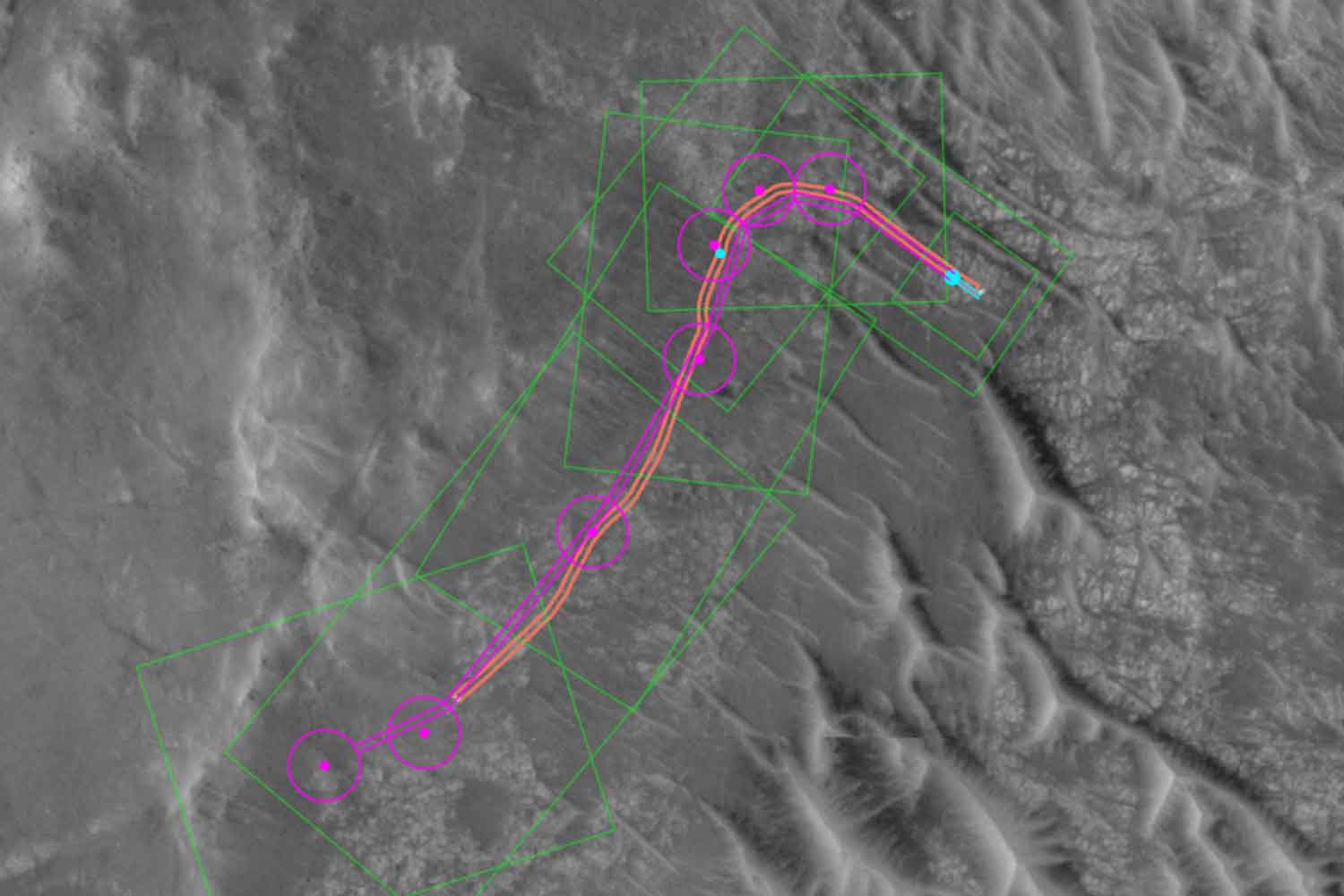
There is a moment in the history of space exploration when you realize that something has really changed. Not in theory, not in the laboratories, but in the field. On the contrary: on the surface of Mars. It happened when Perseverance roverthe rover of NASAcompleted planned trips for the first time entirely by an artificial intelligence systemwithout a human hand tracing the path to follow.
A successful test that marks a concrete turning point: robots no longer limit themselves to carrying out orders from Earth, but begin to decide for yourself how to move on another planet.
The experiment, conducted on December 8 and 10, 2025, was coordinated by Jet Propulsion Laboratory (JPL), the NASA center that manages the daily operations of the Martian rovers. For the first time, engineers entrusted a very delicate task to a generative AI: analyze the terrain of Mars and plan a safe routea job that has been done by human experts for almost thirty years.
The system studied images and topographic data normally used by mission planners, identifying obstacles such as rocks, outcrops, boulder fields and sand ripples. Then it did what makes AI really cool: it connected all this information and built a seamless, viable, safe path to Perseverance.
How AI “saw” Mars and decided where to let Perseverance pass
For this demonstration a particular form of was used generative artificial intelligencebased on vision-language models, capable of interpreting complex images and data together. The AI analyzed the same material that comes to NASA engineers every day: high-resolution photographs, terrain maps and slope models.
In particular, the system worked on the orbital images taken by the camera HiRISEaboard the Mars Reconnaissance Orbiter, cross-referencing them with digital elevation models. In this way he was able to “read” the Martian landscape, recognize the riskiest areas and select waypointsi.e. the intermediate points that guide the rover along the route.
Everything was developed in collaboration with Anthropic, through the use of Claude artificial intelligence models.
Because driving a rover on Mars has always been a tightrope walker’s job
Mars is on average approximately 225 million kilometers from Earth. A distance that makes any real-time control impossible: the signals take several minutes to arrive, and when something goes wrong there is no way to intervene immediately.
For this reason, until now, the driving of the rovers has been entrusted to teams of specialists who plan each movement with extreme precision. The routes are broken up into short sections, with reference points a maximum of 100 meters apart, to minimize risks. With this test, however, planning has moved directly to artificial intelligence.
The results: hundreds of meters traveled following only the AI’s decisions
Before sending any commands to Mars, the AI-created routes were tested in a virtual replica of Perseverance, the so-called digital twin of the rover. Here the engineers checked further 500,000 telemetry variablesto ensure that the instructions were fully compatible with the on-board software.
On December 8th Perseverance ran 210 meterswhile on December 10 he completed a second journey of 246 metersexclusively following the plans developed by artificial intelligence. No unexpected events, no human corrections: the rover performed everything autonomously.
What this step means for the future of space exploration
According to Vandi Verma, space roboticist at JPL and part of the Perseverance team, generative AI is demonstrating enormous potential in improving three key aspects of planetary exploration: perception of the environment, localization and movement planning.
The goal is ambitious but clear: to allow the rovers to cope displacements on a kilometer scalereducing the workload for operators on Earth and increasing the time dedicated to science. Looking ahead, similar systems could automatically flag areas of particular geological or environmental interest, analyzing thousands of images very quickly.
For Matt Wallace, head of JPL’s Exploration Systems Office, this technology is one of the fundamental pieces for building the infrastructure that will serve a stable human presence on the Moon and, one day, to Mars.
Because this news concerns us too
Because the artificial intelligence that drives Perseverance on Mars today is the same family of technologies that, tomorrow, could help us explore extreme environments on Earth, monitor fragile ecosystems or intervene in contexts where humans cannot safely reach. Mars, once again, becomes a laboratory for understanding how to live better with the technologies of the future.
