
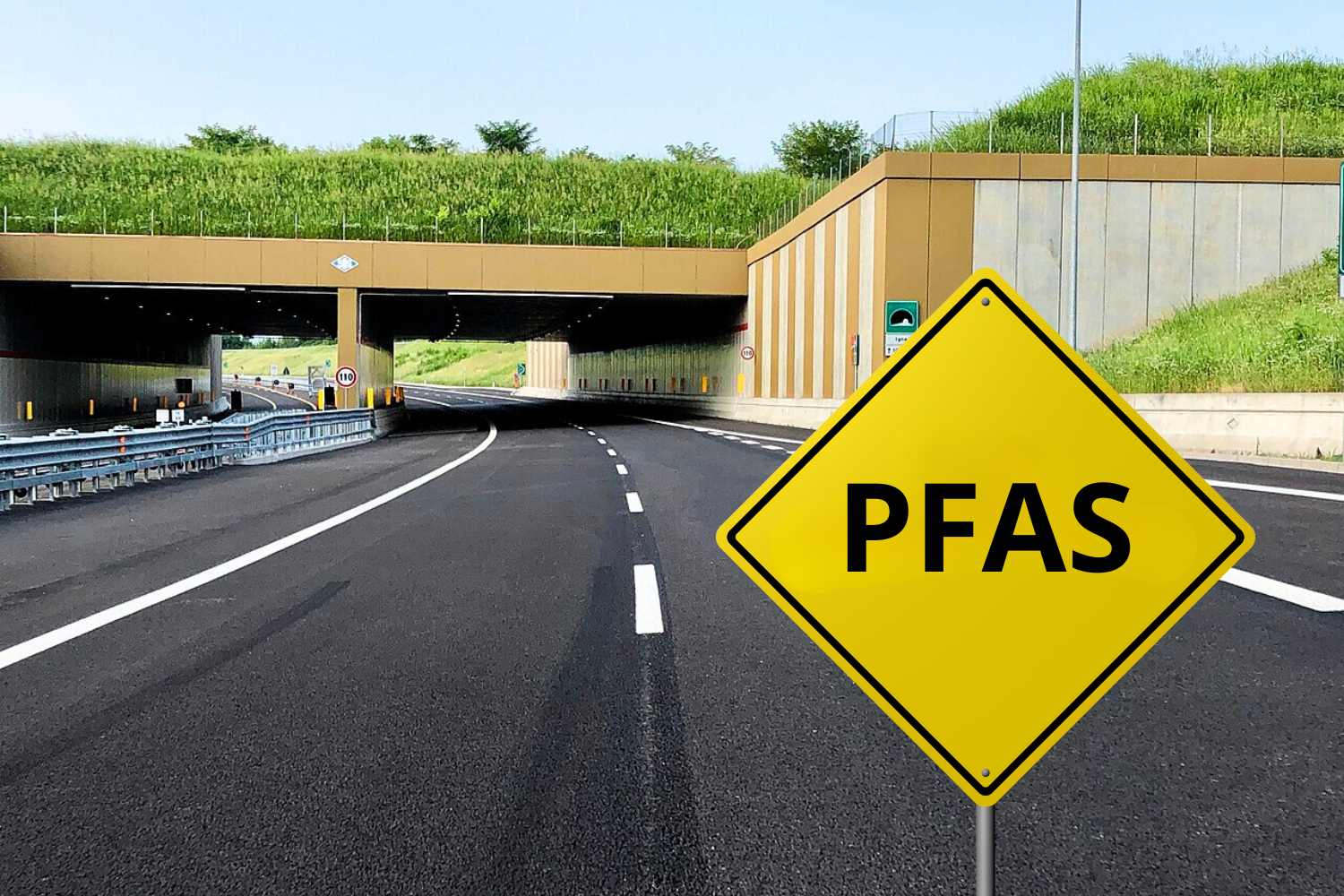
Two of the most controversial events in the Veneto – the construction of the Pedemontana Veneta and PFAS pollution – meet today in a single investigation.
The Vicenza Prosecutor’s Office has closed the preliminary investigations against 12 people, accused in various capacities of environmental pollution and failure to clean up.
According to the accusation, during the construction of two tunnels of the toll highway that connects the provinces of Vicenza and Treviso, an accelerator for concrete containing perfluorobutanoic acid (PFBA) was used, a substance belonging to the same family as PFAS, known as “eternal pollutants” due to their ability to persist in the environment and accumulate in organisms.
The wastewater from the construction site would then have flowed into the Poscola stream, contaminating part of the surface and underground waters between Castelgomberto, Malo, Montecchio Maggiore, Isola Vicentina and Costabissara.
What is the Pedemontana Veneta
The Pedemontana Veneta highway is an infrastructure approximately 96 kilometers long, created to connect Montecchio Maggiore (Vicenza) to Spresiano (Treviso), alleviating traffic in the foothills and on the A4 motorway.
However, it is also the heart of a gigantic political-financial scandal: the project, which originally cost 2.5 billion euros, arrived with the project financing system at an estimated total cost of 12 billion. A mechanism that places the economic burden on the tolls paid by motorists, but which, in the event of insufficient revenue, provides for the intervention of the Veneto Region, already committed from 2024 to the payment of fees to the SIS concessionaire, a Piedmontese consortium attributable to the Dogliani family.
Cement and PFAS: what emerges from the investigations
The investigation examined the period between June 2021 and January 2024. The analyzes of the Carabinieri of the Judicial Police Unit of Vicenza revealed that the additive “Mapequick AF 1000”, containing PFBA, in concentrations higher than the limits set by the opinion of the Istituto Superiore di Sanità (n. 24565/2015).
Although it is not a banned substance, use in excessive quantities can pose high risks to the environment and health. Investigators believe this resulted in “significant contamination of surface and groundwater” in the surrounding areas.
The suspects – including managers of the SIS Consortium, representatives of Società Pedemontana Veneta SpA, and technical managers of the construction sites – are also accused of having failed to clean up and restore the sites, despite full awareness of the ongoing pollution.
The galleries under accusation and the role of public controls
The spotlight of the judiciary is focused on two tunnels: that of Malo, between Castelgomberto and Malo, and that of Sant’Urbano, in the territory of Montecchio Maggiore. Already the subject of investigations in the past for the use of materials that did not comply with European certifications, the works had been seized, slowing down work for months. It is precisely from those checks that the use of the additive containing PFAS emerged.
The investigations make use of the support of the ARPAV of Vicenza, which provided analyzes and scientific feedback on the levels of contamination. Investigators are now working to clarify who authorized the use of the substances, which public controls were omitted and which management responsibilities fall on the top management of the companies involved.
A new environmental wound for Veneto
The episode has no direct links with the disaster caused by the Miteni di Trissino, which contaminated the aquifers of Vicenza, Padua and Verona, but the substances involved belong to the same dangerous chemical family. Once again, therefore, Veneto finds itself having to deal with the weight of industrial and infrastructural choices that leave a legacy of a wounded environment and undermined public trust.
The investigations are not concluded. But one certainty remains: between procurement, finance and chemistry, the Pedemontana Veneta risks becoming the symbol of how the price of “progress” can once again fall on the health of the territory and citizens.
