
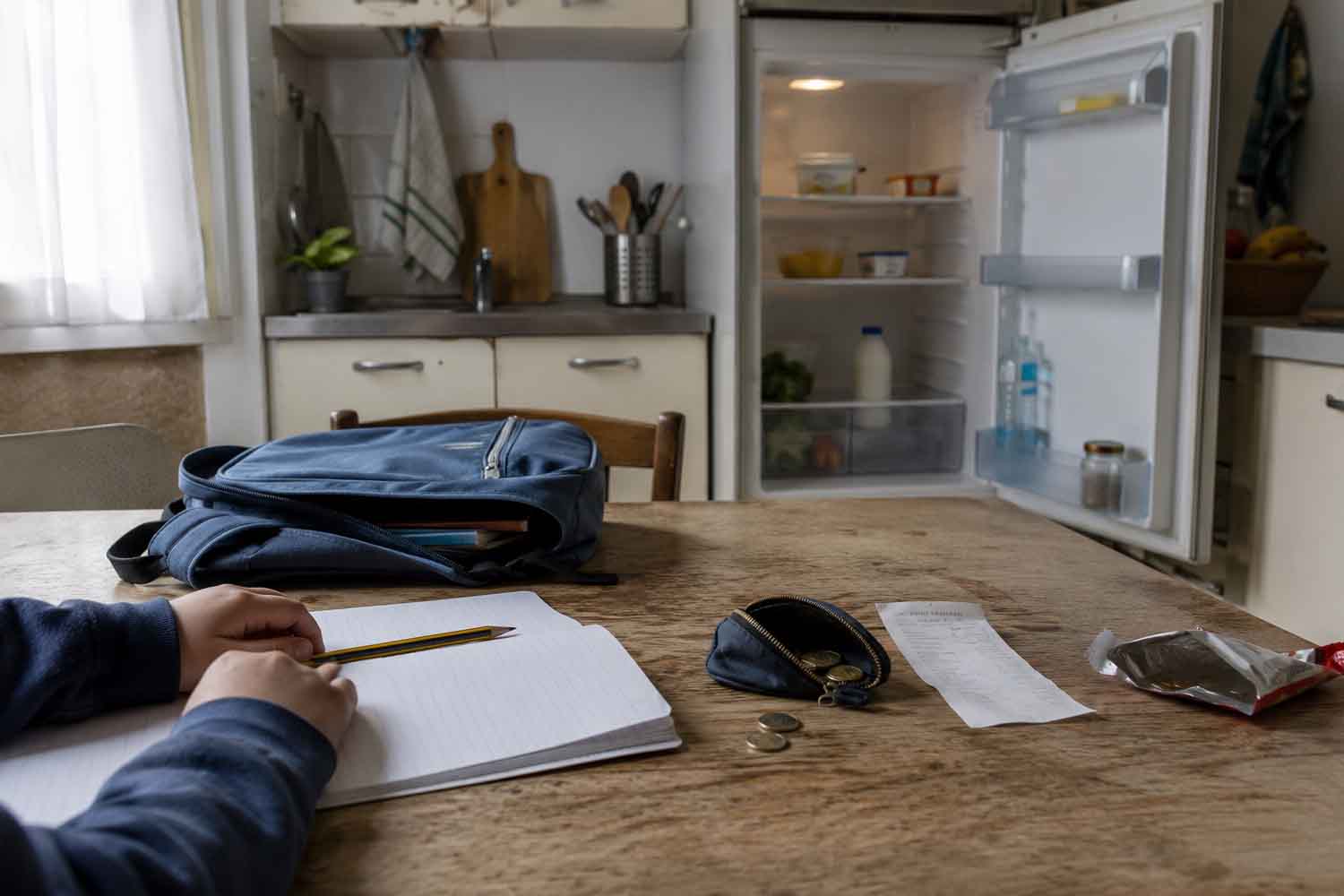
Almost 1.3 million children and young people live in absolute poverty in Italy. They are 13.8% of minors, more than double the 6.4% recorded among people aged at least 65. In 2024, poverty has shown a certain age precision: it hits harder those who are younger and have very few tools to get out of it.
The data comes from SDGs Report 2026 of Istat, which measures Italy’s path towards the objectives of the 2030 Agenda. Overall, absolute poverty concerns over 5.7 million people, 9.8% of residents. A share that remained substantially stable compared to 2023, with a significant worsening in the Islands. Stable, in this case, means that millions of people remained squarely inside the problem.
Minors pay the highest bill
The incidence decreases as age increases. From 13.8% among children and adolescents it goes to 11.7% between 18 and 34 years old, to 9.5% in the 35 to 64 year old range and to 6.4% among the elderly. The generation that should inherit the country is also the one most likely to risk growing up in a family unable to support essential expenses.
Furthermore, child poverty does not come alone. It may mean missing out on a proper meal, warming up, a visit, a sporting activity, a school trip, or a quiet space in which to study. Every voice weighs on the family; it leaves something extra on the child. Istat measures spending capacity, while the effects enter the classroom, relationships and future possibilities.
The gap widens further when looking at citizenship. In 2024, absolute poverty affected 35.6% of foreign citizens, compared to 7.4% of Italians. Almost one foreign person in three therefore lives in this condition. When citizenship, fragile work, rent and the presence of children overlap, the margin to absorb a bill or an unexpected expense becomes very thin.
Employment is growing, so is deprivation
The report then moves on to 2025 and a different indicator, that of the risk of poverty or social exclusion. The share fell from 23.1% to 22.6% of the population: approximately 13.3 million people. The improvement derives above all from the growth in employment, which reduced the percentage of people in families with low work intensity from 9.2% to 8.2%.
They are different measures and must be kept separate: 13.8% concerns the absolute poverty of minors in 2024; 22.6% measure a broader set of economic and social fragilities in the population in 2025. Comparing them, however, shows the contradiction well. More people work and the general indicator improves, while serious material and social deprivation rises from 4.6% to 5.2%. The risk of income poverty remains unchanged at 18.6%.
Having someone busy at home, therefore, helps. Sometimes it’s not enough. In 2025, around 2.5 million adult workers, equal to 10.2% of employed people, were still at risk of poverty. The percentage exceeds the European average by almost two points and reaches 20.7% in the Islands, almost four times the 5.3% in the North-East. Poor work pays a salary and still leaves the table at home uncovered.
In the South the risk is almost triple
The place where you are born continues to weigh heavily. In 2025, the risk of poverty or social exclusion concerned 38.4% of residents in the South, compared to 13.1% in the North. In Campania, Calabria and Sicily the share exceeds 40%. The southern figure has improved compared to 39.2% in 2024, especially thanks to Molise and Calabria, but maintains an enormous distance from the rest of the country.
For a child, these percentages take the form of the family he or she lives in, the neighborhood, the school available, the services available and the income coming in each month. Job growth can alleviate some of the risk, especially when it brings stable work and adequate wages. When employment is intermittent, poor or eaten up by essential expenses, protection becomes thinner.
The 2030 Agenda calls for an end to poverty in all its forms. There are four years left until the deadline and almost 1.3 million Italian minors still live in absolute poverty. The work has moved a marker in the right direction. For now, the children are left waiting.
